
Cultural

The Story, Symbol, and Significance of Navarātri

September 23, 2025April 20th, 2026No Comments

Introduction

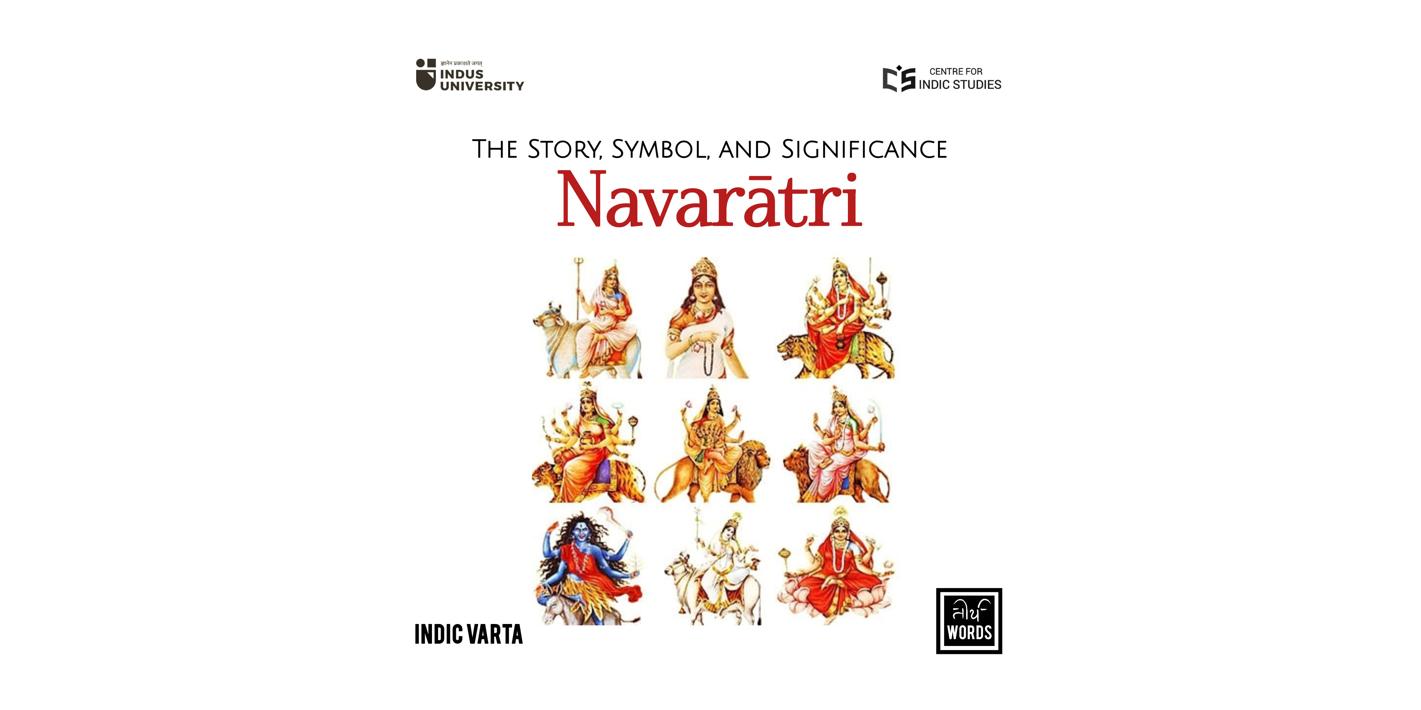
The article reclaims Navarātri as a celebration not just of divine forms, but of the evolving power of womanhood itself. Each goddess— from Śailaputrī to Siddhidātrī— is more than a mythic archetype. They are vibrant symbols of resilience, wisdom, and transformation. While Śailaputrī anchors strength in rootedness, Brahmacāriṇī walks the path of quiet tapas; whereas Candraghaṇṭā roars against injustice, Kūṣmāṇḍā births worlds with effortless grace; if Skandamātā nurtures courage, Kāṭyāyanī defends dharma with fire and Kālarātri shatters fear with her fierce truth; and when Māhāgaurī purifies us with serenity, Siddhidātrī bestows us fulfilment. In this evocative exploration of Navarātri, Tirtha unveils the profound symbolism behind the nine forms of Devī— each a radiant facet of cosmic consciousness. Blending mythic narrative with philosophical insight, the piece invites readers to see Navarātri not merely as ritual, but as a map of transformation where each goddess is a milestone on the self’s ascent.
Navaratri_Significance_Resized

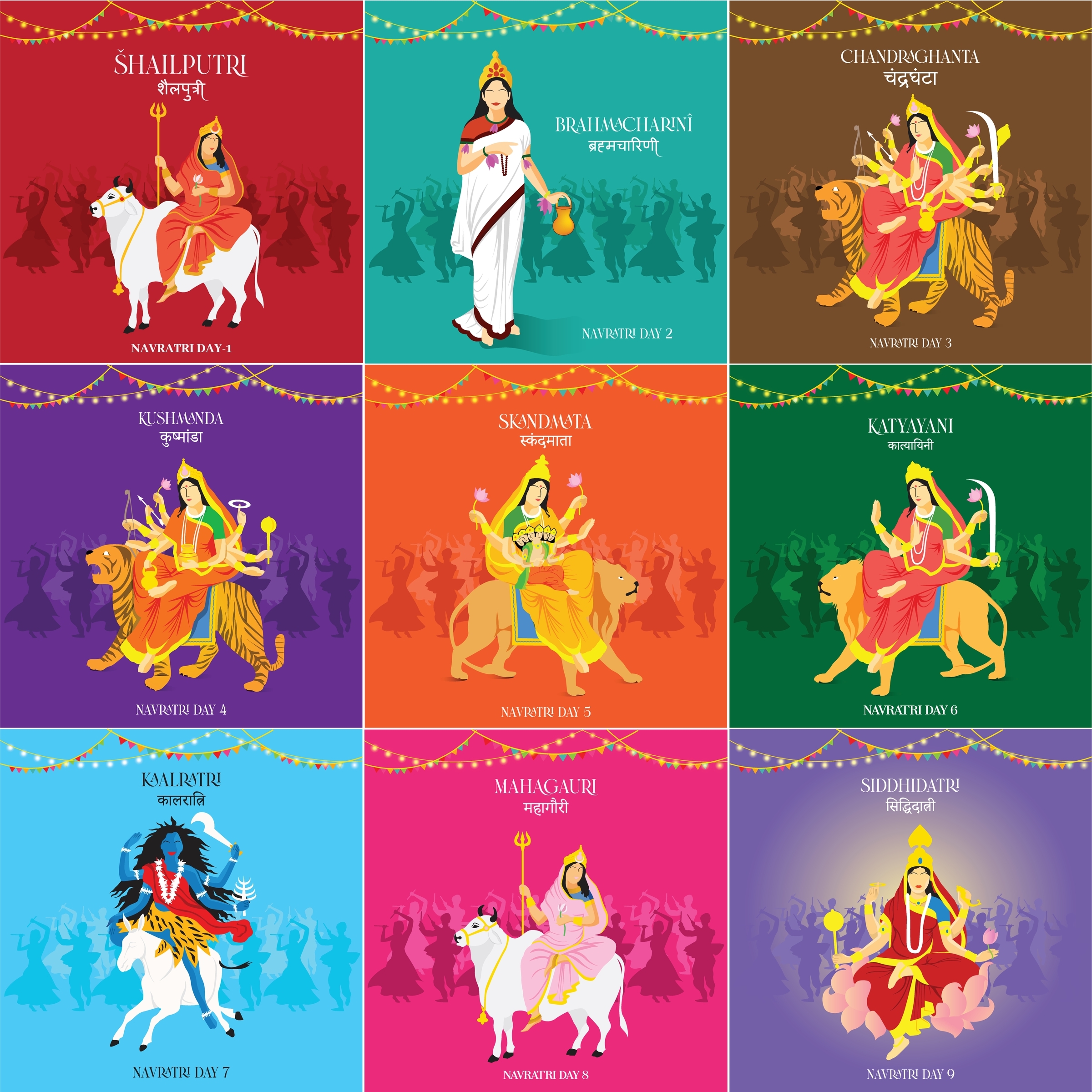
The Story, Symbol, and Significance of Śailaputrī

So, it was a busy day and the arrangement for the yajña at king Dakṣa’s palace was in full swing. The altar was furnished and everyone was decked with robes and jewels. From the nymphs and apsarās of the heaven to the celestial deities of the five elements— all were invited with congenial etiquettes. All except Śiva, the son-in-law of the king. Why? Because, unlike the other gods and deities, he was a grotesquely ash-smeared nomad, living in the crematorium with the beastly animals and horrendously defiled paranormal beings! How could he be invited to the pristine dwellings? Moreover, Dakṣa’s favour for him skewed further when his daughter, Śatī, eloped with him, chucking off the tradition of svayaṃvara.

Now, everyone was exhilarated to be a part of the grand fête and all tuned up simmering. When Śatī heard of the event, she was eager with excitement to attend it. She implored her husband who, in turn, expressed his reluctance to grace the occasion uninvited. Appalled at the rejection of the plea, Śatī fumed with a fit of pique as all ten incandescent modes of her feminine energy manifested, threatening the balance of the cosmos. Seeing his wife nagging and conniving, Śiva permitted her to visit her paternal home.

However, Śatī was greatly underwhelmed to find the cold welcome she received from her own siblings and relatives. Further to her dismay, her repeated petitions to send a formal invitation to his husband were turned down. Her anguish heightened when her father, enraged at her request, slandered her husband with cuss words. A devoted and chaste wife that she was, her father’s rants pierced her soul more than her eardrums. Repining at her ill-conceived wish to attend the ceremony despite her husband’s injunctions, Śatī decided to immolate herself at the fiery pit of the yajña, turning it into a pyre!

Sensing the void of the divine feminine, Śiva’s dhyāna was perturbed immediately and his third eye opened in fury! The calmest and the politest of all beings was ignited with vengeful wrath! He hurried to the place of occurrence and dismantled the entire place, going ballistic to everything! Tears flowed down his cheeks and fell on the ground, turning into rudrākṣa. He lifted the corpse of Śatī on his shoulder and began the tāṇḍavanṛtya, the dance of destruction! The whole cosmos began to tremble and everyone sought Viṣṇu to intervene and save the creation from the maddening ruckus. Viṣṇu, maintaining his role to preserve the creation, hurled his divine discus, Sudarśana, and tore off the body of Śatī into fifty-one pieces which fell on different locations of Bhārata, turning into śaktipīṭhas (places of the divine feminine). Viṣṇu pacified Śiva and solaced him, saying that the eternal spirit of the divine feminine cannot be exterminated and she would once again reincarnate as the daughter of Himālaya, the greatest of the mountains. Aeons later, when she manifested as the daughter of Himālaya, she was named Śailaputrī (daughter of the mountains).

Now, this was the story. Chances are that, unless you have been uprooted from your traditional culture by the Macaulayist education, you have heard it from your parents or grandparents. However, let us delve deeper into this episode of the itihāsa and unravel the symbolical purviews behind it. The first and the foremost lesson that can be extracted out of the story is that the fabric of the cosmos is woven by threading the cosmic masculine with the cosmic feminine and the absence of either will unsettle the very essence of creation. This fundamental understanding of the nature of the two vital forces—as complementary and not adversary, as two halves of one supreme reality and not two distinct realities, as “and” and not “versus”— has been at the crux of the Sanātana Dharma and it may help us to channelize the harmonized reciprocity between both the sexes. In a world full of fights between irrational feminism and misconstrued patriarchy, the story bolsters the sustainability of compassion and devotion over contempt and resentment.

The second underlying message that strikes our observation is that our prejudice often befalls us. Śiva stands for maṅgala (auspice) and no deed of spiritual disposition can be accomplished against his will or without his blessings. Dakṣa’s zealotry based on the mere appearance of Śiva and his constant refusal to swallow his pride despite knowing fully well the true identity of the lord only led to catastrophe. Had he been prudent and discreet enough to peep into the inner self of Śiva, he would not have belittled him. After all, he had the greatest ever son-in-law one can think of and yet he failed to embrace him owing to his petty conceit. Like Dakṣa, we too often fail to discern the piety of the great and the wise if their mere appearance deems unfit to the standard norms. Overcoming our own meanness and cultivating acceptance towards the unique, even if disagreeable at a glance, may help us find the pearl from the oyster shells.

Finally, one must not consume these divine accounts from the itihāsa texts with mortal levity. The acts of the divine beings by no means concern humane replication, rather, on the contrary, usher in the notion that these acts serve the grounds for the līlā tattva to function. The līlā tattva suggests that everything that happens at the divine realm has a purpose to cater to the divine frolics of the supreme being. For the ease of understanding, one may imagine the entire cosmos to be a theatre where everyone plays different characters or roles. When we watch a film in the theatre and our minds are encaptivated by the play of the actors, we associate our passions with the characters by cheering for the hero and the heroine while loathing the villain, forgetting the nature of reality for a certain time. However, once the play is over, we understand that the actors are playing the roles of the characters and are not the characters themselves. Thus, Dakṣa’s prejudice may be framed as a lesson to be imparted upon us rather than it being a cause of our personal censure towards him. Similarly, the demise of Śatī and the subsequent wrath of Śiva are events as real as the air and the fire and yet as emblematic as the play of the actors in a theatre.

Commemorating the metempsychosis of the ādiśakti, the primordial energy, from the previous rūpa named Śatī to the new rūpa named Pārvatī (literally meaning, “from the mountains”) or Śailaputrī (literally meaning, “daughter of mountains”), the followers of the Sanātana Dharma dedicate the first day of the Navarātri (nine nights) festival to worshipping the goddess. The day also marks the beginning of the mātṛpakṣa (the matriarchal fortnight). Some people observe fasting and perform holy rituals on the day. However, it is to be noted that fasting and other modes of ascetic sādhanā are not mandatory and anyone can pray to the divine feminine as per one’s convenient habitat.

If you are reading this far, you must have attained the grace of the devī and, if so willing, you too may join the millions of devoted people in celebrating the resuscitation of the cosmic feminine by calling her up with oblation of a flower and chanting of the mantras:

ॐ वन्दे वाञ्छितलाभाय चन्द्रार्धकृतशेखराम्।

वृषारुढां शूलधरां शैलपुत्रीं यशस्विनीम्॥

या देवी सर्वभूतेषु माँ शैलपुत्री रूपेण संस्थिता।

नमस्तस्यै नमस्तस्यै नमस्तस्यै नमो नम:॥

।। ॐ शैलपुत्री देव्यै नम: ।।

The Story, Symbol, and Significance of Brahmacāriṇī

When Śailaputrī was born, she was greeted by everyone in the mountains and everyone cheered with jollity to receive the new-born baby girl. Since then, having a daughter is considered having devī herself in the house. This notion has long been cherished by the folks cultured in the tradition of the Sanātana Dharma. Fondled and pampered, she grew up to be a teeny lass.

However, as she grew, she started having divine premonitions. She had always felt an uncanny propensity towards lord Śiva. None could explain the strange and mysterious bond that brooded between her and the lord. By the time she reached puberty, she decided that if she is to be married, it has to be none other than Śiva. She forbade her parents, the mountains and the rivers, to hunt a groom for her, and began seeking a manoeuvre to attain her desire. Observing the plight of the devī, Viṣṇu sent the heavenly troubadour, Nārada, to guide her on her mission, fulfilling his promise to unite Śiva and his Śakti.

Nārada told her that one must do rigorous penance to attain Śiva’s grace. Upon his instructions, she was initiated to the ascetic sādhanā method of brahmacarya, attaining the name ‘Brahmacāriṇī’. For centuries, she did tapa and survived on mere fruits and roots. Afterwards, she lived upon eating mere tree-leaves. When she even relinquished that meagre diet, she was hailed by the holy spirits as the ‘Aparṇā’, the one who does not even consume tree-leaves. For centuries, she sustained herself only by water. Yet, she was not graced by Śiva. Eventually, she stopped all means of consumption and embarked into the direst of sādhanā possible. As her tapa surmounted even the greatest of the yogīs, the entire universe was shaken to the core. Observing her, everyone was flabbergasted, uttering their wonder in the onomatopoeic “Umā” which was to become her byname henceforward.

As it no longer became possible to keep her separated from her goal, Brahmā appeared to her and granted her the boon that he himself would get her betrothed to Śiva. He asked her to return to the Himālaya where lord Śiva would soon appear as the groom, asking for her hand in marriage.

It is said that “वेदस्तत्वं तपो ब्रम्ह”, meaning that the supreme brahma can be accessed by studying the Vedas, realizing the tattvas, and performing tapa. One, who observes all these, is called a brahmacārī or brahmacāriṇī. The emergence of the devī as a brahmacāriṇī symbolizes the endurance of the feminine energy. By her sheer asceticism and intense rigour, she not only became the beacon of the feminine prowess, but also emphasized the mettle of women in the sādhanā. Celebrating her feat in the superlatives not only heralds the message loud and clear that women share equal fervent in the Sanātana Dharma as men, but also cleanses the misconceptions surrounding women’s free will and basic rights in ancient Bhārata which were perpetuated by the beguiled, half-baked, and West-indoctrinated feminists.

See, for instance, the way everyone rejoiced at the incarnation of the devī as a daughter. It reflects the joy any family in Bhārata feels upon the birth of a girl, considering her as an aṃśa of the devī. Similarly, the acceptance of her free will to become a celibate ascetic and, later, choosing her husband by herself without any parental objection highlights the liberty of a woman’s life in the household customs of the Sanātana Dharma.

As Brahmacāriṇī stands as the epitome of sādhanā, any person willing to strive in any particular field may seek her grace. She bestows the brahmavidyā, the greatest of wisdom, to the seeker and enkindles all artistic and literary merits. Therefore, poets, authors, artists, scholars, students, and seekers shall be highly benefited by attaining her divine inspiration. As she has adroitly mastered the observation of brahmacharya, she also emboldens our self-control and urge-restraints— qualities that are must-have to succeed in any given field.

On the second day of Navarātri, one might contemplate upon her bright-faced, white-robed, flower-groomed apparition and propitiate her by offering any white flower upon her holy feet, chanting:

ॐ दधाना करपद्माभ्यामक्षमालाकमण्डलु।

देवी प्रसीदतु मयि ब्रह्मचारिण्यनुत्तमा।।

।। ॐ ब्रह्मचारिणी देव्यै नमः ।।

The Story, Symbol, and Significance of Candraghaṇṭā

Now, that the devī had attained the company of Śiva whom she yearned for, she refrained from her Brahmacāriṇī rūpa and embraced the gṛhastha life. Exulted, she returned to the Himālaya after her assiduous venture and the whole nature was cocooned with mirth and mellow. Garments and jewels poured in from every nook and corner to adorn her glistening limbs. All the gods, deities, and celestial beings graced the occasion as she was to be married to Śiva. They decked her with their weapons as gifts, matching her valour and dexterity. To receive all the gifts simultaneously, eight more hands emerged out of her divine body in addition to the existing duo, conferring upon her the name ‘Daśabhūjā’!

Brahmā himself became the purohita in the matrimonial yajña as he offered to the pañcamahābhūta, five cosmic elements, tying their divinely nuptial knot. No sooner was she married to the lord, one part of the crescent moon appeared upon her crown just as it shone bright around the deadlocks of her husband. Amused, Śiva had a lofty giggle as the devī’s feminine coyness had no bound and she hid her face with her anointed hands. All of them revelled and cheered as she was named Candraghaṇṭā by her husband.

The metamorphosis of the devī from celibate Brahmacāriṇī to married Candraghaṇṭā serves as an emblem of the transformation that every woman undergoes once she surrenders her maidenhood and enraptures in the joy of conjugal life. Candraghaṇṭā symbolizes the happiness of a woman’s life when she is married to a doting husband whom she desired all through her life. It is to be noted that the devī did not grudge to her husband for having to undergo the rigorous penance just in order to attain his company, nor did she throw tantrums at him after succeeding in her goal. Thus, through her own acts of life, she teaches women to be compassionate and understanding, not to be finicky and garrulous.

Similarly, on the other hand, she also symbolizes the undaunted resilience and the feminine gallantry as she rides a ferocious tiger and holds ten deadly weapons. As she had two hands before while the other eight emerged out of necessity, her figure represents the fact that women may certainly go beyond the limitations of possibilities if situations so demand and accomplish for her loved one even the most unimaginable of deeds.

However, is it not beautiful to see how she is engulfed by her feminine shyness as her husband courted her despite being such a tremendously valorous persona? Candraghaṇṭā, actually, depicts that a woman need not shun her femininity and grace in order to be vigorous. A woman must not act like a man to boast of her valour, but rather, on the contrary, the truly valorous women are utterly feminine by their natural predisposition. Femininity is not weakness, but rather strength itself. Is this not something that the modern feminists have forgotten altogether?

Moreover, see how the crescent moon replicated itself on her forehead, symbolizing the quality of an ardhāṅginī, the better half who shares all the avenues of her husband, be they in the comforts of heaven or on the hellfire and brimstone. Candraghaṇṭā’s figure marshals as an epithet to the term— a quality that has survived the test of time and may ameliorate the lifestyle of the contemporary women, if embosomed.

On the third day of the Navarātri festival, Candraghaṇṭā is worshipped. In the bhakti mārga of the śākta tradition in the Sanātana Dharma, she is sometimes celebrated in the form of the newly-wed daughter-in-law of the house. As moon is associated with the health and mind of women, Candraghaṇṭā’s blessings are of extreme importance to them. However, men require her blessings no less either. Therefore, men and women, who seek harmonious sustenance, may pray to her in unison:

ॐ पिण्डजप्रवरारूढा चण्डकोपास्त्रकैर्युता।

प्रसादं तनुते मह्यं चन्द्रघण्टेति विश्रुता।।

या देवी सर्वभूतेषु माँ चन्द्रघंटा रूपेण संस्थिता

नमस्तस्यै नसस्तस्यै नमस्तस्यै नमो नम:।।

।। ॐ चन्द्रघण्टा देव्यै नमः ।।

The Story, Symbol, and Significance of Kūṣmāṇḍā

So, the devī was married to Śiva— the cosmic feminine was reunited with the cosmic feminine! A pleasant daughter to a prosperous wife, she was now ready to tread upon the greatest phase of a woman’s life— motherhood! Indeed, motherhood is the bedrock of womanhood itself! What else can make a woman the most loving and venerable at the same time than her motherly instinct? So, the devī’s cosmic genitalia called the prakṛti was churned and seeded by Śiva’s masculine liṅga called the puruṣa— out of which emerged the cosmic egg from which creation itself emerged! Impregnated, the devī was to hold the embryo of the cosmos in her womb.

All the gods, deities, and ethereal beings genuflected before her and hooted in joy to celebrate the creation! They presented to the goddess a golden urn full of amṛta, the ambrosia of eternal joy, and conferred upon her the novel nomenclature of Kūṣmāṇḍā as she held the vessel. Goddess Kūṣmāṇḍā sat upon her mount tiger and shine bright with all her armaments with which she would always protect the cosmos. She smiled at everyone and blessed all as a mother does!

The tale of Kūṣmāṇḍā might be the most panoramic allegory that describes how the cosmos was conceived by the amalgamation of the primordial matter and the primordial consciousness. Thus, the figure of Kūṣmāṇḍā may also be studied from the perspective of cosmology and astrophysics apart from the theological musings attached to her. The urn of amṛta which she holds in her hands very symbolically hints at the idea of the eternal sustenance of creation which may only be converged by the cyclical nature of the cosmos. The figure of Kūṣmāṇḍā encapsulates the essence of creation, embodying the fusion of material existence with the metaphysical realm. At the heart of this allegory is the image of Kūṣmāṇḍā holding an urn filled with amṛta, the nectar of immortality. This potent symbol is a profound representation of the eternal sustenance that supports all forms of life and the ongoing cycles of creation and destruction within the universe. In many ways, this urn serves as a microcosm of the universe itself— holding within it the potential for life, regeneration, and continuity. Just as the cosmos experiences cycles of birth, decay, and rebirth, the amṛta signifies the sustaining force that nurtures existence across these transformations.

From a cosmological standpoint, the narrative of Kūṣmāṇḍā prompts us to consider the origins of the universe through the lens of both matter and consciousness. In modern astrophysics, we explore concepts such as the Big Bang, where the universe emerged from an infinitesimal point of singularity. This initial event can be likened to the primordial matter from which Kūṣmāṇḍā arises, suggesting that the essence of creation is deeply embedded in the fabric of reality itself. The tale challenges us to reflect on how consciousness—often seen as a secondary phenomenon—plays an equally vital role in the shaping of the universe. In this way, Kūṣmāṇḍā stands as a bridge between the material and the metaphysical, inviting a holistic view of existence.

Moreover, the cyclical nature of the cosmos, integral to the narrative of Kūṣmāṇḍā, resonates with various scientific models that describe the universe’s evolution. Theories such as cosmic inflation and oscillating models suggest that the universe undergoes phases of expansion and contraction, paralleling the cyclical themes found in the mythological tale. This cyclical perspective not only informs our understanding of the universe but also enriches our spiritual and philosophical reflections on life itself.

The story of Kūṣmāṇḍā, therefore, transcends mere allegory; it becomes a rich tapestry of interconnected themes that beckons deeper exploration. Her figure embodies a synthesis of creation and preservation, emphasizing that life is not a linear journey but rather a continuous cycle of experiences that feed into one another. This perspective aligns with many indigenous and ancient philosophies that view life as a web of relationships, where each element—be it a star, a planet, or a living being—plays an essential role in the grand design.

The figure of Kūṣmāṇḍā encapsulates a holistic view of existence that bridges spirituality, cosmology, and philosophy. By examining her story, we uncover insights that encourage us to contemplate upon the mysteries of life and the cosmos. The urn of amṛta not only symbolizes the sustenance of creation but also invites us to reflect on our own roles within this vast, interconnected universe. As we explore these themes, we are reminded that the essence of life is an eternal journey— one of growth, transformation, and the relentless pursuit of understanding in an ever-evolving cosmos.

Kūṣmāṇḍā is also a symbol of fertility and motherhood. She represents the vitality of procreation and the phase of pregnancy in a woman’s life. Kūṣmāṇḍā embodies not only cosmic creation but also serves as a profound symbol of fertility and motherhood. In many cultures, motherhood is revered as a source of life, and Kūṣmāṇḍā personifies this vital energy. Her nurturing essence reflects the sacred aspects of procreation, highlighting the transformative journey of pregnancy, which is a time of profound change and growth. Just as the cosmos undergoes cycles of birth and renewal, so too does a woman’s body adapt and flourish during this miraculous phase.

The figure of Kūṣmāṇḍā reminds us of the deep connection between the divine and the human experience of motherhood. She represents the creative forces that allow life to emerge, emphasizing the importance of nurturing and protection. In her presence, the act of giving birth is not just a biological function; it becomes a spiritual journey, one that celebrates the power and resilience of women.

Moreover, Kūṣmāṇḍā’s symbolism extends beyond physical fertility. She encapsulates the emotional and psychological dimensions of motherhood, embodying the unconditional love, strength, and sacrifice that define the maternal bond. Her figure serves as an inspiration, encouraging us to honour and celebrate the cycles of life, the nurturing spirit, and the transformative power inherent in both creation and motherhood. In this way, Kūṣmāṇḍā stands as a timeless representation of vitality, nurturing, and the enduring legacy of life itself.

Kūṣmāṇḍā is worshipped on the fourth day of the Navarātri. As a goddess who embodies creation, fertility, and the cyclical nature of life, she represents the fundamental forces that sustain the universe. Devotees believe that invoking her can lead to blessings of health, prosperity, and fertility, making her particularly revered among those seeking to conceive or nurture new beginnings in their lives.

Her worship is often associated with the celebration of motherhood and the nurturing aspects of femininity, emphasizing the importance of love, compassion, and protection. By honouring Kūṣmāṇḍā, followers engage in rituals that foster a deeper connection to the divine, encouraging personal growth and transformation. So, one may offer prayers to her by chanting the divine words:

ॐ वन्दे वाञ्छितकामार्थे चन्द्रार्धकृतशेखराम्।

सिंहारूढां अष्टभुजां कूष्माण्डा यशस्विनीम्॥

या देवि सर्वभूतेषू सृष्टि रूपेण संस्थिता

नमस्तस्यै नमस्तस्यै नमस्तस्यै नमो नम:।।

।। ॐ कूष्माण्डायै नम: ।।

The Story, Symbol, and Significance of Skandamātā

When Kūṣmāṇḍā gave birth to the cosmos, she became the cosmic mother. The entire clan of the devatās exhorted in delight. She had not only given birth to the cosmic spheres of their governance, but also to the subjects who are to be ruled. All was set and everyone was happy. Until the devī willed to be mother again. She solicited her husband and succeeded in convincing him. They embraced each other and dribbled into the cosmogonic coitus. However, the devatās were frightened at this since they would have an equal or more powerful competitor if another cosmos was to emerge and be given to other supernatural beings to rule. So, they went to Brahmā and pleaded him to intercept the aftermath. He went to the divine couple, beseeching them to abstain from the act. Śiva, being a symbol of magnanimity, yielded to their request.

However, the cosmic semen from Śiva took the form of Agni who later became the lord of fire and energy and the ovum from Pārvatī took the form of Svāha who later became the radiance of auspice. In the course of time, Agni and Svāha entered into the existing cosmos, enabling all possibilities of sustenance. When mankind was projected into the world, they were asked to perform yajña by chanting Svāha’s name while making oblations to the fire. As they both emerged from the purest masculine and the purest feminine, they are considered to be the means of purification. Since Agni and Svāha are eternal companions, they accepted each other as their spouses.

Meanwhile, the devatās were in trouble since they were incessantly tormented by the dānavas. They needed a leader of their army who would be valorous enough to vanquish the enemy. So, they requested the duo to produce an offspring. When Svāha was inseminated by Agni, her womb was highly smouldered. She requested Gaṅgā to carry the zygote as a surrogate mother. The latter promised to carry the pregnancy but denied to rear the child after birth. When the baby was born, he was offered to the six cursed wives of the Saptarṣi sages who were promised redemption once they would bring the child up, breastfeeding it. As they were six in number and the new-born was extremely hungry, the boy appeared with six heads to suck the milk from the breasts of the six foster mothers. Later, as the child grew up to adolescence, it was named Skanda and his valour was unmatched. Impressed by him, Indra, the king of the deities, offered him the position of the leader of the army. The deities together implored the devī to reveal to him the true origin of his birth and accept him as her son. The devī was in tears to finally have her long-cherished desire of having a son of her own. She took Skanda upon her lap and fondled him to her heart’s content. Happy to see the union of the mother to her separated son, the deities named her Skandamātā.

As a representation of maternal love, Skandamātā inspires devotion and reverence. She teaches the importance of selflessness, sacrifice, and unconditional love, values deeply rooted in the concept of motherhood. Her worship invokes the qualities of patience, compassion, and the strength to face challenges, reminding devotees of the transformative power of maternal affection.

In iconography, Skandamātā is depicted holding her son in her lap, often radiating a serene and loving presence. This image encapsulates the essence of unconditional love and support that a mother provides. Her four arms represent different aspects of nurturing: one hand holds a lotus, symbolizing purity and spiritual enlightenment; another holds a bell, signifying the call to dharma; the third hand bestows blessings, and the fourth hand offers refuge. This imagery highlights her role as a guide and protector, emphasizing that motherhood extends beyond mere biological connections to a broader spiritual significance.

Worshipping Skandamātā has two-fold benefits: blessings from Skanda and blessings from the devī, the former representing strength and protection from evil and the latter representing motherly care and affection. Firstly, devotees receive the blessings of Skanda, her divine son, who embodies strength, valour, and protection against malevolent forces. As a formidable warrior and leader of the celestial army, Skanda symbolizes the courage to confront adversities, instilling a sense of fearlessness in his followers. His presence assures devotees of their protection and empowers them to triumph over challenges.

Secondly, as the cosmic mother, Skandamātā epitomizes maternal care, offering solace and guidance to those who seek her blessings. Her affection provides profound emotional support, fostering a deep sense of security and warmth. By propitiating Skandamātā, devotees cultivate resilience while basking in the unconditional love of a mother. This sacred relationship enriches their lives, reinforcing the belief that they are never alone in their struggles, fostering both inner strength and emotional well-being. Therefore, let us pray to Skanda and his mother and seek their blessings simultaneously by chanting:

ॐ सिंहासनगता नित्यं पद्माश्रितकरद्वया।

शुभदास्तु सदा देवी स्कन्दमाता यशस्विनी॥

या देवी सर्वभू‍तेषु माँ स्कन्दमाता रूपेण संस्थिता।

नमस्तस्यै नमस्तस्यै नमस्तस्यै नमो नम:।।

॥ ॐ देवी स्कन्दमातायै नमः ॥

The Story, Symbol, and Significance of Kātyāyanī

Now, that Skandamātā was euphoric to have her son, it is to be noted that there was a time when she was born as a daughter too, other than her reincarnation as Śailaputrī. In ancient Bhārata, there lived a revered sage named Kātyāyana, known for his deep wisdom and spiritual insight. A dedicated brahmacārī, he embraced the path of perpetual celibacy, finding strength and clarity in solitude. Residing in the tranquil forests, he cultivated a profound connection with nature, living simply amidst the trees and rivers. Every day, he diligently performed elaborate rituals of yajña, offering sacred oblations with utmost purity. Through his disciplined lifestyle and unwavering devotion, Kātyāyana became a beacon of spiritual wisdom, attracting seekers from distant lands who sought his guidance and blessings.

He had attained mokṣa and desired nothing, yet he felt lonelier and lonelier as he grew old. One fine morning, he was contemplating upon the sacred form of the Ādiśakti when a thought flickered through his mind: How about having the devī herself as a daughter? What could give more joy to a celibate man than having the goddess whom he worshipped as his little daughter? So, he prayed to the divine feminine to incarnate in the form of his daughter.

Meanwhile, once lord Śiva was lecturing to his followers upon the illusory nature of the world. In that discourse, he depicted the triviality of the materialistic world. Expatiating upon the fact, he told his followers that true wisdom comes in ditching the illusory materialistic world and entering into the realm of spirituality. Now, as he was saying all these, his wife, Pārvatī, who represented all the materialistic phenomena, was sitting beside him, infuriated. Surely, no wife likes to hear the truth that comes from her husband! Angry, she disappeared from the Mount Kailāśa, Śiva’s abode, and appeared as Kātyāyanī, the daughter of sage Kātyāyana, fulfilling his aspiration. Thus, not only she succeeded in punishing her husband for telling the truth, but also graced his devoted worshipper.

Once she left, there ran a hullabaloo in heaven and earth. For years, there grew no crops and grains, letting mankind to face starvation. Everyone on earth starved and was unfed for decades, except Kātyāyana. As the humans themselves had nothing to eat, they stopped performing yajñas and stopped offering to the deities. Together, they all went to Brahmā and Viṣṇu who convinced Śiva to visit sage Kātyāyana’s hermitage and enquire the reason of his materialistic prosperity even in that dire situation. Śiva visited the hermit’s dwelling disguised as a beggar. To his astonishment, he found that the daughter of Kātyāyana who came out of the home to offer him the alms was none other than his wife, Pārvatī, who had grown into a nubile damsel! Although Śiva had outgrown hunger, he had to beg for his followers’ sake. Fully fed, his followers rejoiced and addressed Kātyāyanī as mother ‘Annapūrṇā’, the one who is full of food and wealth. They implored their master to ask her hands in marriage.

Śiva revealed himself and also narrated to her of her true identity. Śiva apologized to her for the ‘wise and truthful’ words. Since that day, every husband has a sacred duty of apologizing before his wife even if he is not guilty. The lord proposed to her, but she sent him to her father, Kātyāyana, to seek his consent. The sage, who knew everything, was delighted to do the kanyādāna in their wedding. The goddess then decided to rebuild the city of Kāśī for the followers of her husband, blessing them with the promise that none in the city will ever sleep unfed!

Whereas we see the joy of having a baby son in the form of Skandamātā, we relish the joy of having a daughter in the form of Kātyāyanī. Goddess Kātyāyanī is the symbol of daughterhood whereas Kātyāyana serves as the symbol of paternity. As the devī herself chose the sage as her father, the latter is hailed as one of the greatest patriarchs of all time in the history of mankind. In the sacred culture of the Sanātana Dharma, even patriarchy stems from parenting and protecting the universal feminine! One may narrate the tale to the ill-informed feminists when they dare to belittle the great tradition of this pristine land making too much of a fuss about patriarchy.

Secondly, one must not fail to notice how Śiva very humbly apologized to his wife despite the fact that what he spoke was true. This mature understanding coming from the emblem of manhood is another great example that debunks the notion of oppression of women in the traditional family affairs of the Sanātana Dharma. On the other hand, when Kātyāyanī easily forgave her husband but refused to be married again without her father’s consent, she made herself the symbol of daughterly loyalty.

Then again, in Kātyāyanī’s emergence into the form of a generous motherly figure as Annapūrṇā, she also epitomizes the role of a woman who can play a daughter and a mother concurrently, fulfilling both her duties in perfect balance.

Every woman who practises the Sanātana Dharma should take lessons on the ideals of daughterhood from the figure of Kātyāyanī whereas all the men should take cues from sage Kātyāyana that ancient Bhārata was perhaps the only place on earth where men prayed to have daughters and celebrated them equally as their male offsprings. It is a shame that the ‘India’ that we have made out of this ‘Bhārata’ suffers from the curse of female foeticide and female infanticide. To restore us back to greatness, calling up Kātyāyanī and taking lessons from her life are of extreme importance. On the sixth day of the Navarātri, one may worship her by chanting:

ॐ चन्द्रहासोज्जवलकराशाईलवरवाहना।

कात्यायनी शुभं दद्याद्देवी दानवघातिनी।।

स्वर्णाआज्ञाचक्रस्थितां षष्टमदुर्गात्रिनेत्राम्।

वराभीतकरां षगपदधरां कात्यायनसुतां भजामि॥

पटाम्बरपरिधानां स्मेरमुखीं नानालंकारभूषिताम्।

मंजीरहारकेयूरकिङ्किनिरत्नकुण्डलमण्डिताम्॥

।। ॐ देवी कात्यायन्यै नम: ।।

The Story, Symbol, and Significance of Kālarātri

Whereas Kātyāyanī incarnates as a dolly daughter, Kālarātri personifies death and destruction. If a woman can be as cordial as a daughter, she can also be as horrendous as death as well. If she can embody the warmth and kindness of a caregiver, she can also possess the capacity for profound darkness. Just as she can bring joy and comfort, she can also exhibit a chilling ferocity.

The complexion of Kālarātri is charcoalite black and she is utterly naked. Her long tousled hairs are spookily upped and three glaring eyes protrude her face. She has a macabre smile on her lips as she breathes fire through her nostrils. Deadly insects like scorpions and cankerworms roam around her body and a garland of skulls adorn her breasts. She has four hands, the two on the left holding a spiky sabre and a kharga and the two on the right showing abhayamudrā and varadāmudrā, gesturing reassurance of safety and the promise of boons.

Kālarātri emerged out of the divine body of Ādiśaktī, the universal feminine, as the most fatalistic and pernicious form of womanhood when the devil named Raktabīja became too insolent and mocked the delicate nature of the goddess. As the devil was promised of regeneration and multiplication from the drops of his blood, he was almost invincible. The moment he was slain or hurt and the blood drops from his body fell on the ground, not only was he rejuvenated but he also appeared with as many figures as the fallen blood drops. Kālarātri slaughtered the devil by decapitating his head and drinking off the stream of blood flowing from the headless body, repelling any chance of his blood being spilled on the ground. Thus, the devil could no longer regroup and multiply, and hence was doomed.

The story of Kālarātri serves as a profound exploration of the dualities within femininity, illustrating how a woman can embody both nurturing warmth and fearsome power. The imagery of her being adorned with skulls and surrounded by deadly insects reflects a raw, untamed force that transcends traditional boundaries. With four hands—two wielding weapons and two offering reassurance—she embodies the balance between threat and protection, illustrating that strength can manifest in various forms. This duality is crucial as it acknowledges that to protect what is cherished, one may need to confront and destroy threats, no matter how daunting.

Kālarātri’s emergence from Ādiśaktī during the battle with Raktabīja signifies the awakening of a powerful, unyielding force in response to evil. In essence, she serves as a powerful reminder of the complex interplay between destruction and preservation. She illustrates that while life can be filled with joy and comfort, it is also intertwined with danger and the necessity of fierce action.

The figure of Kālarātri is fierce and harrowing. But she inspires awe only to the wicked and sinful, not to the virtuous and devoted. To the latter, she bestows peace, protection, and pleasantries. As a matter of fact, her awful persona is actually very gratifying to the holy and the pious as she is a protecting mother. Imagine how a mother reacts when her children are endangered by malignant people! She becomes scornfully cruel to the miscreants. Such is Kālarātri too, for her dreadful acts are protective measures to safeguard her children!

Worshipping Kālarātri offers numerous benefits, especially in the spiritual, emotional, and practical aspects. As a fierce form of the divine feminine, she represents the destruction of negativity and the removal of obstacles. So, worshipping her is particularly beneficial for those facing challenges in their lives. Devotees seek her blessings for safety and protection from malevolent forces, both physical and spiritual. Kālarātri is believed to ward off evil energies and provide a shield against harm. Invoking Kālarātri empowers individuals to confront their fears and challenges. Her fierce nature inspires resilience, encouraging followers to take bold actions in the face of adversity. Worshipping her can facilitate the resolution of personal or professional problems. Her devotees often experience a sense of peace and assurance, feeling the goddess’s presence in their lives, which can lead to greater overall well-being and fulfilment. In essence, worshipping Kālarātri serves as a powerful tool for empowerment, protection, and spiritual development. So, you may pray to her on the seventh day of the Navarātri by chanting:

ॐ एकवेणी जपाकर्णपूरा नग्ना खरास्थिता

लम्बोष्टी कर्णिकाकर्णी तैलाभ्यक्तशरीरिणी।

वामपादोल्लसल्लोहलताकण्टकभूषणा

वर्धनमूर्धध्वजा कृष्णा कालरात्रिर्भयंकरी ॥

या देवी सर्वभूतेषु माँ कालरात्रि रूपेण संस्थिता।

नमस्तस्यै नमस्तस्यै नमस्तस्यै नमो नमः ।।

॥ ॐ देवी कालरात्र्यै नम: ॥

The Story, Symbol, and Significance of Mahāgaurī

Remember when Śatī relinquished her body in the yajña at king Dakṣa’s palace and resurrected as Pārvatī to perform severe penance? She was born with a fair and glowing complexion. However, as she underwent tremendous austerity, her physique decayed and her fair complexion tanned to negritude. When she eventually succeeded in her sādhanā and secured the boon from Brahmā, she returned happily to her home. However, when Śiva arrived at the venue, he poked fun of Pārvatī’s changed complexion in a light-hearted banter, calling her Kālī.

However, as wives are, she did not take Śiva’s humour lightly. She got upset. Observing this, Śiva tried to console her, saying that it hardly mattered to him if she was of fair or dark complexion for only the purity of the heart matters at the end. However, Pārvatī was adamant. She prayed to Brahmā to regain her fair complexion. Brahmā advised her to take a dive into the holy water of the Gaṅgā. Following that, she took bath in the river and all the murkiness of her body faded away as she emerged out of the water lustrously fair as her divine body coruscated with refulgence.

Cladded in white apparels and adorned with chalky flowers, she stood before Śiva who could not take his eyes of her! Mesmerized, he named her ‘Mahāgaurī’, the brightest of the glowing ones! She tittered at her bedazzled husband and sat on his mount, Nandi, asking her husband to take her to his abode in the Kailāśa.

This quintessence of this anecdote lies in celebrating the humours of conjugal life. Śiva is the wisest of all divine beings and he cares two hoots about physical beauty or skin complexion. With deadlocks on his head and ashes smeared all over his body, it needs no saying that he concerns himself with true beauty of the inner self, not the outer paraphernalia. On the other hand, Pārvatī is the divine feminine and she has outgrown all sense of lingering after mundane beauty or material prosperity. Yet, when they come together, Śiva makes fun of her complexion and Pārvatī gets sulky—making the entire episode a scope for the enjoyment of sportive humour. Without occasional humour, what is the purpose of mere wisdom but to dullen our life?

Pārvatī’s desire to regain her fair complexion through Brahmā’s advice to bathe in the Gaṅgā symbolizes the quest for purification and renewal. The holy river is a powerful symbol in the Sanātana Dharma, representing the cleansing of sins and the restoration of spiritual integrity. As she emerges from the water, her radiant form reflects not just physical beauty but also the culmination of her spiritual journey, embodying the idea of śuddhikaraṇa (purification).

Upon returning to Śiva as Mahāgaurī, Pārvatī embodies the divine feminine in its fullest expression— radiant, powerful, and deeply connected to her divine essence. Clad in white and adorned with beautiful flowers, she represents purity and strength. Her confidence and joy in this transformation highlight the importance of self-acceptance and the realization that true beauty arises from embracing one’s complete self, including both light and dark aspects.

Worshipping Mahāgaurī offers profound spiritual understanding which may be observed as rooted in her transformative journey from Kālī to the divine form of Mahāgaurī. Just as Pārvatī underwent austerity and emerged purified, devotees may seek Mahāgaurī’s grace to cleanse their minds and souls, overcoming negativity and impurities in their lives. Her story of perseverance through trials symbolizes the strength required to face life’s challenges. Worshipping her instils courage, empowering devotees to overcome obstacles with grace. Mahāgaurī is also revered for granting boons and fulfilling the heartfelt desires of her devotees, particularly those seeking harmony in relationships, prosperity, and spiritual growth.

Apart from that, Mahāgaurī also represents the divine feminine, encompassing purity, strength, and nurturing. Her worship fosters reverence for feminine qualities, encouraging balance in the universe. So, do pluck some white flowers and offer them to the divine mother, chanting:

ॐ श्वेते वृषे समारुढा श्वेताम्बरधरा शुचिः।

महागौरी शुभं दद्यान्महादेवप्रमोददा।।

सिद्धगन्धर्वयक्षाद्यैरसुरैरमरैरपि।

सेव्यामाना सदा भूयात् सिद्धिदा सिद्धिदायिनी॥

॥ ॐ देवी महागौर्यै नमः ॥

The Story, Symbol, and Significance of Siddhidātrī

When the evil rises to the shore,

The devatās knocked at devī’s door:

She redeems their long-lost glory

As I narrate those in my story.

The goddess, divine and motherly, has incarnated time and again in as many forms as imaginable! Whenever the nefarious forces surmount the apogee and every nook and corner of auspice wails in trauma, the devī appears to annihilate the former and preserve the latter. Whenever the asuras assailed the heaven, the devatās were saved by the devī who slaughtered the demons to revert to the status quo. She is invincible in battles and she also empowers her children. She is called Siddhidātrī because she bestows all forms of siddhi to the devotees.

The story of Siddhidātrī is found in several Purāṇas. According to the legends, the universe was once plagued by demons who disrupted the balance of creation. These demons, fuelled by their ignorance and arrogance, created chaos, threatening the stability of the cosmos. In response, the deities convened and realized that only a powerful force could restore order. To combat the evil forces, the deities prayed fervently to the divine feminine. In response to their devotion, the divine energy manifested as Durgā, who took on multiple forms to confront the demons. Among these manifestations was Siddhidātrī, embodying the ultimate spiritual power. Siddhidātrī seats upon a lotus. She has four arms, holding śaṅkha (conch shell), cakra (discus), gadā (mace), and padma (lotus). As the battle between the deities and the demons raged on, Siddhidātrī emerged as a beacon of hope. With her immense power, she granted the deities the eight siddhis, empowering them to defeat their foes. These siddhis are: aṇimā (reduction to miniscule), mahimā (expansion to enormity), laghimā (loosening weight), garimā (turning heavy and dense), prāpti (attainment), prākāmya (access to all corners), īśitva (dominion over materials), vaśitva (influence over others). Each of these powers represented a unique aspect of spiritual attainment, such as control over elements, mastery of the mind, and the ability to influence the course of events—all of which helped the deities to regroup. The climax of the story occurs when she confronts the most powerful demon, Mahiṣāsura, known for his invulnerability. Utilizing her divine energies and the siddhis she had bestowed upon the deities, Siddhidātrī orchestrated a strategic attack. With her guidance, the deities united their strengths, combining their newfound powers to vanquish the demon. This victory restored balance and harmony to the universe.

Not just the story, but the very figure of Siddhidātrī is filled with symbolism. For instance, the conch shell represents the sound of the divine and the call to awaken one’s inner self. The discus signifies the power of the mind and clarity of thought. The mace represents strength and protection, while the lotus embodies spiritual growth and enlightenment. Lotus being her divine seat suggests that she is as calm and composed in the face of adversity as she is while offering boons.

She represents a beautiful fusion of grace and strength that femininity upholds. As she bestows the eight siddhis, she symbolizes spiritual as well as materialistic prosperity. It is to be noted that whereas she could have vanquished the demons herself, she chose to empower the deities and fight the demons as a team— showcasing the pinnacle of leadership. She symbolizes that when women embrace their feminine self, they not only become qualified achievers, but also the best of leaders in any given field.

One of the most significant benefits of worshipping Siddhidātrī is the potential to attain various siddhis, such as clairvoyance, healing, and mastery over the elements. Devotees believe that sincere devotion and practice can help them harness these powers, leading to enhanced capabilities in personal and spiritual endeavours. She is often seen as the granter of wishes (icchā). Devotees approach her with specific aspirations— be they related to career (karmasiddhi), relationships (saṃbandhasiddhi), or personal growth (ātmavikāśa). Her divine grace is believed to manifest these desires, helping individuals achieve their goals. Worshipping Siddhidātrī fosters a profound sense of inner strength (śakti) and resilience. By invoking her energy, devotees cultivate self-confidence and the ability to face challenges head-on. This empowerment is crucial for personal growth, enabling individuals to navigate life’s difficulties with grace. She represents the pinnacle of spiritual attainment (mokṣa or siddhi). Her worship encourages practitioners to delve into their inner selves, promoting self-awareness (svayamaprakāśa) and enlightenment (jñāna). Devotees often experience a deeper connection to their spiritual essence, guiding them on their path toward self-realization (ātmasākṣātkāra). Many devotees seek Siddhidātrī’s protection (rakṣā) from negative energies (pāpakarma), evil forces (asura), and other harmful influences. Her divine presence is believed to create a shield of spiritual energy that safeguards individuals and their environments, allowing them to cultivate a harmonious atmosphere. Worshipping Siddhidātrī contributes to physical and mental well-being. The act of prayer (prārthanā), meditation (dhyāna), and rituals (saṃskāra) associated with her worship promotes relaxation and reduces stress, anxiety, and dementia, leading to improved mental health. In times of uncertainty, devotees often turn to Siddhidātrī for guidance. Her wisdom (prajñā) and nurturing energy provide clarity and direction, helping individuals make informed decisions (saṅkalpa). This guidance can be particularly beneficial during transitions or challenging life situations. Ultimately, Siddhidātrī serves as a guiding force, illuminating the path toward self-realization and mastery of one’s inner potential, helping individuals navigate the complexities of life with strength and grace. Therefore, you should seek siddhi from Siddhidātrī by chanting:

सिद्धगन्धर्वयक्षाद्यैरसुरैरमरैरपि ।

सेव्यमाना सदा भूयात् सिद्धिदा सिद्धिदायिनी ॥

विद्या: समस्तास्तव देवि भेदा:

स्त्रिय: समस्ता: सकला जगत्सु।

त्वयैकया पूरितमम्बयैतत्

का ते स्तुति: स्तव्यपरा परोक्ति:।।

या देवी सर्वभूतेषु माँ सिद्धिदात्री रूपेण संस्थिता।

नमस्तस्यै नमस्तस्यै नमस्तस्यै नमो नमः।।

।। ॐ सिद्धिदात्र्यै नम: ।।

Tirtha (Dr. Tirthendu Ganguly) is a poet, author, and artist. He has penned a collection of hundred-and-eight poems titled Firefly of Love (ISBN: 9781794652149) and he is now working on his next book, Tales from Mahabharata, a collection of fifty short stories. He has been awarded a Ph.D. degree by the Department of English at Banaras Hindu University on the doctoral thesis titled, The Ontology and Aesthetics of Bhakti in the Hagiographies of Sri Caitanya. At present, he is working as an Assistant Professor in the Centre for Indic Studies at Indus University. He also serves as the Editor-in-Chief of the Journal of Sanatana Dharma Dharma and the Indic Varta magazine.

Leave a Reply

Indic Knowledge System is a collective quest of a very wide range of themes by Indians.

Contact Us

Centre for Indic Studies Indus University
Rancharda, Near Shilaj Via Thaltej,
Ahmedabad 382115 Gujarat

Email: cis@indusuni.ac.in

© 2025 | Centre for Indic Studies | All rights reserved.

Contact Form


    This will close in 0 seconds

    Rajiv Malhotra

    Rajiv Malhotra is an internationally known researcher, writer, speaker and public intellectual on current affairs as they relate to civilizations, cross-cultural encounters, spirituality and science. He studied physics and computer science, and served in multiple careers including: software development executive, Fortune 100 senior corporate executive, strategic consultant, and successful entrepreneur in the information technology and media industries. At the peak of his career when he owned 20 companies in several countries, he took early retirement at age 44 to pursue philanthropy, research and public service. He established Infinity Foundation for this purpose in 1994. Rajiv has conducted original research in a variety of fields and has influenced many other thinkers in India and the West. He has disrupted the mainstream thought process among academic and non-academic intellectuals alike, by providing fresh provocative positions on Dharma and on India. Some of the focal points of his work are: Interpretation of Dharma for the current times; comparative religion, globalization, and India’s contributions to the world. He has authored hundreds of articles, provided strategic guidance to numerous organizations and has over 800 video lectures available online. His following game-changing books are a good resource to understand him deeper:


    1. Academic Hinduphobia

    2. The Battle For Sanskrit: “Is Sanskrit political or sacred, oppressive or liberating, dead or alive?

    3. Being Different: An Indian Challenge to Western Universalism

    4. Breaking India: Western Interventions in Dravidian and Dalit Faultlines

    5. Indra’s Net: Defending Hinduism’s Philosophical Unity

    This will close in 0 seconds

    Kapil Kapoor

    Dr. Kapil Kapoor is an Indian scholar of linguistics and literature and an authority on Indian intellectual traditions. He is former Pro-Vice-Chancellor of Jawaharlal Nehru University (JNU) and served as a professor at the Centre for Linguistics and English, and Concurrent Professor at the Centre for Sanskrit Studies there before retiring in 2005. He is Editor-in-Chief of the 11 Volume Encyclopedia of Hinduism published by Rupa & Co. in 2012.

    Kapil Kapoor has been teaching for fifty-two years; 41 scholars worked for PhD and 36 for M.Phil. under him. He was Dean of the School of Language, Literature and Culture Studies, JNU, from 1996–1999 and Rector (Pro-Vice-Chancellor) of the University from 1999–2002. In 2018, he was appointed chairperson of Indian Institute of Advanced Study (IIAS) at Shimla. Previously, he was Chancellor of Mahatma Gandhi Antarrashtriya Hindi Vishwavidyalaya at Wardha.

    His teaching and research areas include literary and linguistic theories both Indian and Western, the philosophy of language, nineteenth century British life, literature and thought and Indian intellectual traditions. He has written and lectured extensively on these themes. He retired from JNU in 2005.


    Publications


    1 – Semantic Structure and the Verb: A Propositional Analysis

    2 – Grading Criteria for Neo-Literate Materials

    3 – English in India

    4 – Language, Linguistics and Literature: The Indian Perspective

    5 – South-Asian Love Poetry

    6 – Canonical Texts of English Literary Criticism with Selections from Classical Poeticians

    7 – Literary Theory: Indian Conceptual Framework

    8 – Dimensions of Panini Grammar

    9 – Text and Interpretation: The Indian Tradition

    10 – Indian Knowledge Systems

    11 – Sanskrit Studies. Vol.1.

    12 – Rati Bhakti: Bharat Ki Katha Parampara Me.

    13 – Encyclopedia of Hinduism Vols. 1–11, Editor-in-Chief

    This will close in 0 seconds

    Bharat Gupt

    Bharat Gupt, a former Associate Professor in English at the College of Vocational Studies of the University of Delhi, is an Indian classicist, theatre theorist, sitar and surbahar player, musicologist, cultural analyst, and newspaper columnist. His Doctoral Dissertation was titled “A Comparison of Greek and Indian Dramatic Theories as Given in the Poetics and the Natyasastra”. He speaks Sanskrit, Hindi, English and Greek. Trained both in modern European and traditional Indian educational systems, he has worked in classical studies, theatre, music, culture and media studies and researched as Senior Fellow of the Onassis Foundation in Greece on revival of ancient Greek theatre. Much of his writing is devoted to classical Indian and Greek theatre, comparing their similarities and differences and exploring the possibilities of common Indo-European origins. He is an active promoter of the re-introduction of artistic education and Sanskrit language in the Indian education system.

    Publications

    1 – Dramatic Concepts: Greek and Indian (1994) Literary Criticism and Theory (Greek)
    2 – India: A Cultural Decline or Revival?

    This will close in 0 seconds

    Purabi Roy

    Dr. Purabi Roy, retired Professor of Jadavpur University, India and ex. visiting Professor of Moscow State University and St.Petersburg University, Russian Federation is the scholar who is leading scholar in India and the world who is searching for the truth about Netaji Subhash Chandra Bose’s mysterious death. She was the backbone of the Mukherjee Commission. As a research Professor of the Asiatic Society, she published volumes on Russo-Indian Relations XIX Cent, Indo-Russian Relations XX Cent. Part-I and Part-II. Netaji Subhas Chandra Bose Commemoration Vol. of Scottish Church College. She is the author of many articles and a great book on Netaji Subhas Chandra Bose.

    Publications

    1 – The Search for Netaji: New Findings

    This will close in 0 seconds

    Shrikant Talageri

    Shrikant G. Talageri is a self-taught scholar of history, culture and linguistics. He knows more than 20 languages and is an expert of comparative linguistics. Along with history, philosophy, culture and linguistics he is also interested in music, wildlife and comparative religion.

    Shri Talageri was born and brought up in Mumbai. His literary sense was highly developed while he was studying in school and he used to write stories. When he was first asked to recite one of his stories in his childhood, he was praised but encouraged to write it in his mother-tongue – Konkani.

    Shri Talageri accepted the challenge but writing in Konkani made him aware of the many linguistic problems involved, and he developed a strong interest in linguistics (learning different alphabets, reading about the languages of the world, etc) He even invented an alphabet for Konkani.

    This is when he came up against the Aryan Invasion Theory (AIT) and found it extremely dubious. The kinship between the languages spoken by most Indians and by most Europeans, jointly known as the Indo-European (IE) language family, is usually explained through the Aryan Invasion Theory (AIT). He has made a special study of the Konkani language, his mother tongue. He has devoted several years, and much study, to the theory of an Aryan invasion of India, debunking it without an iota of doubt. He has also interpreted the Vedas with the help of the internal chronology of Rig Vedic Rishis within Rig Veda with the help of genealogical records.

    He establishes that Rig Veda was composed by sages living in Saraswati river valley between Saraswati and Ganga rivers (Haryana) who were patrons of the kings who ruled in this area. These patron kings were especially the Puru and particularly the Bharata branch of the Purus. Talageri equates the Vedic-Aryans to the Purus and the Iranians to the Anus a sibling branch of the Purus. Other sibling branches includes the Drahyus, the Yadus and the Turvasus.

    History is a very potent subject. Politics can be, and very often is based on it. A nation which forgets, or falsifies, or willfully ignores, or glosses over the lessons of its history is a nation heading towards doom. And, conversely, when a nation is intended to be sent to its doom, a process of falsification of its history can be profitably launched.

    Shrikant Talageri is one of those scholars who have come forward in recent years to challenge the colonial missionary model imposed on world history during the era of Western-Christian imperialism. In his book, The Aryan Invasion Theory: A Reappraisal, he had conclusively established that India was the original homeland of the Indo-European family of languages. In Aryan Invasion Theory and Indian Nationalism, he has confirmed equally emphatically that India was also the original homeland not only of the Indo-Aryans but also of the Indo-Iranians and the Indo-Europeans.

    The location of the Original Homeland of the Indo-European family of language is the single most significant problem in the study of World History. This language family has members all across Europe and Asia. The question of the homeland of this diverse family has been hotly debated among linguists, historians, archaeologists and, especially in India, also among political writers of every brand.

    In Rigveda and the Avesta: The Final Evidence Shrikant Talageri, claiming to present “the final evidence” on the Indo-European Homeland question, goes a long way indeed in disproving the Aryan Invasion Theory and establishing India as the land of origin of the migrations that spread the Indo-European language family over half of the Eurasian continent, from Bengal to Portugal and from Lanka to Norway. Thus his theory generally categorized under out of India (OIT) theory of origin of IE Family is firm and a strong contender to the well-established IE homeland theories.

    Shri Talageri has written four books so far: The Rigveda: A Historical Analysis 2000; The Aryan Invasion Theory: A Reappraisal; The Rigveda and the Avesta: The Final Evidence; and Aryan Invasion Theory and Indian Nationalism.

    Shri Talageri debunked the Aryan Invasion Theory and Aryan Migration Theory so completely and conclusively that there remains no iota of doubt about it. And he achieved this against all odds. He worked in a bank, his entire working career, which was his source of livelihood. He did his scholarship only in the spare time. Without the benefit of the resources of a University and without the recognition that the paraphernalia of the University system provides, Shri Talageri labored against all odds and against all academic hostility, slander and opposition.

    By debunking the Aryan Invasion Theory, Shri Talageri has taken a major step in the decolonization of Indian mind. He is one of the foremost voices of decolonization of India. His name should be famous all over the world, as one of the most brilliant of scholars who helped debunk a fraud, but sadly the only way academic hegemons can try to counter his work is to ignore it. This Doctorate by Indus University is a humble step in establishing the rightful place of Shri Talageri in the world of scholarship.

    Publications

    1 – The Aryan Invasion Theory and Indian Nationalism
    2 – The Rigveda: A Historical Analysis
    3 – Rigveda and the Avesta: Final Evidence
    4 – Genetics and the Aryan debate: “Early Indians” Tony Joseph’s Latest Assault

    This will close in 0 seconds

    Shankar Sharan

    Dr. Shankar Sharan is one of the greatest scholars of communism and comparative study of religions. With his books, articles and lectures he has been commenting upon some of the most important issues and problems that plague our time. He is concerned one of the foremost experts of Communism in India. His magnum opus, ‘Marxism and Indian History Writing’ is still considered one of the best books on the subject. Along with that he has written a dozen more books.

    Publications

    १ – भारतीय इतिहास दृष्टि और मार्क्सवादी लेखन
    २ – मार्क्सवाद के खँडहर
    ३ – गाँधी के ब्रह्मचर्य प्रयोग
    ४ – जिहादी आतंकवाद

    This will close in 0 seconds

    Sampadananda Mishra

    Sampadananda Mishra is a Pondicherry-based Sanskrit scholar from Odisha. He is the director of Sri Aurobindo Foundation for Indian Culture. Through the Vande Mataram Library Trust, an open-source and volunteer-driven project, he plans to generate verified, authentic English translations of almost all important scriptures available in Sanskrit.This pioneering project would also lay the foundation stone of original Sanskrit works that would enhance the appreciation and cultivation of the Vedic knowledge. Mishra was awarded the Maharshi Badrayan Vyas Award for Sanskrit in 2012 by Pratibha Patil, the then President of India. Mishra specializes in Sanskrit grammar.

    Publications

    1 – Sanskrit and the Evolution of Human Speech.
    2 – Stotravali: A Book of Hymns and Prayers in Sanskrit.
    3 – The Century of Life of Sri Aurobindo with original verses of Bhartrihari.
    4 – Sri Aurobindo and Sanskrit.
    5 – The wonder that is Sanskrit.
    6 – Hasyamanjari: A book of humorous stories in Sanskrit.
    7 – Chandovallari: A handbook of Sanskrit prosody.

    This will close in 0 seconds

    Nithin Sridhar

    Nithin Sridhar is an Author, Speaker, and Journalist based in Mysuru, India. Though trained as a civil engineer and has worked in the construction field, his passion for culture and philosophy made him take a career change into journalism. He is currently the Editor of IndiaFacts, an online portal focused on Indian history, culture and philosophy. He is also the Editor of Advaita Academy which is focussed on the dissemination of the philosophy of Advaita Vedanta. His first book “Musings On Hinduism” provided an overview of various aspects of Hindu philosophy and society. His latest book “Menstruation Across Cultures: A Historical Perspective” examines menstruation notions and practices prevalent in different cultures & religions from across the world. He regularly writes columns on issues ranging from politics and society to religion and philosophy.

    Publications

    1 – The Sabarimala Confusion – Menstruation Across Cultures: A Historical Perspective
    2 – Sri Dakshinamurthy
    3 – Samanya Dharma
    4 – Candika: The Story of Goddess Durga

    This will close in 0 seconds

    Vedveer Arya

    Vedveer Arya is a civil servant and an officer of 1997 batch of Indian Defence Accounts Service (IDAS). Presently, he is working as Integrated Financial Advisor in Ministry of Defence, Government of India. He earned his master’s degree in Sanskrit from University of Delhi. He is the author of “The chronology of Ancient India: Victim of Concoctions and Distortions”, published in 2015.

    Publications

    1 – The Chronology of India: From Manu to Mahabharata
    2 – The Chronology of India: From Mahabharata to Medieval Era – Vol II
    3 – The Origin of the Christian Era: Fact or Fiction

    This will close in 0 seconds

    Sufiya Pathan

    Dr. Sufiya Pathan is a member of the research programme, Comparative Science of Cultures, developed by S.N. Balagangadhara, which seeks to investigate cultural difference and the problems generated thereby. She has a PhD from the Centre for the Study of Culture and Society (CSCS), Bengaluru (affiliated to Manipal University), and a Post-doc from the Department of Religious Studies, University of Pardubice (Czech Republic), with a European Union fellowship. She has previously held teaching positions at Sophia College for Women (Mumbai), UWC Mahindra College (Paud), Wilson College (Mumbai) and others.
    Her research focuses on how India was understood in colonial writings and the contemporary impact of that understanding. Her specific interest lies in the areas of communalism and caste.

    Publications
    Western Foundations of the Caste System. (Co-edited with Martin Farek, Dunkin Jalki and Prakash Shah), Palgrave, London.

    This will close in 0 seconds

    Subramanian Swamy

    Dr. Swamy was born in 1939. In a lifetime spanning over 8 decades; in his multi-dimensional career – he has been a statistician, an economist, a politician, a lawyer, an educationist and more than any of this he is a hero for millions of Indians.
    In simple words: He is a Prodigy; a Genius; a Maverick and for some – He is an Enigma. And this explains why he is followed by more than 85 lakh people on social media; without hiring any professional media expert.
    Dr. Subramanian Swamy is today nationally known and widely respected for his ideological conviction, for his commitment to furthering democracy and market economy in the country. He is also known for his scholarly credentials, and a blemish free political career.
    He has been a Member of Parliament several times and held Cabinet positions in the Union Government, most significantly as a Minister of Commerce, Law and Justice. It is a mark of his brilliance that he has managed to make and keep friends and allies across the whole convoluted spectrum of Indian politics.
    Dr. Swamy has a long and continuing academic association with the world famous Harvard University (since 1962). In 1964, Dr. Swamy earned his Ph.D. two years after he entered Harvard which was a record. He joined as Harvard faculty soon after.
    He was awarded a doctorate in Economics by Harvard after his research with two Nobel Laureates, Simon Kuznets (uuniversally acknowledged as the Father of Econometrics.) and Paul A. Samuelson.
    Dr. Swamy is a joint author with Professor Samuelson in a path breaking study on Index Number Theory. Dr. Swamy was the youngest faculty member of the world famous Economics Department at Harvard University
    He was also the friend of the brilliant scientist J.B.S. Haldane. Under his encouragement Dr. Swamy wrote his first paper, “Note on Fractile Graphical Analysis”, a critique, disproving Mahalanobis’ claims of originality for his own statistical invention. The pre-shaped sample which Dr. Swamy proved mathematically, was nothing but the first derivative of the Lorenz Curve.
    Dr. Subramanian Swamy is a published author of several books, research papers and journals. He received Distinguished Alumni Award from Hindu College, University of Delhi, in 2012, Hindu Ratna Award from the organization of Hindu Helpline, in 2013; and Tamil Ratna award for the Tamil Sangam of New York. He was ranked 25th in Indian Express 2017 List of Most Powerful Indians.
    Dr. Swamy has been amongst the earliest to advocate economic liberalization and competitive market economy for India. As Union Commerce Minister in 1990-91, he prepared the blueprints for economic reforms, adopted by the successor Narasimha Rao government. He also wrote a paper titled “The Swadeshi Plan: An Alternative Approach to Socialism”.
    India of the 1960s and early 1970s was in the grip of the socialists. A whole generation of Indian intellectuals had been brainwashed into hard-core Communism.
    He has taken up issues of Hindu Renaissance, and has had remarkable success in the courts arguing as petition-in-person. He has played crucial roles in the following cases:
    ● The Ram Setu Case
    ● The RamJanmabhoomi Case
    ● Re-opening of Kailash Mansarovar Pilgrimage
    ● Nataraja Temple Case
    He was also instrumental in:
    ● Restoring India-Israel Relations
    ● Restoring India-China Relations
    More than anything, Dr. Swamy’s life journey is characterized by absolute fearlessness which comes from his personal integrity and conviction.

    Publications

    1 – Hindutva and National Renaissance
    2 – Virat Hindu Identity – Concept and its Power
    3 – Economic Growth in China and India
    4 – Indian economic planning: An alternative approach
    5 – Building a New India: An Agenda for National Renaissance
    6 – India’s Labour Standards and the WTO Framework
    7 – India’s economic performance and reforms: A perspective for the new millennium
    8 – Assassination of Rajiv Gandhi: Unanswered Questions and Unasked Queries
    9 – India’s China perspective
    10 – Financial Architecture and Economic Development in China and India
    11 – Trade and Industry in Japan: A Guide to Indian Entrepreneurs and Businessmen
    12 – Sri Lanka in Crisis: India’s Options
    13 – Kailas and Manasarovar after 22 years in Shiva’s domain
    14 – Hindus Under Siege
    15 – Rama Setu: Symbol of National Unity
    16 – Terrorism in India: A Strategy of Deterrence for India’s National Security
    17 – Electronic Voting Machines: Unconstitutional and Tamperable
    18 – Predictions and Meditations
    19 – The Ideology of India’s Modern Right
    20 – RESET: Regaining India’s Economic Legacy

    This will close in 0 seconds

    Sanjay Dixit

    Sanjay Dixit is a columnist, author, writer, speaker, sports administrator and a serving IAS civil servant. He has written dozens of articles in newspapers and periodicals on a range of subjects, and is frequently invited to talk events. His first book, Krishna Gopeshvara has been released on 18th May 2018 by Bloomsbury Publishing. He was earlier the Secretary General of Rajasthan Cricket Association and ran the Rajasthan cricket team. He is also a senior serving officer of the Indian Administrative Service in the highest scale of the service. He has also created a major International think tank, The Jaipur Dialogues Forum, that hosts major events on current scholarly topics.

    Publications

    1 – Krishna Gopeshwar
    2 – Krishna Yogeshwar
    3 – Nullifying Article 370 and Enacting CAA

    This will close in 0 seconds

    Sandeep Singh

    A Post Graduate in Rural Development from Xavier Institute of Social Sciences (XISS) Ranchi. Sandeep has also specialized in Media Planning from the Mudra Institute of Communications Ahmedabad (MICA), Ahmedabad & in General Business Management from the Indian Institute of Management (IIM), Bangalore. Sandeep has worked in various positions in ASSOCHAM, RK Swamy/BBDO, Hindustan Thomson & Associates (HTA), AC Nielsen, ORG-MARG, and as Vice-President with ETC. Network, SABe TV and Sahara News. Sandeep was instrumental in positioning SABe TV as a Comedy Channel. Sandeep was also instrumental in launch of Sahara Samay Bihar & Jharkhand, and Sahara Samay NCR. Sandeep was also an integral part of the team which launched CARE WORLD, Asia’s first TV Health Channel.

    Sandeep Singh is An Author who influences Business Strategies, he has authored “Business of Freedom, an initiative for School of Indian Management”, released in 2008. Sandeep has compared Management Gurus with Indian Freedom Fighters in this thought-provoking publication. The book can be downloaded FREE from www.indianoceanstrategy.com The Book has no Copyright, because Bharat never had the concept of copyright to begin with. Sandeep’s second book – “Indian Ocean Strategy, Indian Management in Practice” was released in January 2011 and explorers the Bharateeya way of Branding and Strategy. Sandeep’s third book “Simhavolokan” – a compilation of thoughts and comments of various Corporate Leaders & Chairmen on his book “Indian Ocean Strategy” and his article was published in December, 2011. Yet another publication, “Tiny Tall Tales”, covering mid- and small-sized agency operations in Maharashtra was released in September 2012. This is probably the first document on the Advertising Agencies in India or in turn this the first documentation of the History of Indian Advertising. “Bharat Ka Samridhi Chakra” is Sandeep’s first book in Hindi and was released in November 2012. This is translation of “The Indian Ocean Strategy”, and “Simhavolokan” along with new learnings on The Indian Way of Management.

    Sandeep publishes his own books using the model of community publishing. Sandeep is also Editor of a few special edition Publications.  Sandeep Singh’s articles & quotes have appeared in various publications. he has presented his thoughts as an impacting Speaker at more than 100 forums. he is on the Advisory Board of the National Institute of Mass Communication & Journalism.


    Publications


    1 – Business of Freedom, an initiative for School of Indian Management


    2 – Indian Ocean Strategy, Indian Management in Practice

    This will close in 0 seconds

    Sandeep Balakrishna

    Sandeep Balakrishna is an author, technologist, independent scholar, columnist and public intellectual.

    Publications

    1 – Tipu Sultan: The Tyrant of Mysore

    2 – The Madurai Sultanate: A Concise History

    3 – Seventy Years of Secularism

    This will close in 0 seconds

    S L Bhyrappa

    Santeshivara Lingannaiah Bhyrappa (born 26 July 1931) is a Kannada novelist, whose work is popular in the state of Karnataka, India. He is widely regarded as one of modern India’s popular novelists. His novels are unique in terms of theme, structure, and characterization. He has been among the top-selling authors in the Kannada language. His books have been translated to Hindi and Marathi and have also been top sellers.

    Bhyrappa’s works do not fit into any specific genre of contemporary Kannada literature such as Navodaya, Navya, Bandaya, or Dalita, partly because of the range of topics he writes about. His major works have been at the center of several heated public debates and controversies. He was awarded the 20th Saraswati Samman in 2010. In March 2015, Bhyrappa was awarded the Sahitya Akademi Fellowship. The Government of India awarded him with the civilian honour of the Padma Shri in 2016.


    Publications


    1 – Gatha Janma Matteradu Kathegalu/ಗತಜನ್ಮ ಮತ್ತೆರಡು ಕತೆಗಳು (1955)

    2 – Bheemakaaya/ಭೀಮಕಾಯ (1958)

    3 – Belaku Mooditu/ಬೆಳಕು ಮೂಡಿತು (1959)

    4 – Dharmashree/ಧರ್ಮಶ್ರೀ (1961)

    5 – Doora saridaru/ದೂರ ಸರಿದರು (1962)

    6 – Matadana/ಮತದಾನ (1965)

    7 – Vamshavriksha/ವಂಶವೃಕ್ಷ (1965)

    8 – Jalapaata/ಜಲಪಾತ (1967)

    9 – Naayi Neralu/ನಾಯಿ ನೆರಳು (1968)

    10 – Tabbaliyu Neenade Magane/ತಬ್ಬಲಿಯು ನೀನಾದೆ ಮಗನೆ (1968)

    11 – Gruhabhanga/ಗೃಹಭಂಗ (1970)

    12 – Nirakarana/ನಿರಾಕರಣ (1971)

    13 – Grahana/ಗ್ರಹಣ (1972)

    14 – Daatu/ದಾಟು (1973)

    15 – Anveshana/ಅನ್ವೇಷಣ (1976)

    16 – Parva/ಪರ್ವ1979)

    17 – Nele/ನೆಲೆ (1983)

    18 – Sakshi/ಸಾಕ್ಷಿ[27](1986)

    19 – Anchu /ಅಂಚು (1990)

    20 – Tantu/ತಂತು (1993)

    21 – Saartha/ಸಾರ್ಥ (1998)

    22 – Mandra/ಮಂದ್ರ (2001)

    23 – Aavarana/ಆವರಣ (2007)

    24 – Kavalu/ಕವಲು (2010)

    25 – Yaana/ಯಾನ (2014)

    26 – Uttarakaanda/ಉತ್ತರಕಾಂಡ (2017)


    This will close in 0 seconds

    RVS Mani

    RVS Mani is a former Central government officer who shot to prominence as a whistleblower in 2009, when he alleged he had been forced to sign documents that fabricated a narrative of ‘Saffron Terror’. His book, ‘Hindu Terror: Insider account of Ministry of Home Affairs’, was released to much acclaim.


    Publications


    1 – ‘Hindu Terror: Insider account of Ministry of Home Affairs’

    This will close in 0 seconds

    Robert Svoboda

    Dr. Robert Svoboda is the first Westerner ever to graduate from a college of Ayurveda and be licensed to practice Ayurveda in India. During and after his formal Ayurvedic training he was tutored in Ayurveda, Yoga, Jyotish, Tantra and other forms of classical Indian lore by his mentor, the Aghori Vimalananda. He is the author of twelve books including Prakriti: Your Ayurvedic Constitution and the Aghora series, which discusses his experiences with his mentor during the years 1975 – 1983.

    Dr. Svoboda was born in Texas in 1953, and in 1972 earned a B.S. from the University of Oklahoma in Chemistry with a minor in French. After being ritually initiated into the Pokot tribe of northern Kenya as its first white member in June 1973 he moved to India, where he lived from 1973-80 and 1982-86, receiving his Bachelor of Ayurvedic Medicine and Surgery (Ayurvedacharya) from the University of Poona in 1980. In his final year of study at the Tilak Ayurved Mahavidyalaya he won all but one of the University of Poona’s awards for academic excellence in Ayurveda, including the Ram Narayan Sharma Gold Medal.

    The Aghori Vimalananda also owned thoroughbred race horses, and Dr. Svoboda served as his Authorized Racing Agent at the Royal Western India Turf Club in Bombay and Poona between 1975 and 1985. He later served as Adjunct Faculty at the Ayurvedic Institute in Albuquerque, NM, and at Bastyr University in Kenmore, WA.

    In the years since 1986 Dr. Svoboda has traveled extensively, spending three months per year on average in India. He often speaks on Ayurveda, Jyotish, Tantra and allied subjects in locales across the world.


    Publications


    1 – Aghora I: At the Left Hand of God

    2 – Aghora II: Kundalini

    3 – Aghora III: The Law of Karma

    4 – Ayurveda for Women

    5 – Ayurveda: Life, Health and Longevity

    6 – Light on Life

    7 – Light on Relationships

    8 – Prakriti: Your Ayurvedic Constitution

    9 – Tao and Dharma: Chinese Medicine and Ayurveda

    10 – The Greatness of Saturn

    11 – The Hidden Secret of Ayurveda

    12 – Vastu: Breathing Life into Space

    This will close in 0 seconds

    Ratan Sharda

    Dr. Ratan Sharda is a project manager, sofrware marketing and development officer and functional consultant with varied experience in ERP. He was awarded PhD on RSS. Topic – Understanding RSS through its Resolutions – with focus on Northeast, Jammu Kashmir and Punjab. Editing and Publishing is a major hobby and a creative turn-on for him. Helped publish and edited 16 English books on wide range of subjects, Now, TV Panelist on major English and Hindi networks.

    Wrote biography of ‘Prof. Rajendra Singh’, fourth Chief of RSS written in Hindi released by current RSS chief Dr. Mohan Bhagwat. Other Hindi book is ‘Aapada Prabandhan’ on Disaster Management, co-authored with Dr. Satish Modh. Translated two important Hindi books of RSS thinktank Shri Ranga Hari from Hindi to English – Guruji – Vision and Mission, Incomparable Guruji – biography of Shri M S Golwalkar, 2nd chief of RSS. Reviewed and edited Hindi translation path breaking book ‘Being Different’ written by renowned public intellectual, Rajiv Malhotra. Columnist in www.newsbharati.com, Organiser, www.merinews.com, Panchajanya weekly, ThePrint etc. Have written by invitation in Times of India, Economic Times, Sunday Guardian etc.

    Publications

    1 – RSS 360: Demystifying Rashtriya Swayamsevak Sangh

    2 – The Sangh & Swaraj

    3 – Secrets Of Rss Demystifying The Sangh

    4 – Prof. Rajendra Singh

    5 – Aapada Prabandhan

    This will close in 0 seconds

    Rajnish Mishra

    This will close in 0 seconds

    Rajat Mitra

    Rajat Mitra is a psychologist who has worked with the grief and trauma of people across many countries. He is a writer and a speaker on issues related to historical injustice and collective trauma. He has spoken in United Nations and also to universities, groups and audiences across the world. He has worked as a psychologist with Islamists in Thailand, terrorists in Indian prisons and also lectured to law enforcement and prison officials, human rights workers across Asia on a large number of issues.

    A social entrepreneur and an Ashoka Fellow from 2004, he received United Nations Public Service award in 2011 for his work on gender justice. While enrolled in a program for world leaders in Harvard’s Program for refugee trauma, Rajat realized how art and literature can bring to light historical wrongs and trans-generational trauma which made him write his novel ‘The Infidel Next Door’, an exploration on healing and reconciliation of an intractable conflict. The book is based on events and characters that tell the reality of what happens when some of us decide to confront injustice and fight for truth after hearing the voice of conscience.

    His journey towards becoming a psychologist was full of challenges. It has been an experiential path and less academic, full of obstacles and challenges that made him question his path in life. He chose a path less traveled by psychologists and worked more as an activist and human rights worker with the poor and the marginalized. He found giving hope and direction with the grief stricken more meaningful that made him search for theories of existentialism, other therapies and religious studies of Vedanta and Buddhism. It gave his life a meaning and he decided to be a psychologist and an author. Victor Frankel’s ‘Man’s Search for Meaning’ and Elizabeth Kubler Ross’s books have been his key influencers that made him what he is today. During his thirty-year career, he has worked on the grief of different groups from schizophrenics, those going through severe emotional disturbances to prisoners and radicalized youth facing life terms.

    Rajat made the transition to a writing career after realizing that the stories reposed in him by survivors should not be lost to mankind. He felt a responsibility that if he doesn’t pen them down on their behalf, their voices will not be heard. Many of the survivors he worked with had died or disappeared without leaving behind any written record. Many survivors still live but are unable to pen it down in a language as they live in a mental universe chained by their past. They are survivors from many countries. The diverse groups he worked with include women and children, widowed and orphaned by separatist violence. Many are survivors of sexual assault in wars and victims of torture and atrocities.

    ‘The Infidel Next Door’ his first book is a story about the people in Kashmir and how their way of life abruptly came to an end facing a genocidal violence. Bigotry and intolerance by Islamists of Kashmir towards the Hindus permanently erased the last traces of a civilization that was one of the grandest and oldest in the world. He tried to give a shape to this story of annihilation in his book. But at a deeper level it asks a fundamental question if Hindus and Muslims of India can live together and if so how?

    At present, Rajat is working on his second novel ‘The Island Without a Shore’ that describes what it was like to be a revolutionary in British India and how they battled against inhuman slavery. He writes about their lives who resisted the British effort to crush the Indian civilization and spirit of the people and how it survived.

    Rajat received the United Nations Public Service Award for Gender Justice in 2011. He received Nasscom Social Innovations Honors and EdelGive Social Innovation Honors for Gender Justice in 2010. He received these awards on behalf of the organization.


    Publications


    1 – The Infidel Next Door

    This will close in 0 seconds

    P. Kanagasabapathi

    Dr. P. Kanagasabapathi is a Professor and former Director of Tamil Nadu Institute of Urban Studies, Coimbatore. He is a professor, author, writer and a social worker. Known for his pioneering field studies in industrial and business clusters in different parts of the country, he is involved in studying the Indian economic, social, business and management systems from the native perspectives. He was one of the key members of the study team that undertook the study of Gujarat Kite Industry on the invitation of the Gujarat Government during 2003-04.

    After obtaining his doctorate in finance as a UGC Research Fellow, he was associated with the stock markets for a brief period. He was earlier the Director of the Tamil Nadu Institute of Urban Studies, the state level research and training institute promoted by the state Government. He writes in Tamil and English. He has written five books and a number of papers and articles in several publications.

    His book entitled “Indian Models of Economy, Business and Management” is considered a pioneering initiative towards Indianising the economics and management education in our country. It is recommended as a text/reference in the reputed institutions at the national level such as the Indian Institute of Management, Bengaluru, Indian Institute of Technology, Mumbai and Amrita University, besides University of Kerala. He has also written for the Central Board of Secondary Education, New Delhi.

    Publications

    1 – Kanagasabapathi, P. Indian Models of Economy, Business and Management. Prentice Hall, 2012.

    This will close in 0 seconds

    P. Rammanohar

    Dr. P. Rammanohar is the Research Director of Amrita School of Ayurveda. He received BAMS degree from Bharathiyar University, Coimbatore, in 1991 and MD (Ay) degree from Rajiv Gandhi University of Health Sciences, Bengaluru, in 2001. He has been contributing in the field of Ayurvedic research since the last 24 years. He has to his credit more than 60 publications with research papers published in SCI research journals as well as contributions in other journals and chapters for books.

    Dr. Manohar was honored with the Ayurveda Marga Pravarthaka Award by the L. Mahadevan’s Ayurveda Foundation in 2014 and Vaidya Sundarlal Joshi Smriti Sodha Puraskara by the Mahagujarat Medical Society in 2015. In 2016, Poonthottam Ayurvedashram bestowed the Bharadvaja Puraskaram Award to him for contributions to research in Ayurveda. In 2017, he was honoured with Dr. C. Dwarakanath Memorial Award by IASTAM for contributions to contemporary interpretations of the principles of Ayurveda. He has made research visits to United States, United Kingdom, Canada, Argentina, Germany, France, Netherlands, Italy, Austria, Latvia, Russia, Denmark, Belgium, Singapore, Switzerland, Thailand and Sri Lanka for the promotion of Ayurveda.


    Publications

    1. 2012 – Ram Manohar P., Clinical evidence in the tradition of ayurveda, vol. 9783642245657. Springer-Verlag Berlin Heidelberg, 2012, pp. 67-78.

    2. 2009 – Ram Manohar P., The blending of science and spirituality in the ayurvedic tradition of healing. Anthem Press, 2009, pp. 169-180.

    This will close in 0 seconds

    Maria Wirth

    Maria Wirth is a German and came to India on a stopover (that’s at least what she thought) on her way to Australia after finishing her psychology studies at Hamburg University. She visited the Ardha Kumbha Mela in Haridwar in April 1980 where she met Sri Anandamayi Ma and Devaraha Baba, two renowned saints. With their blessing she continued to live in India and never went to Australia…
    She dived into India’s spiritual tradition, sharing her insights with German readers through articles and books.
    For long, she was convinced that every Indian knows and treasures his great heritage. However, when in recent years, she noticed that there seemed to be a concerted effort to prevent even Indians (and the world) from knowing how valuable this ancient Indian heritage is, she started to point out the unique value of Indian tradition also in English language and shares them on this blog.


    Her Works

    1. Thank you India – a German woman’s journey to the wisdom of yoga

    This will close in 0 seconds

    Madhu Kishwar

    Madhu Purnima Kishwar is an Indian academic and writer. She was a professor at the Centre for the Study of Developing Societies (CSDS), based in Delhi, and the Director of the Indic Studies Project based at CSDS which aims to promote the study of “Religions and Cultures in the Indic Civilization”. Kishwar is founder editor of Manushi – a Journal about Women published since 1979. In 2013, Madhu Kishwar wrote a series of articles titled Modinama (Chronicles of Modi) in her magazine Manushi, where she was critical of the media for what she termed “false propaganda” about Narendra Modi’s role during the Gujarat violence 2002 and in its aftermath. Subsequently, she published the book Modi, Muslims and Media, documenting a similar stance. She conducted studies on khap and found that only 2% to 3% honor killings are related to gotra killings, rest are done by families. She also conducted studies on 2002 Gujarat riots.


    Her Works

    In Search of Answers: Indian Women’s Voices

    Gandhi and Women

    Women Bhakta Poets: Manushi

    The Dilemma And Other Stories

    Religion at the service of nationalism and other essays

    Off the Beaten Track: Rethinking Gender Justice for Indian Women

    Deepening Democracy: Challenges of Governance and Globalization in India

    Zealous Reformers, Deadly Laws: Battling Stereotypes

    Modi, Muslims and Media: Voices from Narendra Modi’s Gujarat

    This will close in 0 seconds

    Koenraad Elst

    He was born in Leuven, Belgium, on 7 August 1959, into a Flemish (i.e. Dutch-speaking Belgian) Catholic family. He graduated in Philosophy, Chinese Studies and Indo-Iranian Studies at the Catholic University of Leuven. During a stay at the Benares Hindu University, he discovered India’s communal problem and wrote his first book about the budding Ayodhya conflict. While establishing himself as a columnist for a number of Belgian and Indian papers, he frequently returned to India to study various aspects of its ethno-religio-political configuration and interview Hindu and other leaders and thinkers. His research on the ideological development of Hindu revivalism earned him his Ph.D. in Leuven in 1998. He has also published about multiculturalism, language policy issues, ancient Chinese history and philosophy, comparative religion, and the Aryan invasion debate. He is now also working as the Adjunct Professor, Centre for Indic Studies, Indus University, Ahmedabad.


    His Works

    Elst, Koenraad. Asterisk in Bharopiyasthan: Minor Writings. New Delhi: Voice of India. 2007.

    Elst, Koenraad. Ayodhya and After: Issues Before Hindu Society. New Delhi: Voice of India. 1991.

    Elst, Koenraad. Ayodhya: The Case Against the Temple. New Delhi: Voice of India. 2002.

    Elst, Koenraad. Ayodhya: The Finale: Science vs. Secularism in the Excavations Debate. New Delhi: Voice of India. 2003.

    Elst, Koenraad. Bharatiya Janata Party vis-à-vis Hindu Resurgence. New Delhi: Voice of India. 1997.

    Elst, Koenraad. Decolonizing the Hindu Mind: Ideological Development of Hindu Revivalism. New Delhi: Voice of India. 2001.

    Elst, Koenraad. Dr. Ambedkar: A True Aryan. New Delhi: Voice of India. 1993.

    Elst, Koenraad. Gandhi and Godse. New Delhi: Voice of India. 2001.

    Elst, Koenraad. India’s Only Communalist. New Delhi: Voice of India. 2005.

    Elst, Koenraad. Indigenous Indians: Agastya to Ambedkar. New Delhi: Voice of India. 1993.

    Elst, Koenraad. Negationism in India: Concealing the Record of Islam. New Delhi: Voice of India. 1992.

    Elst, Koenraad. Psychology of Prophetism: A Secular Look at the Bible. New Delhi: Voice of India. 1993.

    Elst, Koenraad. Ram Janmabhoomi vs. Babri Masjid: Case Study in Hindu-Muslim Conflict. New Delhi: Voice of India. 1990.

    Elst, Koenraad. Return of the Swastika: Hate and Hysteria against Hindu Sanity. New Delhi: Voice of India. 2007.

    Elst, Koenraad. The Argumentative Hindu. New Delhi: Voice of India. 2012.

    Elst, Koenraad. The Demographic Siege. New Delhi: Voice of India. 1998.

    Elst, Koenraad. The Problem with Secularism. New Delhi: Voice of India. 2007.

    Elst, Koenraad. The Saffron Swastika: Volume 1. New Delhi: Voice of India. 2001.

    Elst, Koenraad. The Saffron Swastika: Volume 2. New Delhi: Voice of India. 2001.

    Elst, Koenraad. Update on the Aryan Invasion Debate. New Delhi: Voice of India. 1999.

    Elst, Koenraad. Who is a Hindu?. New Delhi: Voice of India. 2002.

    This will close in 0 seconds

    J. Nandakumar

    J. Nandakumar, the National Convenor of Prajna Pravah, a Rashtriya Swayamsevak Sangh (RSS)-affiliated organization, is a multifaceted personality. He is an accomplished author, an eminent intellectual, a powerful orator, a gifted poet, and an able organization-builder. Born in Kerala’s Pandalam, Handakumar, an RSS pracharak who has dedicated his entire life to the nation’s cause, unmasked the savage face of CPI(M) at the national level through his relentless campaign against the Marxist party’s murder-politics in its Kerala strongholds. A tech-savvy pracharak, his incisive posts and thoughts are instantly lapped up by thousands of his followers on Twitter and other social media platforms. He was Editor of Ksair, the largest-read weekly magazine in Malayalam. As a member of the specially-constituted editorial team, headed by Shri Ranga Hari, he translated and edited the complete works of Shri Guruji (Malayalam).


    His Works

    Hindutva for the Changing Times. Indus Scrolls Press, 2020.

    This will close in 0 seconds

    Dunkin Jalki

    Dr. Dunkin Jalki received his PhD from CSCS (Manipal University), India. Before joining SDM-CIRHS in 2015, he did his Post-doc from and taught at University of Pardubice (Czech Republic), and worked or held fellowships at various places, like Kuvempu University (Karnataka, India), VSK University (Karnataka, India), University of Ghent (Belgium) and the British Library (London).

    His research interests include the crystallization of the idea of a ‘progressive Lingayat community’ and Shaivism as a domain of studies; adhyatma; caste; comparative study of cultures; Indo-European relations and so on. Research, he has learnt from his teacher, is a way of exploring better ways of living in society, a way of being happy. Dunkin’s work, therefore, is an exploration of some of the thorny self-images of Indians – with their roots in the European unscientific perceptions of India and also themselves – that have shaped the way Indians live, relate to themselves, the world and suffer.


    His Works

    1 – 2017. (ed.) Western Foundations of the Caste System. (co-edited with Martin Farek and others), Palgrave, London.

    2 – 2012. (ed.) Bhaaratadalli jaativyavasthe ideye? Mallaadihalli, Anandakanda Granthamale. [Lang: Kannada]


    This will close in 0 seconds

    D V Sharma

    D.V. Sharma was born on 2 October 1952 at Village Harevali (Delhi).  He did his Post-graduation from Kurukshetra University, Post-graduate diploma in Archaeology from the Institute of Archaeology, New Delhi, Mphil from Delhi University and PhD from Agra University.  He was appointed lecturer of History in D.A.V. College, Hassangarh (Haryana) and subsequently joined the Archaeological Survey of India in 1977.  He participated in many excavation projects with Prof.  B.B. Lal and Shri K.N.

    Dixit and other archaeologists at Sringaverpur, Ayodhya, Hulas, Pariyar, Bhardwaj-Ashram, Ramapuram and other sites in India.  He explored many sited including the Harappan site at Mandoli (in Delhi) for the first time.  He has excavated sites such as Birchhabili-Tila at Fatehpur Sikri and Madarpur, Distt. Muradabad.  Recently, he has carried out excavations at the ancient sites of Govishan at Kashipur (Uttaranchal), Hansi (Haryana) and Harappan Necropolis site at Sanauli (U.P.).

    Dr. Sharma is an archaeologist, conservator and museologist of international repute.  He has served as Superintending Archaeologist in different Circles and Branches of ASI including Delhi and Agra Circles.  He is widely traveled and has contributed books and several research papers on the subject in various Indian and international journals.


    His Works

    1. Archaeology of Fatehpur Sikri: New Discoveries
    2. Kos Minar in History and Architecture

    This will close in 0 seconds

    C K Raju

    Dr. Chandra Kant Raju is a computer scientist, mathematician, educator, physicist and polymath researcher. He is affiliated with the Centre for Studies in Civilizations in New Delhi. He received the Telesio Galilei Academy Award in 2010 for defining “a product of Schwartz distributions”, for proposing “an interpretation of quantum mechanics, dubbed the structured-time interpretation, and a model of physical time evolution”, and for noting that “Einstein made a mistake on which much of modern physics has been built” and proposing “appropriate corrections”.

    Through his research, Raju has claimed that the philosophies that underlie subjects like time and mathematics are rooted in the theocratic needs of the Roman Catholic Church. He has authored 12 books and dozens of articles, mainly on the subjects of physics, mathematics, and the history and philosophy of science. He has also done pioneering work on Indian Mathematics.


    His Works

    1 – Time: Towards a Consistent Theory.

    2 – The Eleven Pictures of Time.

    3 – Cultural Foundations of Mathematics.

    4 – Is Science Western in Origin?


    This will close in 0 seconds

    Aravindan Neelakandan

    Aravindan is a senior editor at Swarajya. He has worked for the past decade with an NGO in Tamil Nadu serving marginalized rural communities in sustainable agriculture. He was awarded a junior research fellowship in cultural economics by the India’s Ministry of Tourism to research the economic potentials of the neglected ruins in Kanyakumari district, in southern Tamil Nadu. These experiences provided him with in-depth knowledge of the history and sociology of Tamil people. He is also a popular science writer in Tamil and a columnist with UPI-Asia, a leading news portal. He is part of the editorial team of highly popular Tamil web portal www.tamilhindu.com.

    His Works

    This will close in 0 seconds

    David Frawley

    Dr. David Frawley D. Litt. (Pandit Vamadeva Shastri) is a Hindu teacher or guru in the Vedic tradition. In India, Vamadeva is recognized as a Vedacharya (Vedic teacher), and includes in his scope of studies Ayurveda, Yoga, Vedanta and Vedic astrology, as well as the ancient Vedic texts. He is a rare recipient of the prestigious Padma Bhushan award, the third highest civilian award given by the government of India, for his lifelong work as a Vedic educator. He is probably the most well-known and honored Vedic teacher in India and in traditional circles. He has also contributed great works to the ongoing Aryan Migration Debate. He has also made a rigorous historical and cultural analysis of The Rigveda. He is the director of the American Institute of Vedic Studies, (www.vedanet.com) which he founded in 1988. His wife Yogini Shambhavi is the co-director. He has authored many books so far illuminating many aspects of Hinduism, Yoga, Vedanta, Jyotisha etc.

    His Works

    1. Frawley, David & Rajaram, N. S. Vedic Aryans and the Origins of Civilization. New Delhi: Voice of India. 2001.
    2. Frawley, David. Arise Arjuna. New Delhi: Voice of India. 1995.
    3. Frawley, David. Awaken Bharata: A Call for India’s Rebirth. New Delhi: Voice of India. 1998.
    4. Frawley, David. Hinduism and the Clash of Civilizations. New Delhi: Voice of India. 2001.
    5. Frawley, David. Hinduism: The Eternal Tradition. New Delhi: Voice of India. 1995.
    6. Frawley, David. How I Became a Hindu: My Discovery of Vedic Dharma. New Delhi: Voice of India. 2000.
    7. Frawley, David. The Myth of the Aryan Invasion of India. New Delhi: Voice of India. 1994.
    8. Frawley, David. The Rig Veda and the History of India. New Delhi: Voice of India. 2003.

    This will close in 0 seconds
