
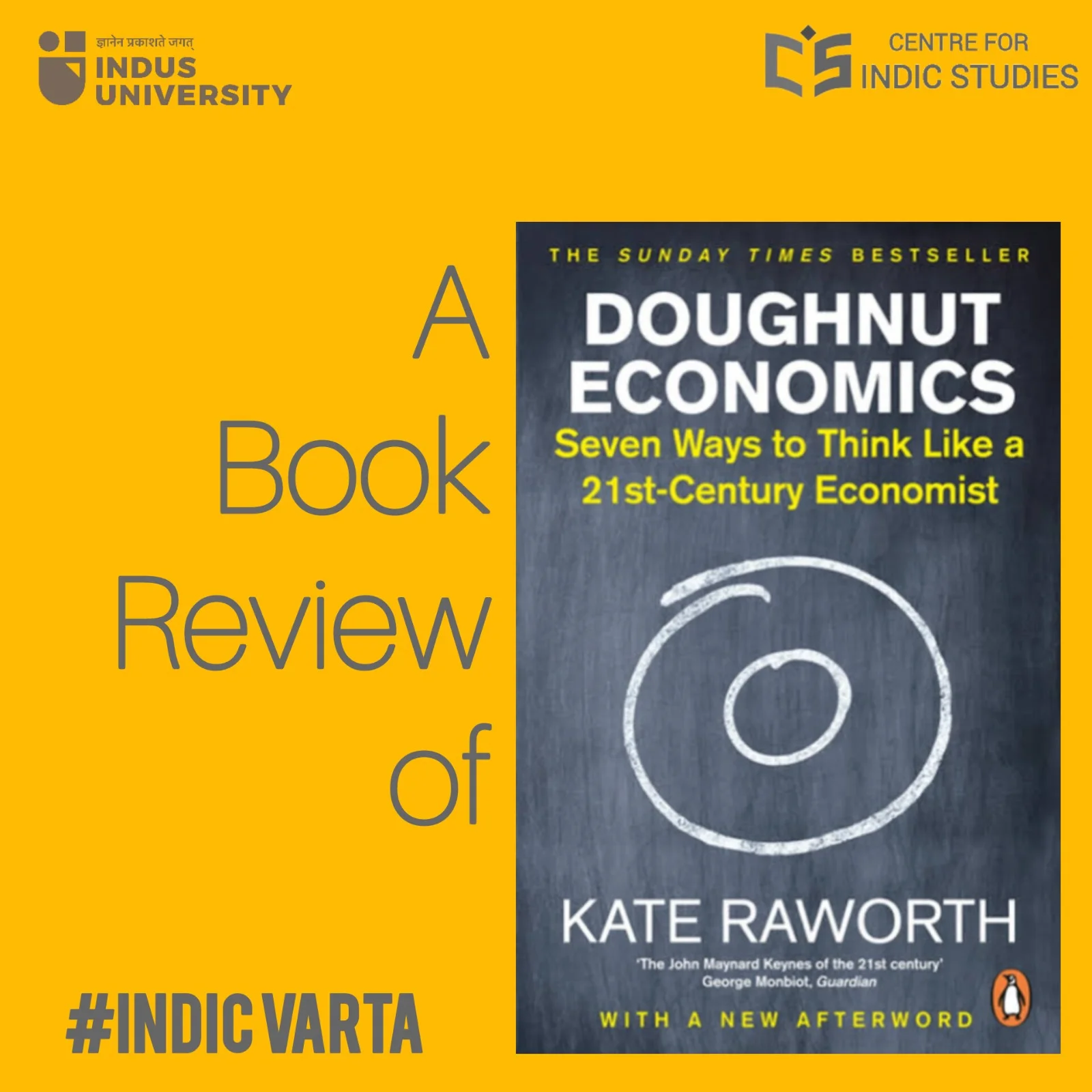
Some books give great insights to readers, while some directs them towards great insights. This book is the sublimation of both.
(The purpose of reviewing this book is to highlight that, amidst the significant challenges faced by the West, there is a growing inclination to seek wisdom from other civilizations and their ethos. Our ancestors, the rishis and sages, meticulously crafted our way of life through profound contemplation and practical implementation. Sadly, many Indians have lost touch with their own identity. This review aims to remind us that what we perceive as normal and natural is the result of our ancestors’ diligent efforts, which some undermine. The write, Kate Raworth, addresses the economic problems of the West and also her unique way of addressing it. However, as you read, you will be astonished to realize why these issues did not afflict India long ago when it was one of the world’s leading economies.)
Today’s important question in economics from western perspectives are raised in this book detailing how economists have built a high tower for themselves ignoring and also failing to understand the basis of society. They are engaged in the ‘jargonism’ and failing to predict the future of economy. The number is so high that even right ‘economists’ are not to be heard or given chance in policy making so for the continuity of the “GDP-ial Economy” benefiting ‘some’.
This book explores those ideas. But, while reading, those who have apt knowledge about the ‘Ancient Indian Economic Thoughts’ or have understood ‘Indic perspective of Economy’ and try to live by those principles, will be more fascinated to know that ‘Modern Western Economics’ is moving its dial towards Indic style of economic state. But, the problem today with us is that we ourselves have forgotten the insights that are already provided with apt implementations by ancient rishis through Vedic and other texts. It has been imbibed into our ‘way of life’ but unfortunately now drifting towards the west.
The writer, Kate Raworth, has risen above the ‘condescending mindset’ of the west giving fresh perspective to the western economy. In this review of the book, I would take some liberty, to attach those ideas to the ancient Indian thoughts despite knowing Kate might have not taken from it. I also note here that the additions don’t mean to decrease the worthiness or intellectual prowess of Kate Raworth. It is for the Indic and western audience for comparative study and understand how modern economy based upon Indic perspective can overcome today’s problem.
Introduction:
Kate Raworth’s, Doughnut Economics, presents a thought-provoking framework that challenges conventional economic paradigms. Named after the iconic “doughnut” image, Raworth’s work aims to redefine economic success and guide global development. The Doughnut Model – Raworth introduces the ‘Doughnut of social and planetary boundaries.’ This playful yet serious approach frames humanity’s 21st-century challenge: meeting essential needs while respecting Earth’s limits.
The model consists of two concentric rings: Social Foundation, derived from internationally agreed minimum social standards (e.g., healthcare, housing, political voice) and, Planetary Boundaries including nine environmental limits (e.g., climate stability, soil health) beyond which degradation occurs. Humanity thrives within the safe space between these boundaries like a doughnut.
The book includes seven chapters based upon Raworths’ model of doughnut. She has criticized the mainstream economics. Raworth has identified seven ways mainstream economics has misled. First being ‘The Rational Economic Man – Homo Economicus’ which is the myth of purely rational decision-making. Second, the western obsession with growth which leads various economies of the world pursuing growth at any cost just to have prowess of GDP. Third, the narrow metrics, Focusing solely on GDP. Fourth, market fundamentalism, Blind faith in markets. Fifth, nature as external, ignoring ecological impacts. Sixth, social inequities, Disregarding inequality, and seventh, short-termism, Prioritizing short-term gains.
The impact and influence of the book can be resonated with diverse audiences, including the Occupy Movement, the United Nations, business leaders and economists. Raworth’s work sets new standards for economic success, emphasizing well-being, equity, and ecological balance.
It is important to understand how west have ‘academic polarity’ and academic prowess upon the global education system including India.
Chapterization:
| It is important to understand how west have ‘academic polarity’ and academic prowess upon the global education system including India. |
The book has been chapterized in seven. Beginning with ‘Who wants to be an economist’ till ‘We are all economists now!’
Raworth quotes F. S. Michaels discussing how western ideas are monocultural and how American economics based upon this is taught throughout the world (based upon modern education system) as ECON 101.
She explains step-by-step what should be needed to understand:
The seven chapters are discussed below: Critical Human Deprivation > Social Foundation > the safe and just space for humanity > Ecological ceiling > Critical planetary degradation. These steps are further discussed in the chapters.
-
Change the Goals: From GDP to the Doughnut
| Western line of thoughts comes directly and indirectly from Hegel and Marx projecting dualism and struggle. By accepting that thought, western academia has failed to understand or bring out some practical aspects to sublimate them. The concept of GDP and the race for that has actually caused the subconscious condescending of local economy. |
In her thought-provoking first chapter, Raworth challenges the conventional pursuit of GDP as mere production as the ultimate objectives of our economic systems introduced by western economists. It began the race for overpowering each other. Instead, she beckons us toward a more profound destination—the actual economy, or GNP.
Raworth’s voyage through economic history reveals a lineage of visionary economists who dared to dream beyond material accumulation. Such as Jean Sismondi, John Ruskin, E. F. Schumacher, Manfred Max-Neef, Nicolas Sarkozy.
Raworth’s writing dissects Western economic thought, revealing its biases, blind spots, and yearnings. Her yearning is for Humanistic Economics inviting us towards humanity, ecology, and life-purpose. She asks for enlargement of people’s capabilities such as health, empowerment and creativity. She has criticized GDP because it only focusses on production.
Indic perspective has always been such. The calculation of wealth was not only of materialistic and tangible object but also of intangible and abstract thoughts. The importance was given to both.
2. See the Big Picture: from self-contained market to embedded economy
| If we go through the Vedic texts, we already have the concept of four Purusharthas – Dharma, Arth, Kaam and Moksha – where our arth or wealth should be based upon dharma (righteousness) |
In 20th century, a bold cohort of economists wove a narrative – a neoliberal thought – that cast the economy as a self-contained market. The western narratives embraced since the ascendancy of Thatcher and Reagan in the 1980s, has dominated the global stage. But, Raworth challenges this myopic perspective. She beckons us to step back, widen our gaze, and reimagine the economic canvas.
| The Indic perspective, proposes for an overall ecosystem where even animals and natural resources are encapsulated within the human civilizational ethos. |
In the second chapter, she explains how western thoughts for self-contained market like a snow globe, isolates economic activity from broader societal and ecological contexts. She calls for embedded economy which is intricately woven into the fabric of society and nature. It’s not a standalone entity; it’s embedded within social structures, cultural norms, and planetary boundaries. It is also important to understand the social threads and ecological threats. Here, markets intersect with human lives, aspirations, and relationships along with Earth’s ecosystem.
Reader must read page no. 59 and 60 retelling the economic 21st century Neoliberal story. ‘The market, which is efficient – so give it a free rein’; ‘business, which is innovative – so let it lead’ and so on… reading this will give a food for thought to even common readers how west have mono-culturalized and profit-oriented their growth. How brutish and short the economic view is!
In the same chapter, opposite and more ecological view is presented on page no. 63. Earth, which is life giving – so respect its boundaries; Society, which is foundational – so nurture its connections… She elaborates this thought very intellectually making the reader understand its nuances and importance.
3. Nurture Human Nature: from rational economic man to social adaptable humans
| Vedas teaches: Tyen tyakten bhunjitha in Ishavasya Upanishad explaining how humans must first give away things and then consume whatever they earn. |
The chapter is a great work on how individual as a part of society should transform into a better social human. Kate has divided this chapter with beginning of the historicity of how west have created humans as individualistic. How the concept of Homo Economics has caused to set a narrative to build human into rational economic man. She quotes various economists such as – Adam Smith; Charles Stanton Devas; Jeremy Bentham; Alfred Marshall. She quotes those work showing how those works being important has caused west to suffer from individualism alienating them from the ecology.
Further, she explains the need for humans to transform from self-interested to socially reciprocating; from fixed preferences to fluid values; from isolated to interdependent; from calculating to approximating; from dominant to dependent.
The goal of human must be transformation. According to Kate, we must transform from – Homo Economicus; à Homo Heuristicus; à Homo Reciprocans; à Homo Altruisticus; à Homo Socialis.
The important message is of evolutionary character that human has always played so far. From Indic perspective, from outside to within and within to outside.
4. Get Savvy with Systems: from Mechanical equilibrium to dynamic complexity
Economics, once enamored with physics envy, sought to mimic the elegance of Newtonian laws. In the 19th century, economists yearned for their own “laws of motion.” But Raworth challenges this reductionist view in the fourth chapter.
She compares western economic system with Mechanical Equilibrium, where economic forces balance like perfectly synchronized gears. This equilibrium model, akin to a pendulum at rest, simplifies reality. Yet, our world throbs with life, unpredictability, and interconnections. But this doesn’t count the other factors and the dynamic complexity. She showcases the system which is more adaptive, nonlinear, and ever-changing. Economic interactions ripple across society, ecology, and time. Feedback loops, emergent behaviors, and tipping points shape our fate.
She presents the thought of how we are affected by ‘trends’ because of networks and interdependencies. Supply chains, financial networks, social bonds present the web of complexity. Raworth believes economics not as a mechanical idea but a symphony of interconnected notes.
The reason for this western being mechanical is because of the very foundation of economics. Kate criticizes Xenophon, who is called as the ‘father of economics.’ Raworth unveils a conspicuous absence in his economic writings: ethics. His treatise ‘Oeconomicus’ presents household management, but it lacks ethical guidance. The marketplace and economic system remain devoid of moral compass. Regarding Women and Slaves, his economic pragmatism overshadows their human nature and marginalizes them. Women are reduced to domestic managers, their voices muffled and slaves are only considered as mere cogs in the economic machinery. Xenophon’s silence on economic ethics reverberates through centuries. This is how the origin of ethics in economy is necessary.
5. Design to Distribute: from ‘growth will even it up again’ distributive by design
The In the 20th century, western economic theory has propagated a powerful message regarding inequality: “It has to get worse before it can get better, and growth will eventually even things up.” But Raworth challenges this fatalistic narrative. The west always had an economy which was individualistic and also of conservation for the individual need and greed. This alike capitalism caused the problem of mismanagement of demand and supply. She has also given the thoughts of Karl Marx, Alfred Marshall, Vilfredo Pareto, Kuznets Curve etc. And to support this without facing the economic pressure from ‘haves-not’, economic dreams were presented despite knowing ‘survivorship bias’. The promise of trickle-down economics – the notion that prosperity at the top will eventually reach the bottom – has left too many waiting, their cups half-full.
Raworth presents her idea of distributive justice as a deliberate design choice. She wishes not to wait for cosmic corrections; and proposes to make a system to distribute wealth, power, and well-being equitably. This should also be inclusively designed. She has elaborated this idea with the questions: who owns the land? Who makes your money? Who owns your labor? Who will own the robots? Who owns the ideas?
6. Create to Regenerate: from ‘growth will clean it up again’ to regenerative by design
The most-bad thing I felt about the beginning of this chapter is the example that Kate gave about an Indian. I felt how we have reached at such level when we, as an Indian, are not able to understand economic dynamics of present and the economic prowess of the past.
Economic theory once portrayed a clean environment as a luxury reserved for the well-off. The western narrative that pollution must increase before it can decline, and eventually, growth will tidy up the mess. Rather than waiting for growth to miraculously clean up our ecological footprint, she urges us to be proactive.
She also explains five steps which is based upon human psychology. First, Do nothing. Second, do what pays. Third, doing our fair share which unfortunately has slipped into ‘taking our fair share’. Fourth, do no harm such as ‘mission zero’. And fifth, be generous.
In this sense, the way of life of Indic lifestyle which has at least been in action since thousands of time have reached fifth level. The concepts of Daandharma, generosity etc. has been a part of Indic lifestyle. It has been inculcated through rituals and daily practices.
7. Be Agnostic about Growth: from growth addicted to growth agnostic
In this chapter, as a concluding chapter, Raworth begins with the question – Is green growth possible? She also quotes W. W. Rostow’s 5 ‘stages of growth’ which describes the developmental process that countries go through as they transition from traditional agrarian societies to modern industrialized economies. Raworth’s model introduces a new stage, emphasizing the need for sustainability and resilience. It involves preparing for a smooth transition from high growth to a stable state. Considerations include environmental impact, social well-being, and equitable distribution of resources.
She also calls for economists to pinpoint the ecological spot in the ‘S curve’. To support this, she has presented some brilliant works such as Beckerman – In defense of economic growth (1974); Benjamin Friedman – The Moral Consequences of Economic Growth; Dambisa Mayo’s work.
Kate Raworth highlights the western failure to address addiction in various domains. First, the financial addiction, where the west often revolves around the question, “What is there to gain?” This focus on perpetual growth and profit can lead to unsustainable economic practices. Second, Political addiction, where western politics frequently centers on hope, fear, and power dynamics. These addictive patterns can hinder effective governance and long-term planning. And third, social addiction, where the west lacks sufficient aspiration to contribute meaningfully to society. Prioritizing individualism over collective well-being perpetuates this social addiction.
Conclusion:
The book is fantastic in its approach, challenging and debunking many of the Western ideas, ideologies, and thoughts that have dominated global economic discourse for centuries. Since the 19th century, economics has largely been shaped by Western perspectives, heavily influenced by colonialism and imperialism. These powers have often stripped economics of its ethical considerations since the beginning, focusing instead on profit and expansion at the expense of human well-being and societal harmony.
This book serves as a crucial starting point for the West to reexamine the economic dogmas they have long held as universal truths. It calls for a critical assessment of these doctrines, highlighting the need for answers to the economic and social problems they have often exacerbated rather than solved.
Moreover, it is an opportune moment for India to break free from any lingering inferiority complexes imposed by its colonial past and to assert its own rich economic traditions. India’s ancient wisdom offers alternative approaches to economics that emphasize sustainability, community, and ethical governance—principles that are increasingly relevant in today’s world. By speaking up and sharing these ideas, India can contribute significantly to a more balanced and humane global economic framework, encouraging a shift from the exploitative practices of the past to a future focused on equity and justice.
