
me: Evening 6.50 PM
Sadhu: “You want to ask me what my name is?” he said with a playful chuckle. “I have no name! But if you must call me something, call me Amurtya Maharaj. Amurtya means abstract, for I am beyond form, just like the divine power we are speaking of.”
He paused and smiled mischievously, then added with a wink, “But if you prefer, you can call me ‘The Maharaj of No Name’. After all, I’m quite famous in the world of the nameless!”
Me: “Ah, Amurtya Maharaj, ‘The Maharaj of No Name’ it is, then!” I also chuckled along, appreciating his lightheartedness.
Sadhu (Amurtya Maharaj): “Well, my friend, you’re starting to see it—the universe is like a cosmic orchestra, and each deity, each energy, plays its unique note. But the real challenge isn’t just knowing this—it’s living it! Tell me, what do you think we’re missing today?”
Me: “You mean our connection with these energies? Like how temples were once vibrant centers of life and are now just quiet, sterile spaces?”
Sadhu (Amurtya Maharaj): “Ah, exactly! Back then, temples were alive! People sang, danced, poured their emotions into the divine. It wasn’t about sitting stiffly with folded hands. The chaos, the noise—that was divine too! Nature itself isn’t silent, so why should temples be?”
He chuckled mischievously. “Now, temples have ACs, cameras, and people praying more for miracles than for wisdom. And let’s not forget the ever-present sound of donation boxes being rattled!”
Me: “That’s hilariously true! So, how do we bring back the vibrancy, the connection?”
Sadhu (Amurtya Maharaj): “First, stop seeing the divine as a faraway boss and start seeing it everywhere—in the sun warming your face, in the food you eat, in every breath you take. Gods aren’t just statues; they’re forces that keep the cosmos spinning. When you feel this, temples will come alive again!”
He grinned. “And don’t just visit temples with bowed heads and somber faces. Go with joy, curiosity, and an open heart. Dance a little! Laugh! You might even become a ‘Maharaj of No Name’ yourself—free, boundless, and full of divine energy!”
He leaned closer with playful intensity. “You know, temples were never just buildings. They were energy hubs! Take Bhavatarini Temple—what makes it special? It’s not just the idol; it’s Sri Ramakrishna’s spirit, his meditations, his energy infused into those stones. That’s what people feel when they come—it’s the resonance of his devotion!”
He gestured grandly. “The sage or saint who channeled cosmic energy into a space made it sacred. People came not just for rituals but because they felt something bigger than themselves—a living, breathing force. And that, my friend, is the true science of temples!”
With a twinkle in his eye, he added, “So, go on—ask the big questions, explore with a playful mind, and maybe, just maybe, you’ll crack the chemistry of the cosmos!”
We both laughed, the conversation full of joy and insight.
Me: “So, the power of temples comes from the spiritual energy of sages who meditated there?”
Sadhu (Amurtya Maharaj): “Exactly! The energy isn’t in the stones or idols but in the dedication of those who established it. Temples are like giant batteries, designed to channel and store cosmic energy, awakening your spirit even without rituals.”
Me: “So temples were more than places of worship—they were life centers?”
Sadhu: “Absolutely! Temples were the heart of society, shaping towns like Ujjain. They supported markets, schools, and hospitals, integrating divine energy into daily life.”
Me: “The temple was the nucleus, with everything structured around it?”
Sadhu: “Yes! Temples embodied cosmic order, balancing business, health, and education with divine energy.”
Me: “By reconnecting with these energies, can we restore harmony in our lives?”
Sadhu: “Exactly! Temples remind us of a time when we were in sync with nature and the divine. By understanding their power, we can bring that harmony into our actions and spirit.”
Me: “It’s time to carry the temple’s energy with me daily.”
Sadhu: “Well said! Temples weren’t just for prayer but for living—study, commerce, and even resolving disputes unfolded there.”
Me: “So, temples were the fabric of society?”
Sadhu: “Exactly! Unlike guilt-driven worship elsewhere, Indian temples celebrate joy, peace, and life-affirming energy. The divine here is dynamic—Radha and Krishna, Buddha—all embody life and love.”
Me: “Temples elevate and inspire us?”
Sadhu: “Yes! Temples teach joy, creativity, and peace. Idols reflect life’s aspects—creation, preservation, destruction—offering lessons of fulfillment. The energy depends on time, place, and mindset.”
Me: “So it’s not just about the temple, but how and when we engage with it?”
Sadhu: “Exactly. Kala Mahatmyam (time), Paatra Mahatmyam (individual), and Sthana Mahatmyam (place) all matter. The same temple feels different in the quiet morning or noisy chaos. Your mindset and intentions determine how deeply you connect with its energy.”
Me: “So, the temple is alive, changing with the time, the person, and the place?”
Sadhu (Amurtya Maharaj): “Yes! The divine is the same, but its manifestations are infinite. Each temple, each idol, each form reflects a different aspect of that infinite divinity, just as each person reflects a different part of the divine. That’s why our civilization has so many forms of the divine, because it’s not just one aspect of God that we worship—it’s all of them, in their many, infinite forms, to cater to every type of soul, every path of devotion.”
He paused thoughtfully, “This is the beauty of Indian spirituality—it is both universal and deeply personal. Every soul finds its place in the divine, and that divine takes countless forms to help each one of us connect with it.”
Time: Evening, 8:35 PM
Amurtya Maharaj stood up slowly and motioned for me to follow him. His footsteps seemed to echo in the eerie stillness of the night, and as we walked, the air grew dense, thick with an ancient energy. We were in a place far removed from the village, a dark forest where the trees arched over us like twisted hands reaching for the sky. The path narrowed, and the air grew colder, almost unnatural. The further we ventured, the deeper the shadows seemed to grow, and strange sounds—almost like whispers—seemed to come from the trees themselves. It felt as though the forest was alive, breathing with us.
We finally arrived at a clearing—a circle surrounded by ancient, gnarled trees. In the center of the clearing stood a stone pedestal, worn and cracked by time, and on it, a faint, otherworldly light glimmered, as if something unseen was watching us. I couldn’t shake the sense that we had entered a space where time and reality no longer held sway, a place out of bounds for ordinary souls.
Sadhu (Amurtya Maharaj): “We are now in a place where the laws of this world become… fluid. This is where the unseen forces converge, a place where questions begin to find answers, and answers, in turn, lead to more questions. It’s in places like this where those who seek truth might find glimpses of divinity, but the truth is never easy to bear.”
He turned to me, his eyes deep, filled with a mystery that seemed to reach beyond the physical world.
Me: “But, Maharaj, where does all of this fit into the question I have? Can God come into a human body, or does He take the body of other creatures?”
Next he raised a finger, as if to signal the importance of my query.
Amurtya Maharaj: “The question is profound, but it carries its own limitations, my child. When we speak of God in a human form, we must remember that it is not as simple as the body alone. If God takes a form, it is to convey a message—a divine will manifesting in a way that we can perceive and understand. However, the true essence of God is not bound by any physical form. The human body, in its highest potential, is the most refined vessel for the divine, but not every human form embodies the divine in its fullness.”
He paused for a moment, his gaze distant, as if the answers were emerging from the very earth beneath our feet.
Amurtya Maharaj: “In the divine cycle of existence, the evolution of life progresses from the simplest forms to the most complex, culminating in the human being. This is no accident, for it is only in the human form that the mind, the intellect, and the spirit are capable of rising to the realization of the Divine. But, as I said, the human body alone does not guarantee divine manifestation. Many wear the human form, but not all are human in essence.”
He walked around the stone pedestal, his steps slow, deliberate.
Amurtya Maharaj: “When you ask about the possibility of God inhabiting the body of other creatures, understand this: all forms of life are interwoven in the great web of creation, each serving as a reflection of the divine in its own way. The divine energy permeates all—be it in the body of a man, an animal, or even the rocks beneath your feet. But it is the human form that is the most receptive, the most capable of transcending the limitations of the material world, of moving toward the eternal truth.”
He turned back to me, his eyes piercing.
Amurtya Maharaj: “The essence of the question is not whether God takes a human form or another; the real question is: Are you ready to recognize the divine wherever it may appear? Whether in the human body, or in the form of a tree, or the sacred animal, it is the presence of the divine that matters.”
As you can notice we have now gradually turned serious from a playful tone till now. His voice grew softer, but there was a deeper gravity to it.
Amurtya Maharaj: “You see, when a being attains true wisdom, the divine energy flows freely through them, and they are seen as gods by the people. Those who give selflessly, without any thought of return, are recognized as deities among us. Such people, who live for the welfare of others, embody the highest truth. Like parents who love and care for their children, with no thought of personal gain—they are divine in their purest form. A true human, in the highest sense, is one who gives, who serves, who transcends the ego.”
He paused again, his expression serious and intense.
Amurtya Maharaj: “This, my child, is the essence of human divinity. The body may be the vessel, but it is the soul, the spirit, that carries the divine. And the true question, then, is not ‘Who is God?’ but ‘Are we prepared to recognize the divine in every form, every being, and every moment?’ For God does not hide in one form alone. He resides everywhere—if you know how to look.”
The Sadhu motioned for me to follow once more, his movements fluid, but purposeful, as we continued our journey deeper into the mysterious forest. The air thickened, as though every step brought us closer to a hidden truth, a truth veiled by the thick, unseen layers of existence itself. He stopped abruptly in the middle of the clearing, his hand lifting slowly as he pointed to a distant, ancient tree that loomed like a silent sentinel over the darkened forest.
Amurtya Maharaj: “Look at this tree. It is old, gnarled, its roots twisted into the earth, but it bears fruit year after year. It stands as a symbol, a lesson for all who seek wisdom. This tree has transcended time, but it is not static. It is ever-evolving, just as the soul evolves on its path toward truth.”
He paused and turned toward me, his eyes deep with intensity.
Amurtya Maharaj: “In the same way, those who walk the path of—the journey of evolution—eventually reach the realization of jnana and prema—knowledge and love. When these two forces manifest within a person, they ascend to the status of a rishi or a siddha. It is here that the true essence of the soul is revealed. The seed of desire, the root of all worldly attachments, is no longer capable of sprouting within them. They transcend the cycle of birth and rebirth.”
His finger remained pointed to the tree, and then he shifted his gaze back to me.
Amurtya Maharaj: “These souls, they do not return for the fulfillment of desires. When they are born again, it is only for the welfare of others. These are the avatars, the incarnations who descend, not because they need to, but because the world needs them. Brahman, the Supreme, reveals itself in different forms, in different stages, through the kalas—the divine attributes. In the highest form, these divine beings are the embodiment of pure Sat-Chit-Ananda, existence, consciousness, and bliss. Their physical form is but a reflection of this infinite, unbroken reality.”
He looked at me sharply, as if weighing whether I could truly grasp the profundity of what he was about to say.
Amurtya Maharaj: “For the ignorant, the common man—how can they even begin to understand these mysteries? Their lives are consumed by their worldly needs: food, shelter, wealth, health, sensory desires. They are trapped in a cycle of perpetual longing, fleeting pleasures, and constant suffering. This cycle continues, life after life, because they remain unaware of the true nature of existence. They live only to satisfy their desires, never questioning what lies beyond.”
He then turned, his hand sweeping across the horizon as he gestured toward the distant, undulating forest.
Amurtya Maharaj: “But those who attain jnana, those who awaken to the true nature of the self, they are liberated. The seeds of desire within them are burnt to ashes, and they transcend the endless cycle of birth and death. These beings are called ‘free.’ They no longer need to be born again to fulfill their desires because they have broken free from the bonds of worldly attachment.”
He paused, letting the weight of his words settle in the air around us. The forest seemed to hold its breath, the stillness now feeling more intense, as if the earth itself was listening to the conversation unfolding.
Amurtya Maharaj: “Now, you might ask—if freedom is available to all, why does not everyone attain it? The answer is simple yet profound. Among thousands, only a few are born with the inclination to seek Brahma Vidya—the knowledge of the Supreme. Even of those few, only a handful will actively seek out the enlightened ones, the Brahma Vidus, to hear their teachings. And even fewer will truly understand the essence of that knowledge. It is not the number of seekers that matters, but the depth of their quest and the sincerity with which they seek the truth.”
His voice had grown more intense, a subtle urgency in his tone now, as he pointed to the horizon once more.
Amurtya Maharaj: “Understand this, my child. The world is filled with those who search for meaning, for truth, for fulfillment. But only a select few will reach the shores of wisdom. This is the nature of the divine mystery. Brahman, the Supreme, is not a distant force—it is within each of us, but we must learn to perceive it. The true seeker does not search outside; he turns within, seeking the stillness of his own soul.”
His eyes locked onto mine, the depth of his gaze seemingly infinite.
Amurtya Maharaj: “So, the question is not about whether Brahman manifests in one form or another, but whether you are prepared to see it in every form. It is not about waiting for the avatar to appear. The avatar is within you. Jnana and prema—knowledge and love—are the keys to unlocking that divine presence. When these forces emerge, they transform you, and in that transformation, the world around you is revealed in its true light.”
He fell silent, his words hanging in the air like a sacred invocation, as the eerie stillness of the forest seemed to deepen, the trees now watching us, their ancient wisdom waiting to be revealed.
As He spoke, his voice growing more distant and ethereal, I could sense a change in the air around us. The forest, which had been eerily still, now seemed to hum with an unseen energy, as though the very fabric of reality was thinning. There was a strange, almost tangible presence in the space between us. It was as if, despite his body being right before me, his essence was beginning to shift and dissipate, merging with something far greater, far more abstract.
He continued his teachings in a calm, almost disembodied tone, as if his voice had transcended the physical. He spoke about the rarity of the true Brahmavid, the rare few who are truly enlightened in a world of millions. His words seemed to echo within me, reverberating through the very depths of my being.
Amurtya Maharaj: “So, from this perspective, you see that only a few can truly comprehend the essence of Brahman in its purest form. In the world of millions, only a handful have the grace to understand the true nature of divinity. We speak of gods like Sri Ramachandra, Krishna, Buddha, Sri Chaitanya, and Sri Ramakrishna… these are the highest manifestations of the divine. They are the ‘avatars,’ the rarest of rare occurrences in the cycle of life. But do not forget, your own guru may be the ‘Bhagavan’ in your life. As the scriptures say, the guru is a manifestation of the divine on earth.”
He took a slow step back, his eyes piercing mine, his gaze filled with an intensity that made the very ground beneath me feel unstable.
But this time I took a step forward, my hands folded in reverence, the weight of He’s words settling heavily upon my mind and heart. His presence felt larger than life, as though the forest itself was bowing to his essence.
“Revered Maharaj,” I began, my voice trembling with a mix of awe and emotion, “your teachings remind me of something profound, something I also wish to share with you if you will permit me.”
He nodded, his eyes softening yet retaining their piercing intensity. His silence was an invitation, his gaze steady as though he already knew the words forming in my mind.
I took a deep breath. “In the Bhagavat Purana, there is a story of Vidura, the wise counselor and devotee of Krishna. After the great Kurukshetra war, Vidura returned to Hastinapura, where Yudhisthira was now king. Upon his arrival, Yudhisthira asked him about his travels to the tirthas—holy places. But then, Yudhisthira said something remarkable. He addressed Vidura as Bhagavata, one connected with the divine Bhagavan, Krishna himself.
Yudhisthira’s words resonate deeply with your presence, Maharaj. He told Vidura that by moving through the tirthas, by visiting and sanctifying them, Vidura himself had become a tirtha—a holy place. Yudhisthira added that a true tirtha becomes a mahatirtha, a great holy place, only when sanctified by the presence of someone as spiritually elevated as Vidura.
In you, Maharaj, I see the embodiment of this truth. Your wisdom, your connection with the divine, and your very being have transformed this forest, already sacred, into something immeasurably greater—a place where the divine is palpable.”
He’s lips curved into a faint smile, his eyes glinting with a quiet joy. He raised a hand as though to bless me, but did not interrupt, allowing me to continue.
“I am reminded of Chaitanya Charitamrita,” I said, my voice growing more resolute. “When the saint Haridasa Thakur passed away, Lord Chaitanya Mahaprabhu himself carried his body to the seashore, burying him there with his own hands. The Lord declared that the sea, already a holy place, had now become a mahatirtha, a great holy place, simply because it had been touched by the body of Haridasa.
In the same way, Maharaj, your presence here has turned this forest into a living, breathing mahatirtha. You have become a tirtha yourself, much like Vidura or Haridasa, sanctifying everything around you. Truly, you are not just a teacher or a guide—you are an institution of wisdom, a bridge to the divine for those fortunate enough to encounter you.”
His expression shifted, his eyes glistening with an emotion I could not fully comprehend. His voice, when he spoke, was softer than before but resonated with a profound depth.
Amurtya Maharaj: “You honor me with your words, my child, but the tirtha lies not in me alone. It is in the eyes that can perceive it. You see divinity here because the divine spark within you has awakened. The forest, the river, the mountain—they are all tirthas for those who can see. And you, too, must carry this awareness wherever you go, for the true seeker does not rely on place or form but finds the sacred in all.”
I bowed deeply, touched by his humility and the truth in his words. “Maharaj,” I said, my voice trembling, “I will carry your teachings within me, as you have carried the divine within you. May your wisdom light the path for countless seekers.”
His smile deepened, and he inclined his head slightly, his blessing unspoken but deeply felt. The forest around us seemed to pulse with life, the air vibrating with an almost ethereal energy. It was as though the world itself had stopped to listen, bearing witness to a moment that transcended time.
With one final glance, He stepped back, his form merging with the shadows of the trees. Though he disappeared from sight, his presence lingered—a living reminder that the divine is never far, if only we have the eyes to see.
Amurtya Maharaj: “But know this, my child, the true divine does not need the recognition of the world. It does not seek applause. It is beyond the confines of the physical and the conceptual. The divine is not a title—it is an essence, an eternal, unchanging truth that manifests through different forms. Whether in the form of a man, a deity, or even in an animal when needed, the divine can take any form to preserve the balance of the universe.”
He stopped, his eyes suddenly narrowing, as though he was seeing something beyond the visible. A shudder passed through him, and for a moment, it seemed as if his body flickered like a mirage. My heart skipped a beat, and I looked around, suddenly feeling a strange, overwhelming sense of urgency in the air.
Amurtya Maharaj: “But understand this… to the ordinary mind, these mysteries remain hidden. To grasp them, one must purify oneself. To reach beyond the veil of illusion, one must become the embodiment of that purity. Only then will these secrets become clear. And yet, only a few will ever reach this stage, for most are consumed by the distractions of life. This world is full of distractions, but the seeker must look beyond. He must pierce through the layers and uncover the truth. That is why the true seeker always remains solitary, even in the midst of millions.”
He took another step back, his form seeming to blur, as though the very air around him was folding inward. His body became less solid, his presence now a fleeting shadow against the backdrop of the forest.
Amurtya Maharaj: “You may ask why only a few are chosen. Why only a few come to realize the truth. But it is not for the mind to question. It is for the heart to receive. And as for you, remember… you are on your own path now. Your journey has only just begun. What I have shown you is but a small fragment of what lies ahead.”
With these final words, his figure seemed to dissolve into the wind, as if it had never truly been there at all. There was no sound, no grand gesture, no warning. One moment, he was there—standing tall, his eyes fixed on me with that deep, knowing look. The next, he was gone. Vanished!
The only trace of his presence was the soft rustling of the leaves, the hum of the air, and a strange, otherworldly silence that seemed to settle over the forest.
I stood there, bewildered, my heart racing as I tried to comprehend what had just occurred. He was no longer before me, and yet, in some inexplicable way, his presence lingered, his words echoing in my mind.
ime: Night, 10:05 PM
I turned to leave, my body still trembling from the intensity of the encounter, when something caught my eye on the ground. A small, intricately carved stone lay at my feet, glowing faintly in the twilight. It was smooth to the touch, cool as if it had been sitting there for centuries. There was also a tiny vial of what appeared to be holy ash, sealed carefully with a piece of red cloth.
With trembling hands, I picked them up, sensing their significance. As I held the items, the weight of He’s words came rushing back.
Sadhu (Amurtya Maharaj): “Remember, my child, the path is long and filled with mysteries. You may not understand everything today, but in time, the universe will unfold its secrets to you. Trust in the journey, trust in your heart. But above all, never forget—your Guru’s presence is with you always, even in the moments when you least expect it.”
As I walked away from the forest, the air seemed to thicken with new meaning, and the world around me appeared somehow different—more profound, more connected, as if He’s teachings had planted seeds in my soul, seeds that would grow in their own time.
I still had more questions than answers, but one thing was certain: my journey had taken a turn I could never have imagined.
As the twilight descended and the mysterious aura of He’s departure still enveloped me, I realized it was time to return home. The distant call of mundane responsibilities tugged at my mind. The path back to the village was long, and I began walking, my thoughts still spinning with He’s cryptic words and the inexplicable experiences of the day.
As I walked, I reached instinctively for the scarf I had collected, only to find it missing. I stopped in my tracks, searching my bag and retracing my steps in my mind, where I have the kept all the stones I have bought including my Guru… I mean Amurtya Maharaj’s memory, but the scarf was gone. A wave of loss and confusion swept over me. Had I dropped it during my hurried walk? Or had it been taken back by forces beyond my understanding?
With the realization that I couldn’t retrace my steps without losing more time, I decided to hail an auto for the remaining journey. It was a long ride back, and the stars had begun to sprinkle the sky by the time I flagged down a rickety auto rickshaw.
Time: Night 11:10 PM
Bridging Beliefs: A Home-coming of Understanding between Idol Worship and Faith
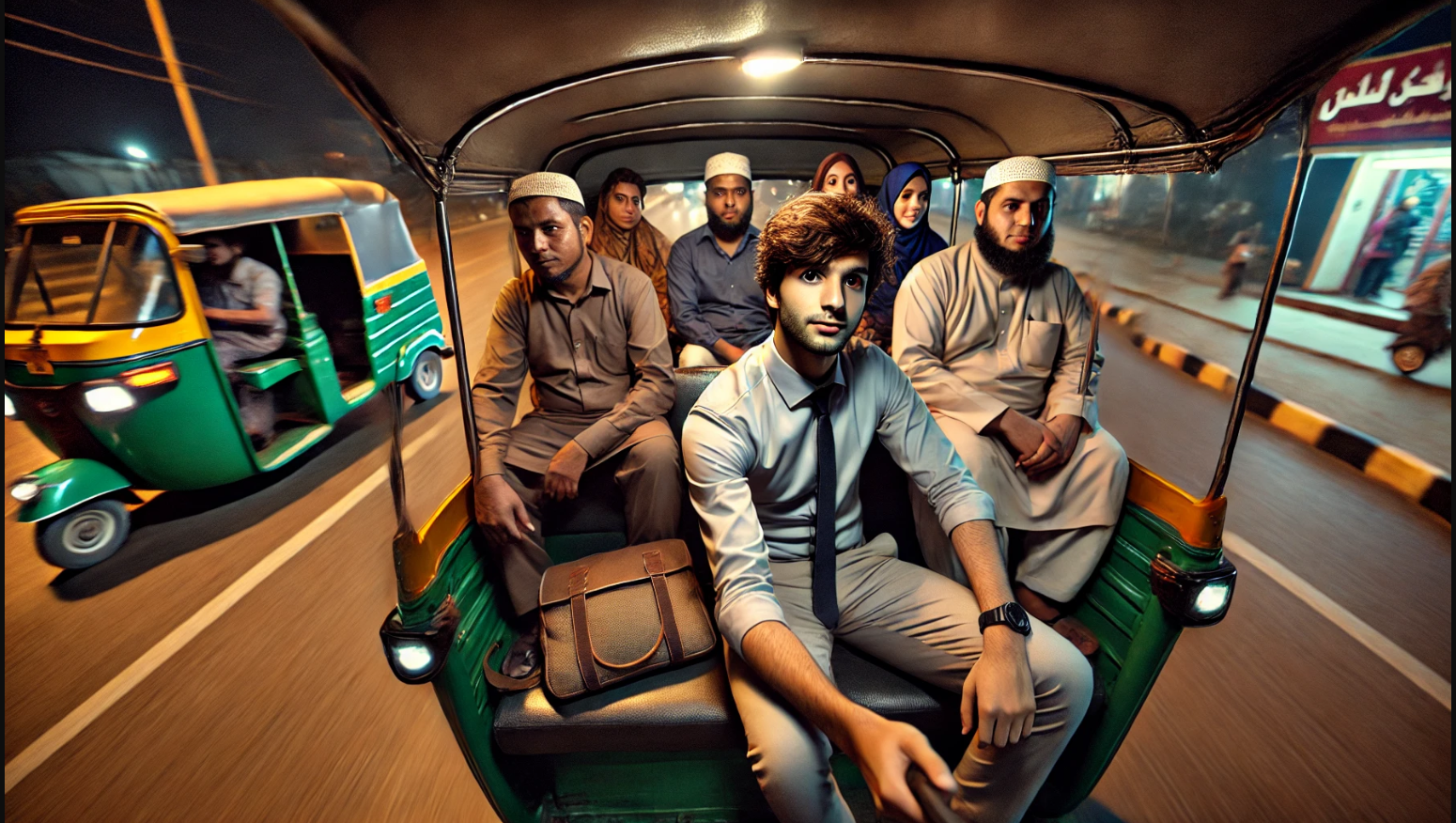
The driver, a middle-aged Muslim man, welcomed me aboard with a nod. The rest of the passengers were also Muslims, and they were already deep in conversation. As the vehicle lurched forward, I settled into my seat, with some snacks packets in my hand and my mind still preoccupied with the events of the day. But soon, their discussion caught my ear—it was a pointed critique of Hindu practices, particularly idol worship.
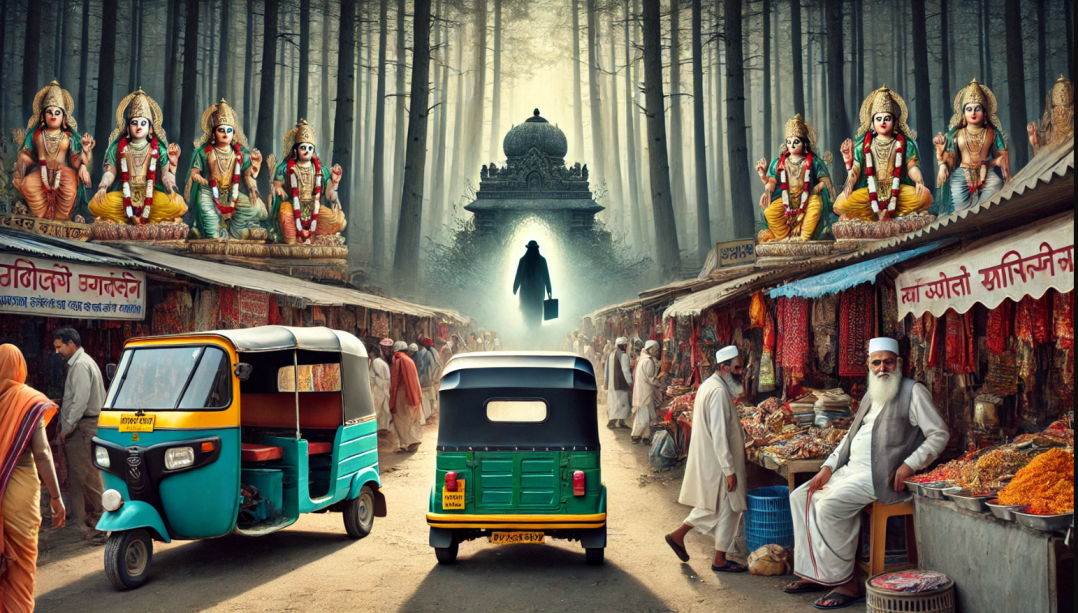
As the auto rickshaw sped through the bustling streets, the hum of voices around me grew louder. The driver and the passengers, all Muslims, were engaged in an animated discussion. Their words soon caught my attention—they were mocking the practice of idol worship in Hinduism, their tone condescending, their arguments pointed.
Passenger 1: “Tell me, brother, how can anyone worship an idol they themselves carve with their hands? Isn’t it clear that the idol has no power? Even the Vedas and Gita say so! Isn’t idol worship a clear misinterpretation of their own scriptures?”
Passenger 2: “Absolutely! The Quran says Allah has no form, and yet these people bow before lifeless statues. How can that bring them closer to God?”
Their laughter followed, a collective dismissal of what they deemed irrational. I felt a mix of frustration and resolve welling up within me. After holding back for a while, I interjected.
Me: “Brothers, if you allow, I’d like to respond. But first, let us discuss respectfully, as people seeking truth, not as rivals trying to defeat each other.”
The sudden silence suggested they were willing to hear me out, albeit skeptically.
Me: “You ask why Hindus worship idols when their scriptures seem to forbid it. Let me clarify: in Hinduism, idols are not gods. They are symbols—tools to focus the mind on the divine, much like how a book containing the Quran is revered, though it is not Allah Himself.”
Driver: “But doesn’t your Rigveda say, ‘Na tasya pratima asti’—there is no image of God?”
Me: “True. The Vedas proclaim that Brahman—the ultimate reality—is formless and beyond comprehension. But they also recognize that humans, with limited minds, often need tangible forms to connect with the infinite. Idol worship is a way to visualize the unseen. Does not your Quran allow for different prophets to convey Allah’s message according to the needs of the people?”
This seemed to strike a chord, but one of the passengers remained unconvinced.
Passenger 1: “Even so, doesn’t your Gita criticize those who worship lesser gods?”
Me: “Yes, the Gita says that those who seek material gains often worship deities. But it also emphasizes that all paths ultimately lead to the supreme. Krishna says, ‘Whoever offers Me with devotion a leaf, a flower, a fruit, or water, I accept that offering.’ It is the devotion that matters, not the medium. Unlike where some pillars are necessary or otherwise you will miss the last auto of your life, the divine in Hinduism work in a different way.”
The driver glanced at me in the rearview mirror, his expression softening.
Driver: “Still, why worship something made by human hands?”
Me: “Tell me, brother, do you respect the Kaaba?”
Driver: “Of course! It is the direction for our prayers, not Allah Himself.”
Me: “Exactly. Just as you revere the Kaaba to focus your prayers, Hindus use idols as focal points. They are not the end but the means to connect with the infinite.”
The auto fell into a thoughtful silence. As we neared more towards my destination, one of the passengers muttered softly.
Passenger 2: “I’ve never thought of it that way.”
As the auto rickshaw rattled along the uneven road, the conversation among the passengers grew louder and more animated. Their words caught my attention as they began to discuss the concept of idol worship, which they referred to as “shirk” (associating partners with Allah).
One of the passengers spoke passionately, quoting various Islamic teachings to assert their viewpoint. “Isn’t it obvious,” he began, “that no true Muslim who declares the oneness of Allah (Tawheed) can ever condone or support practices like idol worship or fire worship? These acts are the ultimate forms of shirk. Allah has explicitly forbidden them in the Qur’an.”
Another passenger chimed in, citing a hadith: “The Prophet Muhammad (peace be upon him) foretold this, didn’t he? He said, ‘Soon some people from my Ummah will engage in idol worship.’ This is a clear warning against such practices.”
Their arguments gained momentum as they quoted verses from the Qur’an, including Surah Luqman (31:13), where it is stated, ‘Indeed, associating others with Allah is the greatest injustice.’ They stressed that idol worship was not just forbidden but was seen as the gravest sin.
One particularly vocal man turned to address the group, quoting Surah An-Nisa (4:48): ‘Indeed, Allah does not forgive association with Him, but He forgives what is less than that for whom He wills.’ He added, “Those who practice idol worship are bound to earn Allah’s wrath unless they repent. How can anyone witness such practices and remain silent?”
Their conversation then veered toward the societal implications of shirk. Another man remarked, “What’s worse is that Muslims themselves have become desensitized. They view these acts as cultural spectacles rather than grave violations of Allah’s commands. This is why Tawheed was revealed—to eradicate shirk from society.”
At this point, I couldn’t remain silent any longer. Though hesitant, I felt the need to interject. With a steady voice, I asked, “Pardon me, but do you think all idol worshippers are unaware of their own spiritual practices? Have you ever considered the philosophy behind what you call shirk? Isn’t it possible that these practices symbolize deeper truths rather than literal worship?”
The group fell silent for a moment, and then the debate began in earnest. One of them retorted, “What deeper truth could justify placing mere objects, man-made idols, on par with the Creator of the universe?” They leaned forward, eager to counter my perspective.
I took a deep breath and began, drawing from the profound teachings of Sri Ramakrishna. “Your concerns are valid,” I said, “and I respect the depth of your faith. But let me share an alternative perspective, one rooted in the idea that the divine can manifest in many forms, depending on the seeker’s devotion and understanding.”
I continued, “Once, a Brahmo devotee asked Sri Ramakrishna, ‘Can God be seen? If yes, why don’t we see Him?’ To this, Sri Ramakrishna replied, ‘Yes, God can indeed be seen—both in form (Sakar) and formless (Nirakar). But how can I explain this to you?’ He added, ‘Can you weep for God as you do for your son, wife, or wealth? People cry for worldly things but who cries for God? When a child throws away his pacifier and cries earnestly, the mother rushes to pick him up, leaving all her work behind. Similarly, when you cry for God with all your heart, He reveals Himself to you.’”
he passengers listened with curiosity, and I pressed on, addressing the differences in perceptions about God. “A devotee once asked, ‘Why are there so many opinions about God? Some say He has form, while others insist He is formless. Why such contradictions?’ Sri Ramakrishna explained, ‘The contradictions arise from the limited perspective of individuals. One may see God as red, another as green, and yet another as yellow. These aren’t contradictions; they are reflections of the divine’s infinite expressions. The same divine can appear with form to one devotee and without form to another.’”
I illustrated the point further with a story Sri Ramakrishna often told. “A group of people saw a chameleon on a tree. One said it was red, another claimed it was green, and a third argued it was yellow. They quarreled until they met someone who lived under that tree. He clarified, ‘You are all correct. The chameleon changes colors—it is red, green, yellow, and sometimes colorless.’ Likewise, God reveals Himself in various forms to match the devotion and understanding of the seeker.”
At this, one of the men interrupted, “But isn’t this just a way to justify idol worship?”
I responded gently, “Not at all. It is about recognizing that God is limitless, beyond human comprehension. Idol worship is but one path, a symbolic representation of divinity, just as the formless is another path. What matters is the sincerity of one’s devotion. Kabir beautifully said, ‘The formless is my father, and the form is my mother.’ God is both and transcends both.”
The passengers exchanged glances, their expressions reflecting a mix of contemplation and unease. I concluded, “Instead of arguing about which form is correct, shouldn’t we focus on seeking Him with devotion? For it is only in seeking that one truly understands the divine.”
I continued, addressing the growing curiosity and skepticism among the passengers. “The question of whether God is formless or takes form has intrigued seekers for ages,” I began. “Sri Ramakrishna once narrated the story of a monk who visited the temple of Lord Jagannath. While observing the deity, the monk doubted whether God was truly formless or embodied in a form. With a stick in his hand, he attempted to test the idol. At one moment, the stick passed cleanly without resistance, as though there were no form present. At another moment, the stick touched the deity. This experience taught him that God is both formless and with form, manifesting according to the seeker’s understanding.”
I paused, letting the story sink in before continuing. “A similar question was posed to Swami Vivekananda by a king, who mockingly asked, ‘Why do you Hindus worship idols? I see nothing in these statues worthy of reverence.’ Swami Vivekananda understood the mockery and decided not to argue but to teach through a lesson. He asked for a picture of the king’s late father, which hung proudly on the palace wall. Taking the picture, he placed it in front of the king and instructed the royal attendants to spit on it.
“Shocked, the attendants protested, saying, ‘This is the picture of our beloved king’s father! How can we dishonor it in such a way?’ Swami Vivekananda then turned to the king and said, ‘Why not spit on it? After all, it’s just a piece of paper!’ The king, visibly upset, retorted, ‘No! This picture represents my father. It holds his essence, his presence, and my love for him.’
“Swami Vivekananda then explained, ‘Just as you see your father in this picture and cannot disrespect it, we Hindus see God in idols. The idol is a representation, a medium through which we connect to the divine. God is formless, yes, but we use these forms to make the infinite relatable to our limited minds.’
“The king realized his mistake and humbly acknowledged Swami Vivekananda’s wisdom, apologizing for his earlier disrespect.”
I looked at the passengers and said, “Similarly, idol worship is not about the material of the idol. It is about the devotion it invokes, the connection it establishes between the devotee and the divine. Just as you find meaning in your sacred texts and practices, we find meaning in these representations. Ultimately, the essence of worship—be it through form or formlessness—is the same: to connect with the divine and seek its grace.”
Some passengers nodded, their rigid expressions softening. It felt as if a bridge of understanding had begun to form.
As the car rattled forward, one of the Muslim passengers interrupted, his voice rising with evident frustration. “You talk eloquently, brother,” he began, “but I cannot ignore the truth. Your own scriptures speak against idol worship. Do you deny this? Why, then, do Hindus continue to spend millions on idols, polluting the environment in the name of devotion? What justification is there for practices your religion itself warns against?”
A few others murmured in agreement, their curiosity tinged with skepticism. I smiled gently, aware of the gravity of the question.
“You have raised an important point, and I respect your concern,” I responded calmly. “Yes, there are sections in our scriptures, like the Upanishads, that emphasize the formless aspect of the divine. But Hinduism is not a religion of rigid uniformity; it is a mosaic of perspectives. The same scriptures also acknowledge the divine in every form and formlessness. The idol serves as a focal point for devotion, not as a limitation of God.”
Another passenger interjected, “But isn’t this contradictory? How can the same scripture allow and deny idol worship?”
I nodded. “It might seem contradictory, but it is not. Hinduism is not book and not a difficulty that it accommodates diverse paths to connect with the divine because it recognizes that people have varied needs and capacities for understanding. Some find solace in the abstract, formless Brahman, while others connect better with the tangible forms of deities. I repeat Sri Krishna, in the Bhagavad Gita, teaches that no matter how one worships, if their devotion is sincere, it reaches Him.”
The Muslim man persisted, “But what about the environmental impact and extravagance? Wouldn’t God prefer simplicity and pure intentions?”
“Absolutely,” I replied, appreciating his valid concern. “True devotion is not about opulence or rituals that harm others or nature. Hinduism itself teaches us to live in harmony with the environment. When rituals are carried out responsibly, they align with these teachings. For instance, many communities now use eco-friendly materials for idols, aiming to minimize environmental harm. The extravagance you see is often a cultural practice, not a spiritual mandate.”
He frowned but seemed to listen intently. Another question followed, “What about Muslims participating in Hindu festivals? Is it right for them?”
A Muslim woman in the group added, “Yes, our faith warns against associating with shirk. Isn’t it wrong to even attend such festivals?”
I turned to her, choosing my words carefully. “I respect your beliefs and understand your concerns. Participation in festivals can vary in intent. If someone attends a celebration to share goodwill and understand another’s culture without compromising their own faith, it fosters unity. But if one feels it conflicts with their religious principles, abstaining is their right and should be respected.”
Turning back to the first man, I continued, “Religious coexistence does not mean compromising one’s faith but respecting others’. Your scriptures also speak of justice and compassion. Isn’t it our shared duty to build understanding?”
The passengers fell silent, pondering. The tension seemed to dissolve a little as the weight of the conversation lingered in the air.
As the conversation shifted, a few passengers looked visibly uncomfortable. The Muslim man who had questioned the idol immersion raised another point: “I still don’t understand why Hindus spend so much money on idols, only to throw them into the water later. Isn’t it wasteful? What’s the purpose?”
I understood the concern, and with a calm smile, I responded, “I can see how it might seem wasteful at first glance, but there’s a deeper meaning behind the practice. The immersion of the idol is not about throwing something away—it’s about acknowledging the impermanence of life and the divine. Hindus believe that the idol is a representation of the divine, not the divine itself. It’s a way to focus one’s devotion and love, but once the rituals are over, the physical idol is returned to nature, symbolizing the cyclical nature of life and death.”
The passenger seemed to contemplate my words, but another person in the group asked, “But isn’t it all a waste of resources? The money spent on idols, the materials, the rituals—it all adds up, doesn’t it?”
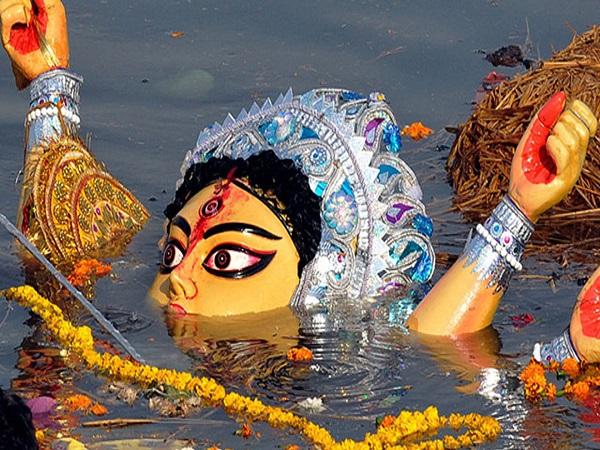
I nodded thoughtfully before continuing, “Yes, festivals like Durga Puja and Ganesh Chaturthi require resources, but their cultural and artistic value is unmatched. Durga Puja, in particular, transcends religious boundaries, embodying spirituality, inclusivity, and a profound connection with mythology, social issues, and modern advancements. Isn’t it remarkable how a festival can seamlessly blend tradition with contemporary concerns? In Bengal, Durga Puja is more than a festival; it’s a fusion of art, spirituality, and technology. The making of the idols, with their pran pratistha ceremony, symbolizes the unification of the divine and the material world. The clay, often sourced from sacred Ganges soil, carries a sacred energy. And did you know soil from near brothels is included, symbolizing inclusivity and breaking societal barriers? What makes Durga Puja even more special is how it brings together people from all backgrounds. Pandals often depict unity through themes that blend Hindu mythology with stories from other faiths, focusing on universal values like compassion and justice. How often do we see such inclusiveness in other cultural events? Durga Puja isn’t just about spirituality; it’s a platform for addressing contemporary issues. Themed pandals in Kolkata tackle gender equality, environmental concerns, and public safety. For example, recent years have seen pandals addressing gender-based violence and climate change. Isn’t it fascinating that a spiritual event is used to bring awareness to urgent social issues? The festival is also a hub for scientific awareness. One pandal portrayed the solar system, drawing parallels between Durga as a cosmic force. Another focused on COVID-19, merging mythology with medical science to inspire trust. The role of technology is another aspect worth noting. Advanced lighting, 3D projections, and augmented reality now transform pandals into immersive spaces. The fusion of technology and traditional craftsmanship creates a unique experience that appeals to all generations. Isn’t it exciting to see such innovation within a centuries-old tradition? Durga Puja also fosters intellectual creativity. Poets and writers contribute, creating stories that resonate with contemporary struggles and triumphs. The pandals themselves are like living galleries of art. Wouldn’t you agree that this celebration elevates human ingenuity to new heights? Importantly, Durga Puja is also embracing eco-friendly practices. Biodegradable materials and solar-powered lighting are becoming the norm, ensuring that the festival’s grandeur doesn’t harm nature. Isn’t it encouraging to see festivals becoming more sustainable? At its core, Durga Puja celebrates divine feminine energy, Shakti, through rituals that symbolize the journey from material to divine. The inclusion of soil from outside a courtesan’s house reinforces the festival’s message of inclusivity—divinity transcending societal boundaries. Doesn’t this show how deeply rooted the festival is in values of acceptance? Durga Puja unites people across religions and social classes. It’s a celebration of creativity and spiritual devotion. And the festival sustains millions of livelihoods—from artisans to vendors, making it a significant contributor to the local economy. Isn’t it remarkable how such a spiritual event can also have such a powerful economic impact? Here, I want to humbly know what your religion speaks of boosting economy of a community?”
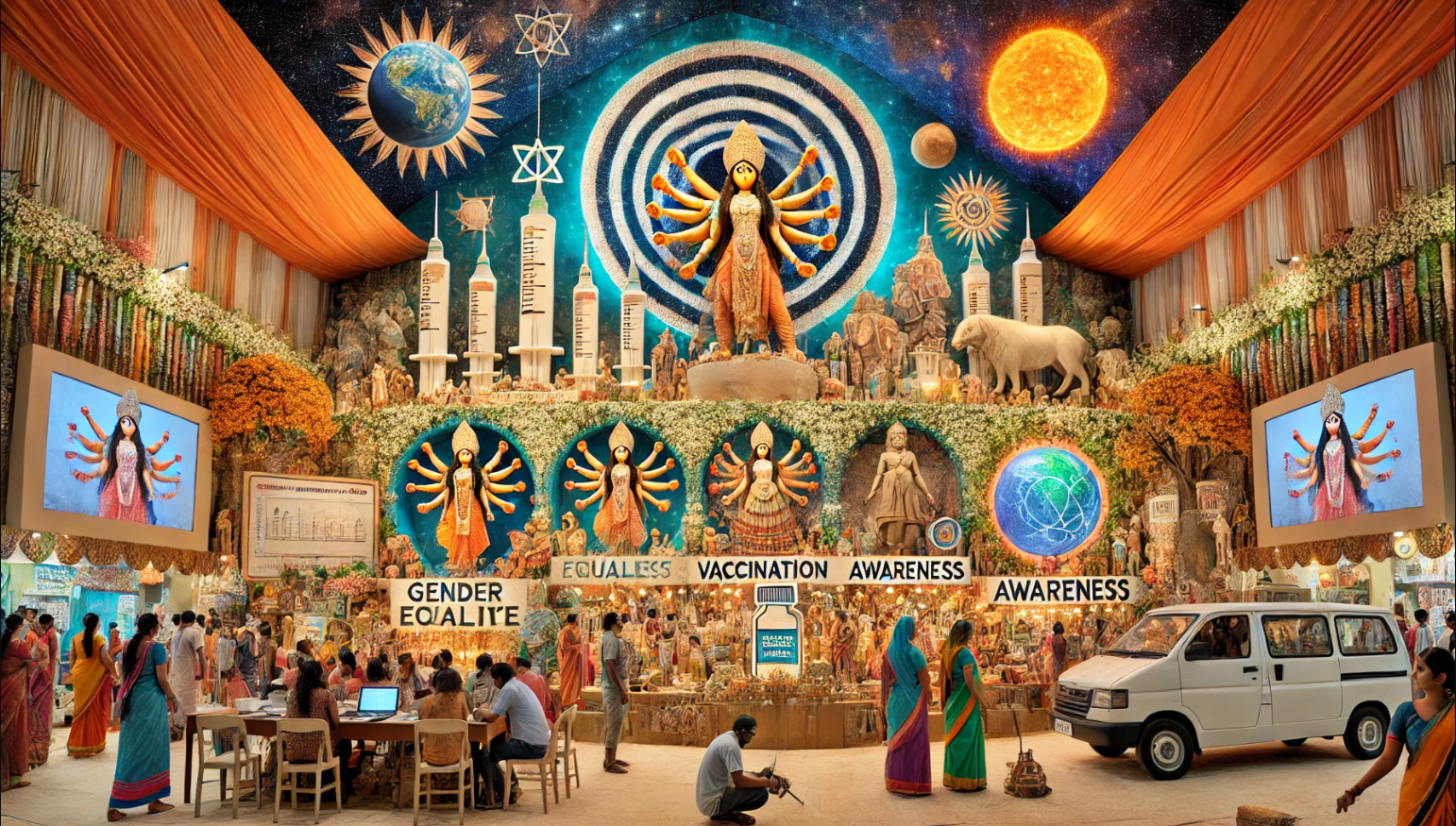
Durga Puja exemplifies how tradition can evolve without losing its essence. While rooted in mythology, the festival constantly reinvents itself, reflecting the aspirations and challenges of contemporary society. This adaptability ensures its enduring relevance, making it a celebration of the past, present, and future. Durga Puja is a reminder of what a festival can achieve when it becomes a platform for blending tradition with innovation, spirituality with inclusivity, and art with activism. It’s a symphony of contrasts—where mythology meets modernity, and individual creativity finds expression in collective celebration. This festival truly embodies the spirit of transformation, proving that our cultural heritage is not static but dynamic, always evolving to reflect the times.”
After engulfing so much, the woman seemed to be brave enough among them who had earlier expressed concern about idol worship spoke again, this time more thoughtfully, “But still… doesn’t all this extravagance contradict the values of simplicity and humility?”
I appreciated her perspective and replied, “The extravagance, when it does occur, is often a reflection of local traditions and cultural practices rather than a strict religious requirement. Hinduism, at its core, teaches balance and harmony, and it is equally important to recognize that not all aspects of the religion are centered around lavishness. In fact, there are many aspects of Hinduism that emphasize simplicity, including the practice of yoga, meditation, and the pursuit of spiritual knowledge.”
Another man, a bit quieter now, asked, “So, is it wrong for someone from another faith to participate in such celebrations?”
I responded gently, “I have already said that. But humbly repeating that again. No, not at all! Hindu festivals, while deeply spiritual, are also cultural celebrations. They invite people from all walks of life to come together in joy, music, dance, and art. If someone from another faith joins in with respect and curiosity, they’re experiencing a rich part of our culture. Religious coexistence isn’t about converting others but about sharing our traditions in a way that fosters understanding and mutual respect.”

A few of the other passengers nodded, reflecting on this idea of mutual respect. I continued, “In Hinduism, we embrace diversity in ways of worship and expression. Some prefer quiet meditation, some seek the form of a deity to connect with, and some engage in artistic expression through rituals. These diverse paths are a reflection of the multifaceted nature of spirituality itself. Ultimately, it’s about sincerity, intention, and the respect for the divine, however one chooses to perceive it.”
The atmosphere on the car had shifted. The tension seemed to ease as the group reflected on the value of cultural and artistic exchange. There was no longer an adversarial edge to the conversation—just an open exploration of different perspectives.
As the ride continued, I could feel a shift in the atmosphere. The initial discomfort and questions seemed to have softened, and I sensed an opportunity to take the conversation to a deeper, more reflective level. I took a moment to gather my thoughts and then gently spoke, weaving in the wisdom of an ancient Bengali teaching:
“There’s a beautiful saying in our tradition: ‘যত্র জীব, তত্র শিব’—wherever there is life, there is Shiva. This concept reminds us that the divine presence is not confined to any single form or group but is universal. When we start seeing others as manifestations of the divine, all divisions—whether of caste, religion, or background—disappear. The differences between Hindu, Muslim, Christian, Jew, or Buddhist, all vanish when we recognize the inherent divinity within each person.”
A thoughtful silence enveloped the group as my words sank in. The conversation, once filled with skepticism, had turned into a space for reflection.
I continued, “Consider the story of Eklavya from the Mahabharata. Despite being from a different clan and rival community, he demonstrated immense dedication and devotion to learning archery, even crafting an idol of his guru, Dronacharya, to receive guidance. This story is a testament to two things: the power of unwavering devotion, and the realization that true strength lies within the self. Eklavya didn’t need external validation; he sought his own inner power, which is a lesson for all of us.”
A few passengers seemed to nod thoughtfully, the tension from earlier moments easing into a kind of calm understanding. I further elaborated, drawing on another powerful lesson: “In the Upanishads, we are described as ‘amritasya putra,’ the children of immortality, meaning each one of us is a vessel of infinite potential. The true purpose of life is to awaken that power within, to realize the divinity that resides in every one of us. This is what true education is about—not merely acquiring knowledge, but awakening the immense power that already exists within.”
The discussion now seemed less about specific religious practices and more about a shared understanding of human potential and mutual respect. I continued, “It’s also important to remember that the core of secularism—the acceptance and respect for all faiths—must be taught from an early age, in schools, and by families.”
A quiet murmur of agreement passed through the group. The concept of secularism, as I explained, wasn’t about disregarding faith but about recognizing that a peaceful, flourishing society can only exist when all people, regardless of their religious background, are treated with dignity and respect.
“Just think about it,” I said, “a society built on mutual respect for different beliefs can create harmony, rather than division. Our differences—whether they are in religion, caste, or background—are part of the richness of our humanity. But if we truly want to thrive, we must understand that the welfare of society depends on the cooperation of all people, regardless of who they are or what they believe.”
The vehicle was now enveloped in a rare stillness. I could sense that the passengers were not only reflecting on my words but also reevaluating their assumptions about difference and unity. The earlier discomfort had dissolved, replaced by a quiet sense of understanding.
In that silence, I could tell that the passengers were no longer merely tolerating each other’s differences—they were beginning to appreciate them.
“To build a peaceful society,” I concluded, “we must embrace diversity, not fear it. We must realize that peace is only possible when we view the world through the lens of respect, when we acknowledge the divine presence in all, and when we actively seek to understand and learn from one another.”
The car was quiet now, the hum of the engine and the distant sounds of the city outside filling the silence. No one spoke for a few moments, but the air felt different—calmer, more open. The journey, once filled with tension, had become a shared moment of reflection, where the values of understanding, respect, and mutual recognition of the divine in each other had begun to take root.
As I stepped out, the driver turned to me.
Driver: “You speak well. May your God guide you.”
With a nod, I walked away, my mind heavy with the lingering thoughts of He and the debate. As I reached home, I instinctively reached for the scarf I had collected earlier but found it missing. A pang of disappointment struck me. Had I dropped it? Or had it vanished, like He himself?
My heart raced as I realized this was no coincidence. He’s mysterious ways had left me with more questions than answers, yet his presence lingered, guiding me to explore deeper truths.
Date: Sunday, 25 August
Time: 1:08 AM, Mid Night
The night felt charged with the echoes of the divine, the debate, and the mysterious journey I had begun. As I placed my bag carefully on my desk, a sudden thought again struck me: perhaps the scarf had merely returned to the wind, where it belonged—just as he had.
I slumped into a chair, the fire of my anger giving way to an aching hollowness. Despite all the wisdom I had gained from Amurtya Maharaj and my visit to the temple, this encounter felt like a betrayal of everything I had come to believe. It was as if the universe itself mocked my attempts to grasp its truths, like a poorly executed experiment yielding results that defied all known theories.
The room around me mirrored my turmoil. The old clock ticked with an impatient, grating rhythm, reminiscent of the slow degradation of unstable isotopes, each second a reminder of impermanence. The walls seemed to close in, their shadows stretching ominously in the dim light, like the intricate, incomprehensible patterns of electron clouds in quantum chemistry—beautiful yet chaotic, impossible to fully grasp.
I have successfully returned home after so much tiredness and experience in just less than 24 hours, seeking solace in the simplicity of routine—a light dinner, a cup of tea, and a moment of quiet to steady my restless mind. Yet even this modest comfort seemed out of reach. My newly employed cook, a man with the demeanor of someone perpetually in the thrall of divine orders, stood before me with a placid expression.
ring me some tea,” I had requested, the weight of the day pressing down on me, my head heavy with the residue of unanswered questions.
“No tea,” he replied with an unyielding calm. “Krishna, our Malik does not approve. Tea is not sattvik.”
His words landed like a cold slap, the term malik reverberating through my mind. It felt alien, out of place, as though it had wandered into the sanctum of my thoughts from an entirely different cosmos. To hear Krishna, the mischievous, playful, and deeply intimate friend of our tradition, reduced to malik—a distant, sovereign overseer—was an affront to everything I understood about our relationship with the divine.
“Yes, yes,” I snapped, the frustration boiling over like a hot tea in pan or an unstable reaction in a poorly controlled experiment. “Go on, keep reshaping Hinduism in the form of Islam and Christianity. Turn Krishna into a distant malik, an accountant of sins and virtues, instead of the beloved friend who shares our joys and sorrows.”
The words left my lips with a sharpness I hadn’t intended, but I didn’t regret them. His silence, heavy and unbroken, only deepened the dissonance. The room seemed to freeze in the wake of my outburst, the shadows on the walls growing longer, darker, as if reflecting the chasm between us—a divide of interpretation, of belief, and of what it meant to connect with the infinite. Outside, the wind howled like a wounded creature, rattling the windows as if echoing the discord within me. I gazed out into the fading twilight, where the trees swayed violently, their bare branches clawing at the sky—a sky that offered no answers, only an indifferent expanse of gray. It reminded me of my organic chemistry book’s cover page- the chaotic interplay of molecules in a gas, each one driven by unseen forces, colliding aimlessly yet inevitably, bound by the unyielding laws of entropy.
My mind churned with questions I couldn’t resolve, like a chemist grappling with an elusive compound that resists synthesis. How could people distort something as pure as spirituality into rigid rules? Why was the divine, meant to liberate, so often turned into a tool of control? Despite the profound teachings I had heard, my real-world encounters with religion and spirituality left me more disillusioned than enlightened. The juxtaposition of ideals and reality gnawed at my soul.
I thought of an old experiment from my studies—the Belousov-Zhabotinsky reaction, a chemical oscillator that defies intuition by cycling between order and chaos. It was mesmerizing to watch as the reaction shifted between bright colors, yet it carried a deeper truth: even in systems governed by laws, chaos is inevitable, and balance is fleeting. Was my spiritual journey just another oscillation, doomed to repeat the same cycle of hope and disillusionment?
I felt like a sailor lost at sea, navigating between the serene wisdom of distant shores and the relentless storm of everyday contradictions. The temple visit had been a beacon of hope, like the theoretical beauty of a perfectly balanced chemical equation. But now, sitting here, I was adrift again, the light obscured by thick clouds of doubt and despair—an unstable compound, on the verge of decomposing into fragments.
The room’s air seemed heavy, saturated like a solvent approaching its saturation point, teetering on the edge of crystallization. My thoughts were like unbonded radicals, reactive and destructive, seeking stability in a chaotic environment. Yet, even in my frustration, a part of me clung to the possibility of synthesis—a hope that, from the chaos, a new understanding might emerge.
But for now, I was caught in the in-between, a transitional state with no equilibrium in sight.
But still, regret clawed at me as I was sitting, the loss of the holy scarf weighing heavily on my mind. It had been more than just an object; it was a symbol of the day’s fleeting moments of clarity, a tangible reminder of my connection to something greater. The ache of its absence felt like a metaphor for my own spiritual disarray—a misplaced fragment of meaning in the chaos of existence.
Helplessly I stared blankly out the window, the growing twilight deepening the shadows of my thoughts. Then, as my gaze lowered, something caught my eye. Beneath the window grilles, there it was—THE SCARF!!, slightly crumpled but radiant in its simplicity. My heart leapt, and for a moment, the fog of despair lifted, replaced by a stunned, grateful silence.
Beneath the scarf lay another surprise: a dusty stack of books I hadn’t noticed before. I pulled them out, and my breath caught when I read the title—VEDA MIMANSA by Sri Anirvan, three volumes in Bengali. These must have belonged to my grandfather, a man I admired but never truly understood.
Time: 1:45 AM, Mid Night
Flipping through the pages, I stopped at a passage discussing Amurtya (formless divinity) and its contrast with Murtya (divinity with form). The concept felt like a revelation, bridging the abstract and the concrete, echoing the struggle within my soul—a profound whisper from the past, urging me to reconcile the opposites within myself.
Amurtya vs. Murtya in Sri Anirvan’s Teachings: Review of “Mur” Deva from Veda Mimansa- Volume II
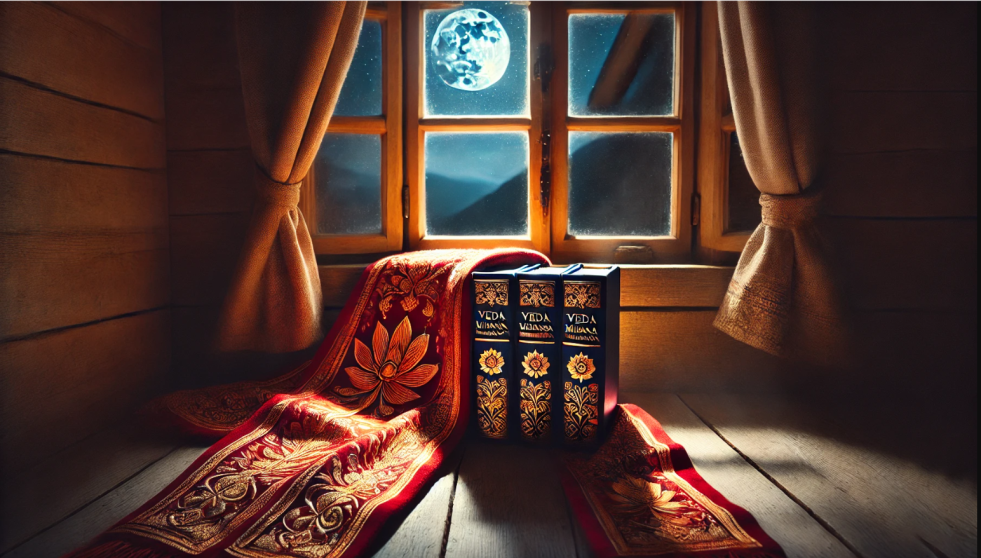
Sri Anirvan, in his seminal work Veda Mimansa – Volume II (Page: 256), undertakes an in-depth exploration of the nature of deities, focusing on their forms, qualities, and actions. He begins by addressing the concept of form, noting that while the Vedas seemingly present a plethora of deities, closer analysis reveals a stronger emphasis on their inherent similarities rather than their outward differences. Anirvan emphasizes that diversity lies in their external forms, but unity persists in their underlying essence. To elucidate this, he draws an analogy: just as all humans share a common essence despite individual differences in form, the deities too embody one essence manifesting in various forms. This principle resonates with the Vedic proclamation, “Ekam sad vipra bahudha vadanti”—the wise declare the same truth in manifold ways [1].
Anirvan further explains that when the deity is singular, he is referred to as Divya Suparna, the radiant bird of the sky, or Aditya. In contrast, in his formless and non-dual essence, he is called Ekamsam. The Āraṇyakas describe two distinct paths to attain the supreme realm. The first path, associated with Agni, Indra, Mitra, and Varuṇa, represents the external vision (Parāk) and aligns with the sky or void. The second path, linked to Agni, Mātariśvan, Āditya, and Yama, symbolizes the internal vision (Pratyak). This internal journey finds further reference in the Kaṭha Upaniṣad (2.2.15), which describes a realm that is beyond fear and indescribable in nature [2].
Challenging the perception of polytheism in the Vedas, Anirvan posits that it is, at its core, an extension of Advaita (non-dualism). Despite the multiplicity of forms, the sages consistently maintain an awareness of the deities’ true essence. He underscores the ultimate spiritual goal (Puruṣārtha): the unification with the divine through the elevation of consciousness. Symbolically, the Samhitās describe this unification as reaching the sun by ascending through the upper flame of the terrestrial fire—moving from darkness to the northern light, and ultimately to the supreme light or the sun. This idea is encapsulated in Ṛg Veda (1.50.10) and reiterated in the appendix of the Sāmaveda Āraṇyaka songs, where the Udbhayāmeka (the source of Sāma) signifies its importance.
In the Brāhmaṇas, this process is termed Lokottaraṇa (transcendence of the world), while in the Upaniṣads, it is referred to as Utkraanti (spiritual ascent). Regardless of the forms of deities, the singular vision of one sun symbolizes the essence of Vedic non-dualism (Advaita) [3].
Further Sri Anirvan delves into the essence of deities, exploring their characteristics and their profound connection with natural phenomena. He suggests that the attributes and experiences of deities can be discerned through direct interaction with nature, as seen in elements such as the sky or the sun (Āditya). These natural manifestations, Anirvan argues, serve to elevate and inspire human consciousness, akin to the transformative experience of a poet. This expansion of consciousness fosters a sense of unity with the deity, which Anirvan identifies as the ultimate human purpose. The state of Sāyujya (union) signifies an eternal connection with the divine, transcending all distinctions. This is illustrated through Ṛg Veda (1.164.20) and its resonance with the Mundaka Upaniṣad (3.1.1) and Kaṭha Upaniṣad (4.6), where the metaphor of two birds sitting on the same tree symbolizes the unity of the self with the supreme. The sentiment is beautifully encapsulated in the declaration: “O Indra, by being united with you, we become victorious” (Ṛg Veda 4.40.5; 5.62.1).
This realization is further described as an encounter with an indescribable realm—where, at sunrise and sunset, the horses of the sun are released, the sun’s thousand rays converge into one, and the one supreme deity, the wonder among wonders, resides. This is the realm “where the eternal light shines” (Ṛg Veda 9.113.7; Taittiriya Upaniṣad 10.139.1) and where the “supreme light among all lights” (Ṛg Veda 10.170.3) reveals itself. Anirvan notes that the Samhitās frequently discuss the conquest of the sun, symbolizing the attainment of this supreme realization.
This profound realization leads the individual to a state of vastness, equating one’s consciousness and soul with Brahman. The realization aligns the inner self of the individual with the essence of Āditya. Anirvan references the Aitareya Upaniṣad (3.3) to elucidate the challenge of grasping this truth through conventional means, as illustrated in the verse: “He tried to catch it by SPEECH. But it was not possible to catch it by speech. For indeed, were he able to seize it by speech, then merely by talking about food, we would have been satisfied!”
The synthesis of name and form, and their unity with the ultimate reality, is elaborated in the Mandukya Upaniṣad (verse 2) and Shankara’s introductory remarks. Shankara explains that while the name (Aum) and the object signified by it are one, the Śruti emphasizes the primacy of their unity. He remarks: “The quarters (Pādas) are the letters of Aum (Mātrā), and the letters are the quarters.” This profound insight seeks to remove the duality between name and form, establishing the nature of Brahman as transcendent to both. Shankara underscores the purpose of this knowledge: to dissolve the illusions of separateness and affirm the non-dual nature of Brahman [4].
The attainment of one’s chosen deity is equated with the realization of the supreme light. Vedic worship, therefore, seamlessly integrates the veneration of deities with the worship of light, thereby diminishing the focus on physical idols. The Vedic texts emphasize that deities are Amūrta, signifying their formless nature or existence as pure consciousness. This concept is substantiated through various references in the Ṛg Veda [5]. Sri Anirvan elaborates on this principle, associating it particularly with Agni, who is described as Amūrta. While deities are not directly visible during sacrificial rituals, Agni, as the mediator who brings the deities and carries offerings to them, is perceptible [6].
In this context, Anirvan also discusses Puramdhi, a term denoting “one who harms wholeness (Pūrṇatā).” Although commonly depicted as female and often likened to Lakṣmī, Anirvan highlights that, in specific contexts, Puramdhi assumes a male form and is associated with Indra. This connection is evident in a hymn dedicated to Indra [7].
Agni’s role further illustrates the distinction between the physical fire, which serves as a symbol, and the deity itself, which remains formless, as captured in the term Amūrta. Anirvan also references Yāska’s assertion that Amūr means “not deluded” (Nirukta 6.8). This interpretation aligns with Ṛg Veda 10.4.4: “Mūra amara, the wise, do not perish; Agni, you are self-existent.” The mantra underscores knowledge and awareness, interpreted as: “We are not deluded; you, Agni, are the great one.”
Yāska’s interpretation has been widely adopted, including by Geldner, who integrates it consistently in his analysis. However, the etymological roots of Mur remain contested. Some scholars trace it to the root v muh but note that the voiceless form of the aspirate sound is atypical, potentially indicating a dialectical exception. While some interpret Mur as “mortal,” phrases such as “deluded mortal” or “root” fail to adequately capture the intended meaning, particularly in the term Muradeva. Consequently, the precise meaning remains elusive and continues to invite scholarly inquiry.
Sri Anirvan further elucidates that while deities are formless, they are not entirely devoid of form or shape. This nuanced distinction is illustrated by Yāska in the seventh chapter of Nirukta, where the forms of deities are deliberated. Initially, it is acknowledged that deities possess forms. The debate then focuses on whether these forms are akin to human forms. One perspective suggests that deities do resemble humans, as they are praised and invoked as conscious beings with descriptions of their limbs and actions comparable to human characteristics. Conversely, another viewpoint posits that deities such as Agni, Vāyu, and Āditya, while described as conscious entities in the hymns, do not possess human-like forms. Yāska reconciles these seemingly opposing views by asserting that while deities are distinct from humans in form, they embody the inner spirit or the immanent force governing all actions, both human and divine. This understanding underpins the narrative constructs surrounding deities.
For example, in the worship of Agni, the Apuruṣabidhvāda perceives a direct transition to pure consciousness through the visible fire, whereas the Puruṣabidhvāda may conceptualize an intermediary, human-like form of Agni. However, neither perspective substitutes the visible fire with an anthropomorphic representation of the deity. Both views ultimately converge on the notion that the deity remains Amūrta or formless. Yāska’s integration of these perspectives reflects a profound comprehension of spiritual consciousness.
The Puruṣa Sūkta further elaborates on this principle, with the sage Nārāyaṇa identifying the supreme deity as Puruṣa. Through the sacrificial ritual (Puruṣamedha), the mortal sacrificer attains divine status, becoming akin to the sun (Sūrya). The sage proclaims: “I have known this great Puruṣa, who shines beyond darkness, the one who, knowing him, transcends death; there is no other path.” Here, both the supreme deity and the sun are described as Puruṣa.
The Upaniṣads provide a dual portrayal of this Puruṣa, depicting both form and formlessness. In certain passages, Puruṣa is described as divine, devoid of mind, life force, or form, and invisible to any physical eye. Conversely, in other passages, Puruṣa is presented as resplendent, with golden beard and hair, embodying an auspicious form. Additionally, this Puruṣa is described as residing within the heart as a thumb-sized light, akin to the sun. The Puruṣa in the sun and the Puruṣa within the heart are revealed to be one and the same.
Sri Anirvan further analyzes this dual aspect of Puruṣa—form and formlessness—as expounded in the Bṛhadāraṇyaka Upaniṣad. He explains that Brahman manifests in two forms: the tangible (Murta) and the intangible (Amūrta). The tangible form is mortal, immovable, and real, while the intangible form is immortal, mobile, and transcendent. From a divine perspective, the tangible essence is represented by the sun (Āditya), while from a spiritual perspective, it is symbolized by the eye. Similarly, the essence of the intangible is represented by the person within the sun and the person within the eye.
The intangible Puruṣa is described using metaphors, such as lightning, a lotus, a flame, an insect, or turmeric-stained cloth, emphasizing its elusive and transcendent nature. The phrase “Neti Neti” (not this, not this) encapsulates the impersonal essence of the formless Puruṣa. However, the Chāndogya Upaniṣad presents an alternative depiction, portraying the Puruṣa in the sun as personal, thus highlighting the coexistence of both personal and impersonal dimensions within the supreme reality [9].
Sri Anirvan further elaborates on the concept of the vital force, describing it as the Brahman perceived by those who have forgotten their true identity with the singularity of the Absolute Brahman. This forgetting, according to him, is the root cause of their ignorance. He explains:
“That Brahman of the ignorant is thought to have material attributes, both gross and subtle. That Brahman with material attributes is being described here, but it will finally be stated that the True Absolute Brahman is not this (vital force or Brahman with attributes) [10].”
This distinction between Brahman with attributes and the Absolute Brahman forms a crucial point in understanding the metaphysical duality perceived by the ignorant. Anirvan emphasizes that the Brahman associated with material attributes serves as a stepping stone in the spiritual journey, ultimately leading to the realization of the Absolute, formless Brahman.
In concluding his discussion on the concept of Amūrta (formlessness), Sri Anirvan provides insights into the practices of the early Aryans, who, despite worshiping deities, did not initially engage in idol worship. He explains that these deities were not associated with physical forms, and as a result, there were no permanent temples dedicated to their worship. Instead, temporary sacrificial altars were constructed at the behest of the Shrautashākhas. These altars were devoid of idols, though meditative contemplation of the deity took place during rituals.
Those who rejected the deities were met with disapproval by believers and were pejoratively labeled with terms such as ‘A-deva,’ ‘Anindra,’ ‘Deva-nid,’ and ‘Ayajña.’ Additionally, there was animosity towards a distinct group referred to as ‘Anta-deva,’ or worshippers of false deities. Among these so-called false worshippers were the ‘Mura-deva’ and ‘Shishma-deva,’ terms whose precise meanings remain a subject of scholarly debate.
Time: 3:30 AM, Mid Night
Murari’s Blessing: A Final Embrace of Memory and Faith
Puff!!! So…it had already crossed the midnight! To take a break and continue with the next section, in my dimly lit room as I scoured my room for the small, glowing stone and the tiny vial of holy ash from the previous evening, my eyes landed on something unexpected. There, atop my well-worn copy of “My Little Krishna Book”, lay the cherished items, where I have already placed the items when I entered my home hurrily. The stone seemed to pulse with a quiet glow, and the vial, carefully sealed with a piece of red cloth, exuded an aura of sacredness. A wave of nostalgia washed over me as I held the book, remembering how its stories once filled my childhood with wonder.
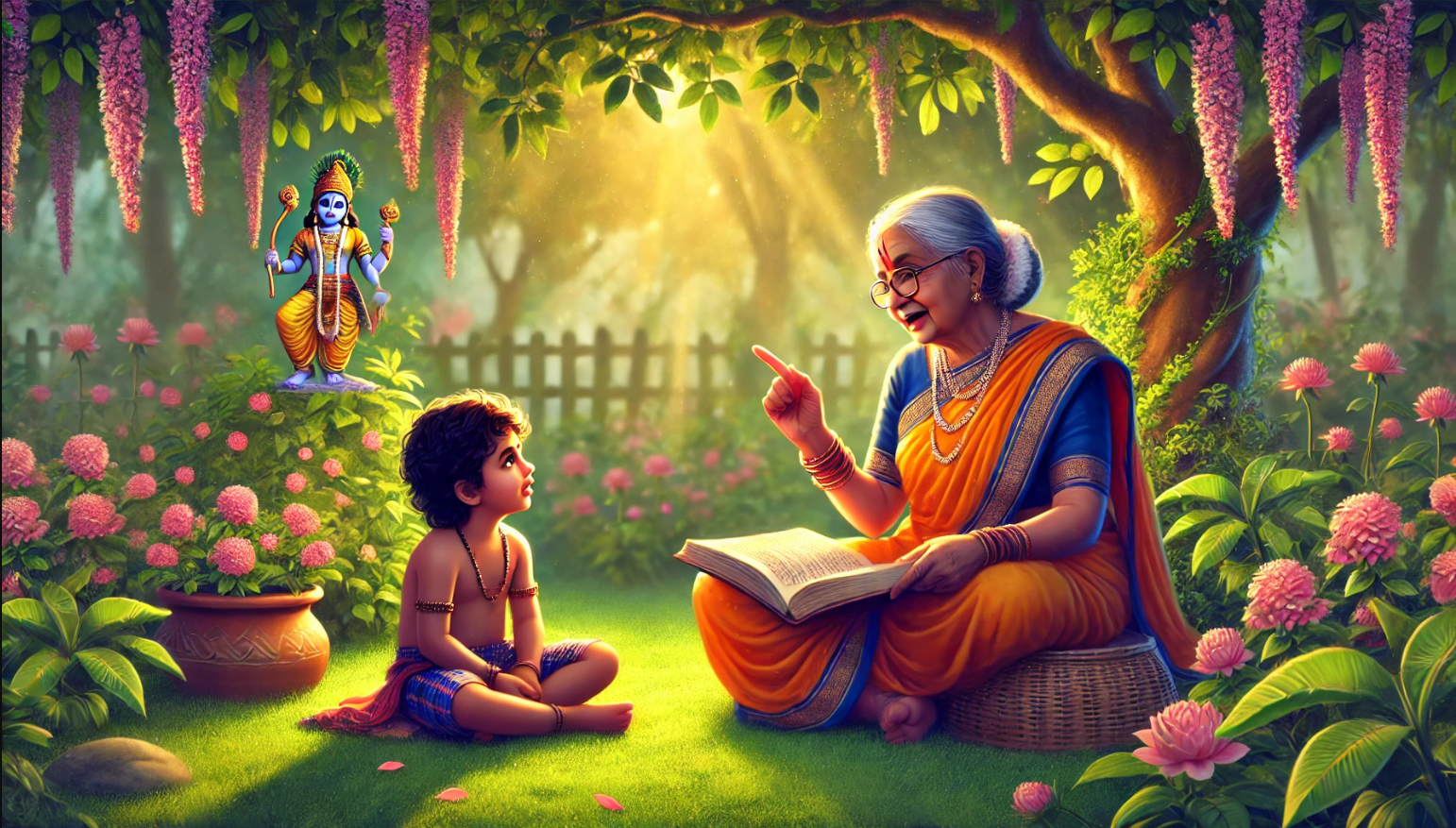
I couldn’t help but smile as I flipped through the familiar pages, stopping at the story of Mura the demon and Krishna, the formless one, who became known as Murari after slaying Mura. Memories of my grandmother’s gentle voice filled my mind. She used to narrate this tale to me, her words weaving a magical tapestry that brought the story to life.
e: “Granny, who is Mura? Why is Krishna called Murari?”
Grandmother: “Ah, my little one, Mura was a mighty demon, the commander of the armies of Narakasura, the cruel king of Pragjyotishpur. Narakasura had kidnapped 16,100 beautiful women and kept them in a grand city atop the Mani Mountain, guarded by Mura.”
Me: “But why did Krishna have to fight him?”
Grandmother: “Narakasura’s evil deeds troubled both gods and humans, but the final straw was when he stole the divine earrings of Aditi, the mother of the gods. Lord Indra pleaded with Krishna to defeat Narakasura.”
Me: “And Mura tried to stop Krishna?”
Grandmother: “Yes, child. As Krishna and Satyabhama flew on Garuda to Pragjyotishpur, Mura stood in their way. He was fierce, with five heads and a formidable army. Mura lunged at Garuda, but Krishna’s might was greater.”
Me: “Did Krishna fight him alone?”
Grandmother: “Indeed, Krishna fought valiantly. Mura came with his five heads, breathing fire and fury, but Krishna struck him down with his Sudarshan Chakra. The battle was fierce, but Krishna emerged victorious.”
Me: “What happened after Mura’s death?”
Grandmother: “After Mura fell, his sons sought revenge. One after another, they charged at Krishna, but none could withstand his divine power. Thus, Krishna was called Murari—the slayer of Mura.”
Me: “Granny, why do they call Krishna ‘the formless one’ if he fought like a warrior?”
Grandmother: “Ah, that is the beauty of Krishna, my dear. He is both Amurtya, the formless divine essence, and Murtya, the one who takes form when needed. He is everywhere, yet can appear before us. That’s the magic of Krishna.”
Her words had always filled me with awe, and even now, as I read the story, it felt like she was right there beside me, guiding me through the complexities of divinity with her timeless wisdom.
Time Stops: 3:59 AM, Mid Night
References:
ঈশ্বরদর্শন — সাকার না নিরাকার?
মূর্তিপূজা নয়, মৃণ্ময় মাঝে চিন্ময় দেখি
Maramia – জিজ্ঞাসা :— ‘ভগবান’ কি মানুষ শরীরেই আসেন নাকি অন্য জীব… | Facebook
Maramia – মন্দির মাহাত্ম্য জিজ্ঞাসু :— আমরা বলি ‘অমুক মন্দিরে… | Facebook
Apu Ray – ভালোবাসা – এক অমূর্ত ধারণা, যা কবিতা, গান, গল্পে বারবার… | Facebook
প্রতিমা প্রাকৃতিক, উপাদানের হতে হয়… – Dr. Kushal Baran Chakraborty | Facebook
বান্না মজুমদার – আমি দূরে তাকিয়ে আছি। সেখানে, যেখানে মেঘ আর… | Facebook
Maramia – মন্দির মাহাত্ম্য জিজ্ঞাসু :— আমরা বলি ‘অমুক মন্দিরে… | Facebook
শ্রী সৌরভ দেবশর্ম্মা | Facebook
Nazmun Nahar – ভালোবাসা- এক অমূর্ত ধারণা, যা বিভিন্ন ভাবে বর্ণিত… | Facebook
Maramia – মূর্তির মাটি জিজ্ঞাসা :— মা দুর্গার মূর্তি বানাতে… | Facebook
Maramia – * বেদ ও কোরানের সার্বিকতা * (দ্বিতীয় পর্ব) জয়দীপ… | Facebook
Bollywood’s passive-aggressive attitude towards Hinduism | by Amrit Hallan | Medium
” ব্রহ্মই কালী ও কালীই ব্রহ্ম… – মাতৃশক্তি। MATRI SOKTI | Facebook
রামমোহনের ব্রহ্মসংগীতে ‘দেবতা’… – Dr. Kushal Baran Chakraborty | Facebook
