
AnalysisHistory, Society & CultureNationalismPolitics & Current Affairs

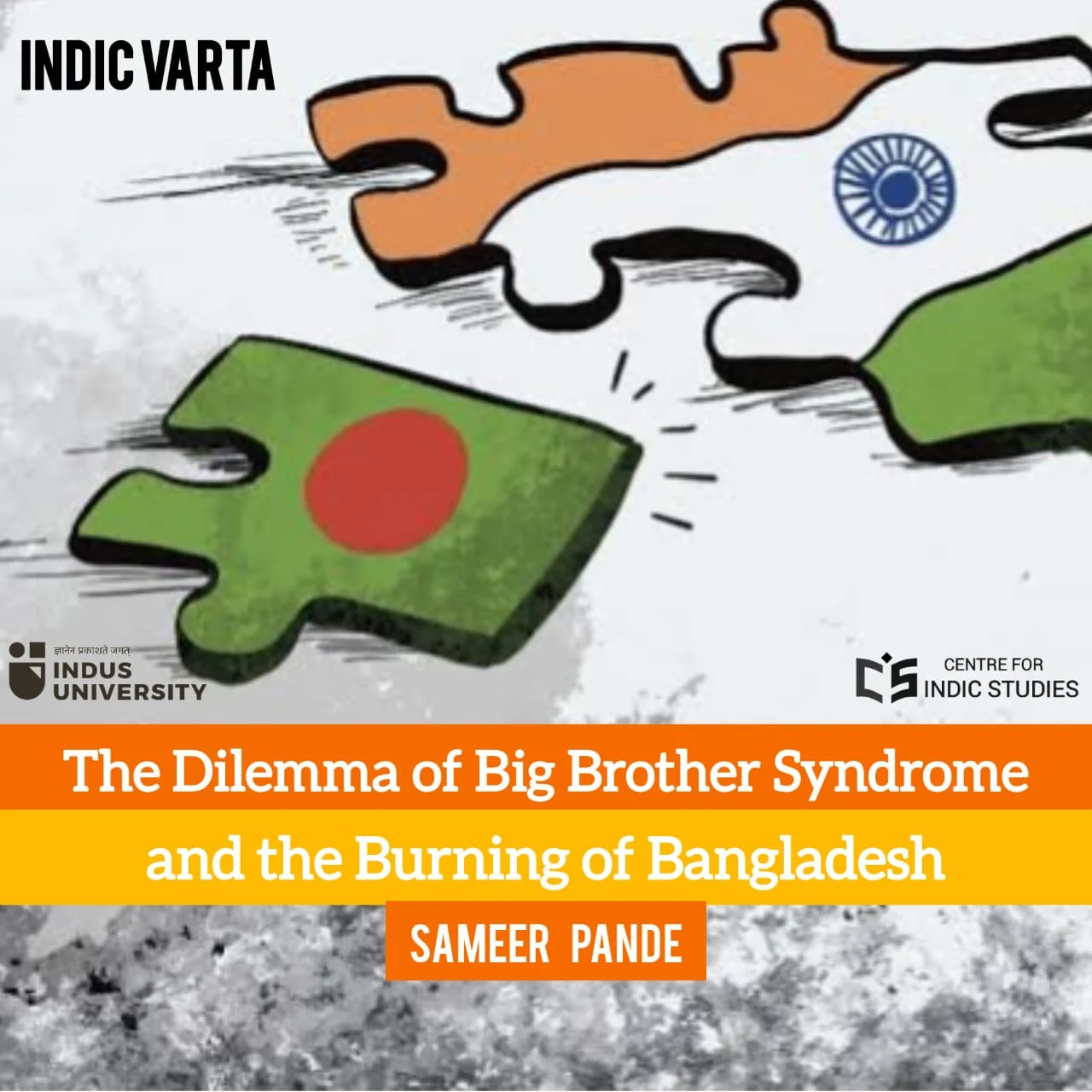
The Dilemma of ‘Big Brother Syndrome’ and the Burning of Bangladesh

January 9, 2025April 16th, 2026No Comments

The world allows power to act, but asks Bharat to explain.
Others defend history with force; India is told to defend morality with silence.
The question is not why Hindus suffer—it is why Bharat is restrained from responding.

Introduction

Perhaps, the most important question of this time in South-Asian geopolitics is to ask why the head of a state had to flee her own nation? Is there anything that India could do? Would it happen if India would have been ‘Bharat’? Is this the right time to break the shackle of ‘Big Brother Syndrome’ and do what is needed? The important argument is the question to understand why the USA or Russia or Israel take impactful steps going on a full ‘warlike mode’ in international politics. The USA uses its own constitution as an extension of world politics. Russia, safeguarding her sovereignty in the historical sanity in the dream of USSR 2.0, boldens the stand day by day. In the name of security and justice, historicity is twisted and turned and retwisted in the global forum by Israel, which doesn’t stop it from counterattacking its neighboring terrorist groups, and here we are, at the helpless sight of Hindu genocide in Bangladesh despite knowing that it is only Bharat that will care for the safety and security of like-minded and our own people. The question is ‘why’— why India is not allowed internally and externally to participate in the South-Asian issues? The reason is the narratives set against India and this is the title project ‘Big Brother Syndrome’.

The phenomenon of the ‘Big Brother Syndrome’ has often been used in international relations to describe a situation in which a dominant nation exercises significant influence over its neighbors or less powerful counterparts. This syndrome manifests itself in complex political, economic, and cultural relationships, where the dominant nation is often viewed as both a protector and a bully. In the context of South Asia, the term is often applied to describe India’s role in regional politics, especially as it pertains to its smaller neighbors.

The central question that arises, however, is why, despite its historical, cultural, and geographical proximity to the countries of South Asia, India remains marginalized or constrained in its ability to assert influence or intervene decisively in regional issues, after all she is the motherland of all the South-Asian nations and not because of Britishers rule but counter to that. Why does India, a rising global power, often find itself unable to play a more proactive role in the protection of ethnic and religious minorities, such as the Hindus in Bangladesh? And what does this reveal about the power dynamics of international relations and the constraints placed on India by both internal and external forces?

The ‘Big Brother Syndrome’ is a term used to describe a situation where a larger, more powerful state exerts a paternalistic influence over smaller neighboring states. In this dynamic, the smaller nations may feel the pressure of political, military, and economic control or guidance from the larger power, often resenting it as an imposition on their sovereignty. In a way, the smaller countries are caught between their desire for autonomy and the inevitability of being affected by the policies and actions of their larger neighbor.

The term, when applied to India, refers to the perception held by some smaller South-Asian nations—such as Nepal, Sri Lanka, Bangladesh, and Bhutan—that India’s size, power, and historical legacy in the region lead to an overpowering influence in their domestic and foreign policies. This syndrome is complicated by both the benevolent and coercive aspects of India’s relationships with these countries. India is often expected to act as a regional leader and protect the security and welfare of its neighbors, but at the same time, it is accused of overstepping its boundaries or using its power in a way that undermines the sovereignty of smaller nations.

India’s Historical and Geopolitical Context

India’s role in South Asia has been shaped by a variety of historical, cultural, and geopolitical factors. Historically, the Indian subcontinent has been a central force in shaping the political and cultural fabric of South Asia. From the Maurya and Gupta empires to the British colonial period, India has long been a dominant power in the region, influencing trade, culture, religion, and governance.

When India gained independence in 1947, the boundaries of the new nation were drawn with little regard for ethnic, cultural, or religious divisions, leaving behind a complex web of political and security challenges. In the decades following independence, India found itself at the crossroads of regional and international politics. As the dominant power in South Asia, India sought to maintain its sovereignty while addressing the security concerns posed by neighboring countries. However, this led to tension with countries that were either wary of Indian dominance or felt that their sovereignty was being undermined by India’s regional assertiveness.

The role of India as the “big brother” in South Asia was cemented during the Cold War when India aligned itself with the Soviet Union, while Pakistan and China sought to align with the West. India’s involvement in the 1971 Bangladesh Liberation War, where it supported the creation of Bangladesh and helped defeat Pakistan, is one of the defining moments of its regional influence. However, it also created a narrative of India as a force to be reckoned with in South Asia, leading to both admiration and resentment from neighboring states.

However, for political analysts to understand this, it is imperative to understand the role of the USA, Western academia, and Indian academicians under foreign payroll in the name of scholarship, and that this is the narrative that has constrained Indian influence in the South Asian region.

The Constraints on India’s Regional Engagement

Despite its size, military strength, and economic potential, India faces significant internal and external constraints on its ability to engage actively in South Asian affairs. Externally, these constraints are largely driven by the strategic interests of other global powers, as well as the delicate balance of power within the region.

  1. First comes the influence of major powers and the narratives they set. Both the United States and China, two of the most powerful nations in the world, have significant interests in South Asia, and their strategic engagements often serve to counterbalance India’s regional dominance. For instance, the U.S. has forged strong alliances with Pakistan for much of the Cold War and the War on Terror, creating a space where Pakistan could challenge India’s influence. Similarly, China’s growing presence in Sri Lanka, Nepal, and the broader Indian Ocean region is seen as a way to counterbalance India’s influence and secure its strategic interests, including access to key maritime routes and resources.
  2. Second is the regional dynamics. The relationships between India and its neighbors are fraught with historical tensions, territorial disputes, and political complexities. For example, India’s relationship with Pakistan is heavily influenced by the unresolved Kashmir dispute, leading to a highly charged atmosphere that makes regional cooperation difficult. Likewise, India’s attempts to assert itself in Sri Lanka, Nepal, or Bangladesh often meet resistance due to local political dynamics and the desire for autonomy. Smaller nations in South Asia, while recognizing India’s economic and military strength, often seek to balance this power by fostering relationships with external powers such as China, the USA, or Russia.
  3. Third is the internal political constraints. Internally, India’s policy towards South Asia has been influenced by its own political dynamics, including concerns over minority rights, religious tensions, and ideological divides. There is a considerable domestic constituency that is wary of engaging too aggressively in regional affairs, especially when it comes to issues involving ethnic or religious minorities. For example, India’s government has often been criticized for its failure to act decisively in cases of ethnic or religious violence within neighboring countries, such as the ongoing plight of Hindus in Bangladesh. This political hesitation stems from domestic concerns about fostering tensions within India’s diverse population and the potential repercussions for its internal stability.
  4. And, the fourth is the narratives of Indian intervention. There is also a narrative within South Asia that India is an overbearing neighbor, motivated by its own self-interests rather than a genuine concern for the welfare of its neighbors. These narratives have been created in the name of ‘big brother syndrome’. This perception has been reinforced by a few events such as India’s intervention in Sri Lanka in the 1980s, where its military presence was met with resistance and resentment, but neglecting the welfarism that India does in the region. As a result, any Indian attempt to take a more active role in regional affairs, whether in addressing the plight of minorities or mediating in conflicts, is often viewed with suspicion or outright hostility by other South Asian states.

India and the Question of Hindu Genocide in Bangladesh

One of the most poignant questions in the current geopolitical climate is why India has not taken a stronger stance in the face of the alleged persecution of Hindus in Bangladesh, despite being the natural protector of Hindu minorities in the region. The situation is particularly tragic given India’s shared cultural and historical ties with Bangladesh, as well as the significant Bengali Hindu population that resides in India.

India’s apparent inaction can be attributed to a combination of diplomatic considerations, the delicate balance of regional relations, and the fear of inflaming tensions with Bangladesh, which has long been wary of India’s influence. The international community, too, has largely remained silent on the issue, in part due to the global push for stability in South Asia and concerns over the economic and security implications of a more interventionist Indian foreign policy.

This situation highlights the limitations of India’s soft power and the ‘Big Brother Syndrome’. While India may be seen as a natural leader in the region, it is unable to assert itself as a protector of minorities in neighboring countries without risking its own domestic and international standing.

The Need for a New Paradigm: Breaking Free from the Big Brother Syndrome

Historically, Bharat (ancient India) never engaged in imperial or colonial conquests in South Asia or Southeast Asia. Instead, it fostered a model of interconnectedness and mutual enrichment through cultural exchange, trade, and spiritual influence. Unlike European colonial powers, which imposed their rule with coercion and exploitation, the Indian subcontinent’s engagement with its neighbors was characterized by peaceful assimilation and shared values. The spread of Indian culture, language, religion (particularly Buddhism, Hinduism, and Jainism), and governance systems in regions such as Southeast Asia and Central Asia was largely a result of trade and the voluntary adoption of Indian ideas and practices. Historical records, such as those from ancient Sri Lanka, Thailand, Cambodia, and Indonesia, demonstrate the profound impact of Indian culture, without the exploitation or domination that colonialism entailed. India’s ethical and cultural philosophy, based on non-violence, respect for life, and the concept of Dharma, guided its interactions, making them far more inclusive than coercive or exploitative.

This non-colonial legacy is important to emphasize because it contrasts with the perception of India as a ‘big brother’. India’s regional leadership, far from being one of dominance, is rooted in the principles of mutual respect and cultural exchange, which should be the basis of its engagement with its neighbors today.

Understanding the Colonial Legacy and the Divide and Rule Effect

The colonial period, under British rule, left a lasting psychic and political impact on South Asia. The British implemented the divide and rule strategy to fragment regional unity and foster animosity between various ethnic, religious, and cultural groups. This strategy not only weakened the subcontinent but also created lasting divisions that continue to haunt the region. For instance, the British deliberately exacerbated tensions between Hindus and Muslims, while drawing arbitrary borders in the process of partition that created enduring hostilities between India and Pakistan. This colonial-era legacy of division still influences contemporary geopolitics, where India’s neighbors sometimes view its regional influence with suspicion, influenced by the historical experiences of British imperialism.

Thus, the ‘Big Brother Syndrome’ in the Indian context, if anyone believes it to be true, is not an intrinsic reflection of the Indic approach, but a byproduct of this colonial legacy. The Indian subcontinent’s history of peaceful coexistence and cultural fluidity is often overshadowed by these colonial-induced narratives of division. These historical wounds need to be healed in order to foster a more accurate and positive image of India as a regional leader, not an imperial overlord.

China’s Modern Imperialism: Debt Diplomacy and Economic Coercion

While India faces criticism for the so-called ‘Big Brother Syndrome’, it is important to highlight that it is China, not India, that is the current exponent of imperialism in the South Asian and Southeast Asian regions. Through its debt diplomacy, China is effectively using loans to trap smaller nations into economic dependency. This “debt trap diplomacy” has led countries like Sri Lanka, Pakistan, and several African nations into a cycle of unsustainable debt, where China gains control over critical infrastructure, such as ports and railways, in exchange for financial aid. These practices are reminiscent of the colonial strategies of control through economic dependence, yet they are often dressed up as “welfare” or development aid.

Unlike China’s coercive methods, India’s foreign policy is largely based on voluntary cooperation and mutual benefit. India’s support for regional infrastructure, trade, and development through initiatives such as the South Asian Association for Regional Cooperation (SAARC) and the India-Bangladesh connectivity projects, is designed to empower neighbors without creating undue dependency. Furthermore, India’s diplomatic approach encourages shared growth and respect for sovereignty, in stark contrast to China’s tactics, which often blur the lines between aid and influence.

The below table will help to understand it more:

Period Nations Investments in South Asia (USD) Economic Gains (USD)
1950s-1970s China Approx. $50 million (support for Nepal, Sri Lanka, and ideological allies). Negligible economic returns; focus on ideological influence.
India Approx. $150 million (aid to Nepal, Bhutan, and post-1971 Bangladesh reconstruction). Indirect gains through stronger diplomatic ties.
1980s China Approx. $200 million (infrastructure and aid in Pakistan, some regional partnerships). Early trade benefits; growing influence in Pakistan.
India Approx. $400 million (aid to Sri Lanka, Bhutan, and involvement in regional initiatives). Limited trade growth; focus on maintaining regional ties.
1990s China Approx. $1 billion (initiating economic ties and infrastructure projects in Pakistan). Trade with South Asia began generating approx. $2 billion annually.
India Approx. $2 billion (development assistance, Bhutan’s hydro projects, SAARC initiatives). Trade gains and improved economic ties, generating approx. $1.5 billion annually.
2000s China Approx. $25 billion (infrastructure, energy, and connectivity projects under early BRI efforts). Approx. $10 billion annually through enhanced trade and strategic partnerships.
India Approx. $10 billion (aid to Afghanistan, Bhutan’s hydro projects, and regional connectivity). Approx. $5 billion annually through improved trade and strategic relations.
2010s China Approx. $60 billion (BRI projects, including $62 billion pledged for CPEC in Pakistan). Approx. $30 billion annually through trade and strategic gains; concerns over debt repayments.
India Approx. $20 billion (aid to disaster-hit regions, Bhutan, Sri Lanka, and Afghanistan). Approx. $10 billion annually through trade and regional economic integration.
2020s China Approx. $50 billion (continuing BRI but with reduced scale due to economic constraints). Approx. $25 billion annually; concerns about debt sustainability in partner countries.
India Approx. $25 billion (aid to economic crisis-hit neighbors like Maldives and infrastructure projects). Approx. $15 billion annually through strengthened economic ties and reduced Chinese influence.

Conclusion

The perception of India as a ‘big brother’ in South Asia is a narrative rooted more in historical generalizations and contemporary misrepresentations than in India’s actual engagements with its neighbors. While India’s size, economic power, and cultural influence make it a pivotal actor in the region, labeling its efforts as overbearing overlooks the nuanced and collaborative nature of its approach.

India’s contributions—ranging from disaster relief to infrastructure development, and from peacebuilding to regional connectivity—demonstrate its commitment to fostering mutual growth. Unlike coercive models of engagement seen elsewhere, India’s investments are guided by a civilizational ethos that prioritizes respect, co-existence, and shared progress. The deep historical, cultural, and ethical ties India shares with its neighbors underscore its genuine intent to act as a responsible partner, rather than an imposing hegemony.

The so-called “Big Brother Syndrome” often distracts from the constructive role India plays in addressing the region’s challenges. While some voices perpetuate this narrative for strategic or political reasons, it is clear that India’s regional engagements aim to empower rather than dominate. For instance, its aid to Bhutan and Nepal focuses on strengthening their sovereignty, and its assistance to crisis-hit nations like Maldives and Sri Lanka underscores a philosophy of solidarity over subjugation.

In contrast, coercive practices by contemporary powers like China highlights the stark difference in approach. Debt diplomacy and strategic encroachments have often led to reduced autonomy for smaller nations, a trajectory that India’s cooperative model consciously avoids. By fostering partnerships based on mutual respect and shared values, India has laid the foundation for a more balanced and inclusive South Asia.

As the region moves forward, India must continue to evolve its narrative from one of dominance to one of collaborative leadership. By addressing colonial legacies, countering misleading perceptions, and championing cooperation, India can redefine its role in South Asia as a beacon of hope and progress. This reimagined paradigm will not only strengthen regional ties but also showcase India as a leader whose rise benefits not just itself but the entire region, united by a shared vision of prosperity and peace.

Leave a Reply

Indic Knowledge System is a collective quest of a very wide range of themes by Indians.

Contact Us

Centre for Indic Studies Indus University
Rancharda, Near Shilaj Via Thaltej,
Ahmedabad 382115 Gujarat

Email: cis@indusuni.ac.in

© 2025 | Centre for Indic Studies | All rights reserved.

Contact Form


    This will close in 0 seconds

    Rajiv Malhotra

    Rajiv Malhotra is an internationally known researcher, writer, speaker and public intellectual on current affairs as they relate to civilizations, cross-cultural encounters, spirituality and science. He studied physics and computer science, and served in multiple careers including: software development executive, Fortune 100 senior corporate executive, strategic consultant, and successful entrepreneur in the information technology and media industries. At the peak of his career when he owned 20 companies in several countries, he took early retirement at age 44 to pursue philanthropy, research and public service. He established Infinity Foundation for this purpose in 1994. Rajiv has conducted original research in a variety of fields and has influenced many other thinkers in India and the West. He has disrupted the mainstream thought process among academic and non-academic intellectuals alike, by providing fresh provocative positions on Dharma and on India. Some of the focal points of his work are: Interpretation of Dharma for the current times; comparative religion, globalization, and India’s contributions to the world. He has authored hundreds of articles, provided strategic guidance to numerous organizations and has over 800 video lectures available online. His following game-changing books are a good resource to understand him deeper:


    1. Academic Hinduphobia

    2. The Battle For Sanskrit: “Is Sanskrit political or sacred, oppressive or liberating, dead or alive?

    3. Being Different: An Indian Challenge to Western Universalism

    4. Breaking India: Western Interventions in Dravidian and Dalit Faultlines

    5. Indra’s Net: Defending Hinduism’s Philosophical Unity

    This will close in 0 seconds

    Kapil Kapoor

    Dr. Kapil Kapoor is an Indian scholar of linguistics and literature and an authority on Indian intellectual traditions. He is former Pro-Vice-Chancellor of Jawaharlal Nehru University (JNU) and served as a professor at the Centre for Linguistics and English, and Concurrent Professor at the Centre for Sanskrit Studies there before retiring in 2005. He is Editor-in-Chief of the 11 Volume Encyclopedia of Hinduism published by Rupa & Co. in 2012.

    Kapil Kapoor has been teaching for fifty-two years; 41 scholars worked for PhD and 36 for M.Phil. under him. He was Dean of the School of Language, Literature and Culture Studies, JNU, from 1996–1999 and Rector (Pro-Vice-Chancellor) of the University from 1999–2002. In 2018, he was appointed chairperson of Indian Institute of Advanced Study (IIAS) at Shimla. Previously, he was Chancellor of Mahatma Gandhi Antarrashtriya Hindi Vishwavidyalaya at Wardha.

    His teaching and research areas include literary and linguistic theories both Indian and Western, the philosophy of language, nineteenth century British life, literature and thought and Indian intellectual traditions. He has written and lectured extensively on these themes. He retired from JNU in 2005.


    Publications


    1 – Semantic Structure and the Verb: A Propositional Analysis

    2 – Grading Criteria for Neo-Literate Materials

    3 – English in India

    4 – Language, Linguistics and Literature: The Indian Perspective

    5 – South-Asian Love Poetry

    6 – Canonical Texts of English Literary Criticism with Selections from Classical Poeticians

    7 – Literary Theory: Indian Conceptual Framework

    8 – Dimensions of Panini Grammar

    9 – Text and Interpretation: The Indian Tradition

    10 – Indian Knowledge Systems

    11 – Sanskrit Studies. Vol.1.

    12 – Rati Bhakti: Bharat Ki Katha Parampara Me.

    13 – Encyclopedia of Hinduism Vols. 1–11, Editor-in-Chief

    This will close in 0 seconds

    Bharat Gupt

    Bharat Gupt, a former Associate Professor in English at the College of Vocational Studies of the University of Delhi, is an Indian classicist, theatre theorist, sitar and surbahar player, musicologist, cultural analyst, and newspaper columnist. His Doctoral Dissertation was titled “A Comparison of Greek and Indian Dramatic Theories as Given in the Poetics and the Natyasastra”. He speaks Sanskrit, Hindi, English and Greek. Trained both in modern European and traditional Indian educational systems, he has worked in classical studies, theatre, music, culture and media studies and researched as Senior Fellow of the Onassis Foundation in Greece on revival of ancient Greek theatre. Much of his writing is devoted to classical Indian and Greek theatre, comparing their similarities and differences and exploring the possibilities of common Indo-European origins. He is an active promoter of the re-introduction of artistic education and Sanskrit language in the Indian education system.

    Publications

    1 – Dramatic Concepts: Greek and Indian (1994) Literary Criticism and Theory (Greek)
    2 – India: A Cultural Decline or Revival?

    This will close in 0 seconds

    Purabi Roy

    Dr. Purabi Roy, retired Professor of Jadavpur University, India and ex. visiting Professor of Moscow State University and St.Petersburg University, Russian Federation is the scholar who is leading scholar in India and the world who is searching for the truth about Netaji Subhash Chandra Bose’s mysterious death. She was the backbone of the Mukherjee Commission. As a research Professor of the Asiatic Society, she published volumes on Russo-Indian Relations XIX Cent, Indo-Russian Relations XX Cent. Part-I and Part-II. Netaji Subhas Chandra Bose Commemoration Vol. of Scottish Church College. She is the author of many articles and a great book on Netaji Subhas Chandra Bose.

    Publications

    1 – The Search for Netaji: New Findings

    This will close in 0 seconds

    Shrikant Talageri

    Shrikant G. Talageri is a self-taught scholar of history, culture and linguistics. He knows more than 20 languages and is an expert of comparative linguistics. Along with history, philosophy, culture and linguistics he is also interested in music, wildlife and comparative religion.

    Shri Talageri was born and brought up in Mumbai. His literary sense was highly developed while he was studying in school and he used to write stories. When he was first asked to recite one of his stories in his childhood, he was praised but encouraged to write it in his mother-tongue – Konkani.

    Shri Talageri accepted the challenge but writing in Konkani made him aware of the many linguistic problems involved, and he developed a strong interest in linguistics (learning different alphabets, reading about the languages of the world, etc) He even invented an alphabet for Konkani.

    This is when he came up against the Aryan Invasion Theory (AIT) and found it extremely dubious. The kinship between the languages spoken by most Indians and by most Europeans, jointly known as the Indo-European (IE) language family, is usually explained through the Aryan Invasion Theory (AIT). He has made a special study of the Konkani language, his mother tongue. He has devoted several years, and much study, to the theory of an Aryan invasion of India, debunking it without an iota of doubt. He has also interpreted the Vedas with the help of the internal chronology of Rig Vedic Rishis within Rig Veda with the help of genealogical records.

    He establishes that Rig Veda was composed by sages living in Saraswati river valley between Saraswati and Ganga rivers (Haryana) who were patrons of the kings who ruled in this area. These patron kings were especially the Puru and particularly the Bharata branch of the Purus. Talageri equates the Vedic-Aryans to the Purus and the Iranians to the Anus a sibling branch of the Purus. Other sibling branches includes the Drahyus, the Yadus and the Turvasus.

    History is a very potent subject. Politics can be, and very often is based on it. A nation which forgets, or falsifies, or willfully ignores, or glosses over the lessons of its history is a nation heading towards doom. And, conversely, when a nation is intended to be sent to its doom, a process of falsification of its history can be profitably launched.

    Shrikant Talageri is one of those scholars who have come forward in recent years to challenge the colonial missionary model imposed on world history during the era of Western-Christian imperialism. In his book, The Aryan Invasion Theory: A Reappraisal, he had conclusively established that India was the original homeland of the Indo-European family of languages. In Aryan Invasion Theory and Indian Nationalism, he has confirmed equally emphatically that India was also the original homeland not only of the Indo-Aryans but also of the Indo-Iranians and the Indo-Europeans.

    The location of the Original Homeland of the Indo-European family of language is the single most significant problem in the study of World History. This language family has members all across Europe and Asia. The question of the homeland of this diverse family has been hotly debated among linguists, historians, archaeologists and, especially in India, also among political writers of every brand.

    In Rigveda and the Avesta: The Final Evidence Shrikant Talageri, claiming to present “the final evidence” on the Indo-European Homeland question, goes a long way indeed in disproving the Aryan Invasion Theory and establishing India as the land of origin of the migrations that spread the Indo-European language family over half of the Eurasian continent, from Bengal to Portugal and from Lanka to Norway. Thus his theory generally categorized under out of India (OIT) theory of origin of IE Family is firm and a strong contender to the well-established IE homeland theories.

    Shri Talageri has written four books so far: The Rigveda: A Historical Analysis 2000; The Aryan Invasion Theory: A Reappraisal; The Rigveda and the Avesta: The Final Evidence; and Aryan Invasion Theory and Indian Nationalism.

    Shri Talageri debunked the Aryan Invasion Theory and Aryan Migration Theory so completely and conclusively that there remains no iota of doubt about it. And he achieved this against all odds. He worked in a bank, his entire working career, which was his source of livelihood. He did his scholarship only in the spare time. Without the benefit of the resources of a University and without the recognition that the paraphernalia of the University system provides, Shri Talageri labored against all odds and against all academic hostility, slander and opposition.

    By debunking the Aryan Invasion Theory, Shri Talageri has taken a major step in the decolonization of Indian mind. He is one of the foremost voices of decolonization of India. His name should be famous all over the world, as one of the most brilliant of scholars who helped debunk a fraud, but sadly the only way academic hegemons can try to counter his work is to ignore it. This Doctorate by Indus University is a humble step in establishing the rightful place of Shri Talageri in the world of scholarship.

    Publications

    1 – The Aryan Invasion Theory and Indian Nationalism
    2 – The Rigveda: A Historical Analysis
    3 – Rigveda and the Avesta: Final Evidence
    4 – Genetics and the Aryan debate: “Early Indians” Tony Joseph’s Latest Assault

    This will close in 0 seconds

    Shankar Sharan

    Dr. Shankar Sharan is one of the greatest scholars of communism and comparative study of religions. With his books, articles and lectures he has been commenting upon some of the most important issues and problems that plague our time. He is concerned one of the foremost experts of Communism in India. His magnum opus, ‘Marxism and Indian History Writing’ is still considered one of the best books on the subject. Along with that he has written a dozen more books.

    Publications

    १ – भारतीय इतिहास दृष्टि और मार्क्सवादी लेखन
    २ – मार्क्सवाद के खँडहर
    ३ – गाँधी के ब्रह्मचर्य प्रयोग
    ४ – जिहादी आतंकवाद

    This will close in 0 seconds

    Sampadananda Mishra

    Sampadananda Mishra is a Pondicherry-based Sanskrit scholar from Odisha. He is the director of Sri Aurobindo Foundation for Indian Culture. Through the Vande Mataram Library Trust, an open-source and volunteer-driven project, he plans to generate verified, authentic English translations of almost all important scriptures available in Sanskrit.This pioneering project would also lay the foundation stone of original Sanskrit works that would enhance the appreciation and cultivation of the Vedic knowledge. Mishra was awarded the Maharshi Badrayan Vyas Award for Sanskrit in 2012 by Pratibha Patil, the then President of India. Mishra specializes in Sanskrit grammar.

    Publications

    1 – Sanskrit and the Evolution of Human Speech.
    2 – Stotravali: A Book of Hymns and Prayers in Sanskrit.
    3 – The Century of Life of Sri Aurobindo with original verses of Bhartrihari.
    4 – Sri Aurobindo and Sanskrit.
    5 – The wonder that is Sanskrit.
    6 – Hasyamanjari: A book of humorous stories in Sanskrit.
    7 – Chandovallari: A handbook of Sanskrit prosody.

    This will close in 0 seconds

    Nithin Sridhar

    Nithin Sridhar is an Author, Speaker, and Journalist based in Mysuru, India. Though trained as a civil engineer and has worked in the construction field, his passion for culture and philosophy made him take a career change into journalism. He is currently the Editor of IndiaFacts, an online portal focused on Indian history, culture and philosophy. He is also the Editor of Advaita Academy which is focussed on the dissemination of the philosophy of Advaita Vedanta. His first book “Musings On Hinduism” provided an overview of various aspects of Hindu philosophy and society. His latest book “Menstruation Across Cultures: A Historical Perspective” examines menstruation notions and practices prevalent in different cultures & religions from across the world. He regularly writes columns on issues ranging from politics and society to religion and philosophy.

    Publications

    1 – The Sabarimala Confusion – Menstruation Across Cultures: A Historical Perspective
    2 – Sri Dakshinamurthy
    3 – Samanya Dharma
    4 – Candika: The Story of Goddess Durga

    This will close in 0 seconds

    Vedveer Arya

    Vedveer Arya is a civil servant and an officer of 1997 batch of Indian Defence Accounts Service (IDAS). Presently, he is working as Integrated Financial Advisor in Ministry of Defence, Government of India. He earned his master’s degree in Sanskrit from University of Delhi. He is the author of “The chronology of Ancient India: Victim of Concoctions and Distortions”, published in 2015.

    Publications

    1 – The Chronology of India: From Manu to Mahabharata
    2 – The Chronology of India: From Mahabharata to Medieval Era – Vol II
    3 – The Origin of the Christian Era: Fact or Fiction

    This will close in 0 seconds

    Sufiya Pathan

    Dr. Sufiya Pathan is a member of the research programme, Comparative Science of Cultures, developed by S.N. Balagangadhara, which seeks to investigate cultural difference and the problems generated thereby. She has a PhD from the Centre for the Study of Culture and Society (CSCS), Bengaluru (affiliated to Manipal University), and a Post-doc from the Department of Religious Studies, University of Pardubice (Czech Republic), with a European Union fellowship. She has previously held teaching positions at Sophia College for Women (Mumbai), UWC Mahindra College (Paud), Wilson College (Mumbai) and others.
    Her research focuses on how India was understood in colonial writings and the contemporary impact of that understanding. Her specific interest lies in the areas of communalism and caste.

    Publications
    Western Foundations of the Caste System. (Co-edited with Martin Farek, Dunkin Jalki and Prakash Shah), Palgrave, London.

    This will close in 0 seconds

    Subramanian Swamy

    Dr. Swamy was born in 1939. In a lifetime spanning over 8 decades; in his multi-dimensional career – he has been a statistician, an economist, a politician, a lawyer, an educationist and more than any of this he is a hero for millions of Indians.
    In simple words: He is a Prodigy; a Genius; a Maverick and for some – He is an Enigma. And this explains why he is followed by more than 85 lakh people on social media; without hiring any professional media expert.
    Dr. Subramanian Swamy is today nationally known and widely respected for his ideological conviction, for his commitment to furthering democracy and market economy in the country. He is also known for his scholarly credentials, and a blemish free political career.
    He has been a Member of Parliament several times and held Cabinet positions in the Union Government, most significantly as a Minister of Commerce, Law and Justice. It is a mark of his brilliance that he has managed to make and keep friends and allies across the whole convoluted spectrum of Indian politics.
    Dr. Swamy has a long and continuing academic association with the world famous Harvard University (since 1962). In 1964, Dr. Swamy earned his Ph.D. two years after he entered Harvard which was a record. He joined as Harvard faculty soon after.
    He was awarded a doctorate in Economics by Harvard after his research with two Nobel Laureates, Simon Kuznets (uuniversally acknowledged as the Father of Econometrics.) and Paul A. Samuelson.
    Dr. Swamy is a joint author with Professor Samuelson in a path breaking study on Index Number Theory. Dr. Swamy was the youngest faculty member of the world famous Economics Department at Harvard University
    He was also the friend of the brilliant scientist J.B.S. Haldane. Under his encouragement Dr. Swamy wrote his first paper, “Note on Fractile Graphical Analysis”, a critique, disproving Mahalanobis’ claims of originality for his own statistical invention. The pre-shaped sample which Dr. Swamy proved mathematically, was nothing but the first derivative of the Lorenz Curve.
    Dr. Subramanian Swamy is a published author of several books, research papers and journals. He received Distinguished Alumni Award from Hindu College, University of Delhi, in 2012, Hindu Ratna Award from the organization of Hindu Helpline, in 2013; and Tamil Ratna award for the Tamil Sangam of New York. He was ranked 25th in Indian Express 2017 List of Most Powerful Indians.
    Dr. Swamy has been amongst the earliest to advocate economic liberalization and competitive market economy for India. As Union Commerce Minister in 1990-91, he prepared the blueprints for economic reforms, adopted by the successor Narasimha Rao government. He also wrote a paper titled “The Swadeshi Plan: An Alternative Approach to Socialism”.
    India of the 1960s and early 1970s was in the grip of the socialists. A whole generation of Indian intellectuals had been brainwashed into hard-core Communism.
    He has taken up issues of Hindu Renaissance, and has had remarkable success in the courts arguing as petition-in-person. He has played crucial roles in the following cases:
    ● The Ram Setu Case
    ● The RamJanmabhoomi Case
    ● Re-opening of Kailash Mansarovar Pilgrimage
    ● Nataraja Temple Case
    He was also instrumental in:
    ● Restoring India-Israel Relations
    ● Restoring India-China Relations
    More than anything, Dr. Swamy’s life journey is characterized by absolute fearlessness which comes from his personal integrity and conviction.

    Publications

    1 – Hindutva and National Renaissance
    2 – Virat Hindu Identity – Concept and its Power
    3 – Economic Growth in China and India
    4 – Indian economic planning: An alternative approach
    5 – Building a New India: An Agenda for National Renaissance
    6 – India’s Labour Standards and the WTO Framework
    7 – India’s economic performance and reforms: A perspective for the new millennium
    8 – Assassination of Rajiv Gandhi: Unanswered Questions and Unasked Queries
    9 – India’s China perspective
    10 – Financial Architecture and Economic Development in China and India
    11 – Trade and Industry in Japan: A Guide to Indian Entrepreneurs and Businessmen
    12 – Sri Lanka in Crisis: India’s Options
    13 – Kailas and Manasarovar after 22 years in Shiva’s domain
    14 – Hindus Under Siege
    15 – Rama Setu: Symbol of National Unity
    16 – Terrorism in India: A Strategy of Deterrence for India’s National Security
    17 – Electronic Voting Machines: Unconstitutional and Tamperable
    18 – Predictions and Meditations
    19 – The Ideology of India’s Modern Right
    20 – RESET: Regaining India’s Economic Legacy

    This will close in 0 seconds

    Sanjay Dixit

    Sanjay Dixit is a columnist, author, writer, speaker, sports administrator and a serving IAS civil servant. He has written dozens of articles in newspapers and periodicals on a range of subjects, and is frequently invited to talk events. His first book, Krishna Gopeshvara has been released on 18th May 2018 by Bloomsbury Publishing. He was earlier the Secretary General of Rajasthan Cricket Association and ran the Rajasthan cricket team. He is also a senior serving officer of the Indian Administrative Service in the highest scale of the service. He has also created a major International think tank, The Jaipur Dialogues Forum, that hosts major events on current scholarly topics.

    Publications

    1 – Krishna Gopeshwar
    2 – Krishna Yogeshwar
    3 – Nullifying Article 370 and Enacting CAA

    This will close in 0 seconds

    Sandeep Singh

    A Post Graduate in Rural Development from Xavier Institute of Social Sciences (XISS) Ranchi. Sandeep has also specialized in Media Planning from the Mudra Institute of Communications Ahmedabad (MICA), Ahmedabad & in General Business Management from the Indian Institute of Management (IIM), Bangalore. Sandeep has worked in various positions in ASSOCHAM, RK Swamy/BBDO, Hindustan Thomson & Associates (HTA), AC Nielsen, ORG-MARG, and as Vice-President with ETC. Network, SABe TV and Sahara News. Sandeep was instrumental in positioning SABe TV as a Comedy Channel. Sandeep was also instrumental in launch of Sahara Samay Bihar & Jharkhand, and Sahara Samay NCR. Sandeep was also an integral part of the team which launched CARE WORLD, Asia’s first TV Health Channel.

    Sandeep Singh is An Author who influences Business Strategies, he has authored “Business of Freedom, an initiative for School of Indian Management”, released in 2008. Sandeep has compared Management Gurus with Indian Freedom Fighters in this thought-provoking publication. The book can be downloaded FREE from www.indianoceanstrategy.com The Book has no Copyright, because Bharat never had the concept of copyright to begin with. Sandeep’s second book – “Indian Ocean Strategy, Indian Management in Practice” was released in January 2011 and explorers the Bharateeya way of Branding and Strategy. Sandeep’s third book “Simhavolokan” – a compilation of thoughts and comments of various Corporate Leaders & Chairmen on his book “Indian Ocean Strategy” and his article was published in December, 2011. Yet another publication, “Tiny Tall Tales”, covering mid- and small-sized agency operations in Maharashtra was released in September 2012. This is probably the first document on the Advertising Agencies in India or in turn this the first documentation of the History of Indian Advertising. “Bharat Ka Samridhi Chakra” is Sandeep’s first book in Hindi and was released in November 2012. This is translation of “The Indian Ocean Strategy”, and “Simhavolokan” along with new learnings on The Indian Way of Management.

    Sandeep publishes his own books using the model of community publishing. Sandeep is also Editor of a few special edition Publications.  Sandeep Singh’s articles & quotes have appeared in various publications. he has presented his thoughts as an impacting Speaker at more than 100 forums. he is on the Advisory Board of the National Institute of Mass Communication & Journalism.


    Publications


    1 – Business of Freedom, an initiative for School of Indian Management


    2 – Indian Ocean Strategy, Indian Management in Practice

    This will close in 0 seconds

    Sandeep Balakrishna

    Sandeep Balakrishna is an author, technologist, independent scholar, columnist and public intellectual.

    Publications

    1 – Tipu Sultan: The Tyrant of Mysore

    2 – The Madurai Sultanate: A Concise History

    3 – Seventy Years of Secularism

    This will close in 0 seconds

    S L Bhyrappa

    Santeshivara Lingannaiah Bhyrappa (born 26 July 1931) is a Kannada novelist, whose work is popular in the state of Karnataka, India. He is widely regarded as one of modern India’s popular novelists. His novels are unique in terms of theme, structure, and characterization. He has been among the top-selling authors in the Kannada language. His books have been translated to Hindi and Marathi and have also been top sellers.

    Bhyrappa’s works do not fit into any specific genre of contemporary Kannada literature such as Navodaya, Navya, Bandaya, or Dalita, partly because of the range of topics he writes about. His major works have been at the center of several heated public debates and controversies. He was awarded the 20th Saraswati Samman in 2010. In March 2015, Bhyrappa was awarded the Sahitya Akademi Fellowship. The Government of India awarded him with the civilian honour of the Padma Shri in 2016.


    Publications


    1 – Gatha Janma Matteradu Kathegalu/ಗತಜನ್ಮ ಮತ್ತೆರಡು ಕತೆಗಳು (1955)

    2 – Bheemakaaya/ಭೀಮಕಾಯ (1958)

    3 – Belaku Mooditu/ಬೆಳಕು ಮೂಡಿತು (1959)

    4 – Dharmashree/ಧರ್ಮಶ್ರೀ (1961)

    5 – Doora saridaru/ದೂರ ಸರಿದರು (1962)

    6 – Matadana/ಮತದಾನ (1965)

    7 – Vamshavriksha/ವಂಶವೃಕ್ಷ (1965)

    8 – Jalapaata/ಜಲಪಾತ (1967)

    9 – Naayi Neralu/ನಾಯಿ ನೆರಳು (1968)

    10 – Tabbaliyu Neenade Magane/ತಬ್ಬಲಿಯು ನೀನಾದೆ ಮಗನೆ (1968)

    11 – Gruhabhanga/ಗೃಹಭಂಗ (1970)

    12 – Nirakarana/ನಿರಾಕರಣ (1971)

    13 – Grahana/ಗ್ರಹಣ (1972)

    14 – Daatu/ದಾಟು (1973)

    15 – Anveshana/ಅನ್ವೇಷಣ (1976)

    16 – Parva/ಪರ್ವ1979)

    17 – Nele/ನೆಲೆ (1983)

    18 – Sakshi/ಸಾಕ್ಷಿ[27](1986)

    19 – Anchu /ಅಂಚು (1990)

    20 – Tantu/ತಂತು (1993)

    21 – Saartha/ಸಾರ್ಥ (1998)

    22 – Mandra/ಮಂದ್ರ (2001)

    23 – Aavarana/ಆವರಣ (2007)

    24 – Kavalu/ಕವಲು (2010)

    25 – Yaana/ಯಾನ (2014)

    26 – Uttarakaanda/ಉತ್ತರಕಾಂಡ (2017)


    This will close in 0 seconds

    RVS Mani

    RVS Mani is a former Central government officer who shot to prominence as a whistleblower in 2009, when he alleged he had been forced to sign documents that fabricated a narrative of ‘Saffron Terror’. His book, ‘Hindu Terror: Insider account of Ministry of Home Affairs’, was released to much acclaim.


    Publications


    1 – ‘Hindu Terror: Insider account of Ministry of Home Affairs’

    This will close in 0 seconds

    Robert Svoboda

    Dr. Robert Svoboda is the first Westerner ever to graduate from a college of Ayurveda and be licensed to practice Ayurveda in India. During and after his formal Ayurvedic training he was tutored in Ayurveda, Yoga, Jyotish, Tantra and other forms of classical Indian lore by his mentor, the Aghori Vimalananda. He is the author of twelve books including Prakriti: Your Ayurvedic Constitution and the Aghora series, which discusses his experiences with his mentor during the years 1975 – 1983.

    Dr. Svoboda was born in Texas in 1953, and in 1972 earned a B.S. from the University of Oklahoma in Chemistry with a minor in French. After being ritually initiated into the Pokot tribe of northern Kenya as its first white member in June 1973 he moved to India, where he lived from 1973-80 and 1982-86, receiving his Bachelor of Ayurvedic Medicine and Surgery (Ayurvedacharya) from the University of Poona in 1980. In his final year of study at the Tilak Ayurved Mahavidyalaya he won all but one of the University of Poona’s awards for academic excellence in Ayurveda, including the Ram Narayan Sharma Gold Medal.

    The Aghori Vimalananda also owned thoroughbred race horses, and Dr. Svoboda served as his Authorized Racing Agent at the Royal Western India Turf Club in Bombay and Poona between 1975 and 1985. He later served as Adjunct Faculty at the Ayurvedic Institute in Albuquerque, NM, and at Bastyr University in Kenmore, WA.

    In the years since 1986 Dr. Svoboda has traveled extensively, spending three months per year on average in India. He often speaks on Ayurveda, Jyotish, Tantra and allied subjects in locales across the world.


    Publications


    1 – Aghora I: At the Left Hand of God

    2 – Aghora II: Kundalini

    3 – Aghora III: The Law of Karma

    4 – Ayurveda for Women

    5 – Ayurveda: Life, Health and Longevity

    6 – Light on Life

    7 – Light on Relationships

    8 – Prakriti: Your Ayurvedic Constitution

    9 – Tao and Dharma: Chinese Medicine and Ayurveda

    10 – The Greatness of Saturn

    11 – The Hidden Secret of Ayurveda

    12 – Vastu: Breathing Life into Space

    This will close in 0 seconds

    Ratan Sharda

    Dr. Ratan Sharda is a project manager, sofrware marketing and development officer and functional consultant with varied experience in ERP. He was awarded PhD on RSS. Topic – Understanding RSS through its Resolutions – with focus on Northeast, Jammu Kashmir and Punjab. Editing and Publishing is a major hobby and a creative turn-on for him. Helped publish and edited 16 English books on wide range of subjects, Now, TV Panelist on major English and Hindi networks.

    Wrote biography of ‘Prof. Rajendra Singh’, fourth Chief of RSS written in Hindi released by current RSS chief Dr. Mohan Bhagwat. Other Hindi book is ‘Aapada Prabandhan’ on Disaster Management, co-authored with Dr. Satish Modh. Translated two important Hindi books of RSS thinktank Shri Ranga Hari from Hindi to English – Guruji – Vision and Mission, Incomparable Guruji – biography of Shri M S Golwalkar, 2nd chief of RSS. Reviewed and edited Hindi translation path breaking book ‘Being Different’ written by renowned public intellectual, Rajiv Malhotra. Columnist in www.newsbharati.com, Organiser, www.merinews.com, Panchajanya weekly, ThePrint etc. Have written by invitation in Times of India, Economic Times, Sunday Guardian etc.

    Publications

    1 – RSS 360: Demystifying Rashtriya Swayamsevak Sangh

    2 – The Sangh & Swaraj

    3 – Secrets Of Rss Demystifying The Sangh

    4 – Prof. Rajendra Singh

    5 – Aapada Prabandhan

    This will close in 0 seconds

    Rajnish Mishra

    This will close in 0 seconds

    Rajat Mitra

    Rajat Mitra is a psychologist who has worked with the grief and trauma of people across many countries. He is a writer and a speaker on issues related to historical injustice and collective trauma. He has spoken in United Nations and also to universities, groups and audiences across the world. He has worked as a psychologist with Islamists in Thailand, terrorists in Indian prisons and also lectured to law enforcement and prison officials, human rights workers across Asia on a large number of issues.

    A social entrepreneur and an Ashoka Fellow from 2004, he received United Nations Public Service award in 2011 for his work on gender justice. While enrolled in a program for world leaders in Harvard’s Program for refugee trauma, Rajat realized how art and literature can bring to light historical wrongs and trans-generational trauma which made him write his novel ‘The Infidel Next Door’, an exploration on healing and reconciliation of an intractable conflict. The book is based on events and characters that tell the reality of what happens when some of us decide to confront injustice and fight for truth after hearing the voice of conscience.

    His journey towards becoming a psychologist was full of challenges. It has been an experiential path and less academic, full of obstacles and challenges that made him question his path in life. He chose a path less traveled by psychologists and worked more as an activist and human rights worker with the poor and the marginalized. He found giving hope and direction with the grief stricken more meaningful that made him search for theories of existentialism, other therapies and religious studies of Vedanta and Buddhism. It gave his life a meaning and he decided to be a psychologist and an author. Victor Frankel’s ‘Man’s Search for Meaning’ and Elizabeth Kubler Ross’s books have been his key influencers that made him what he is today. During his thirty-year career, he has worked on the grief of different groups from schizophrenics, those going through severe emotional disturbances to prisoners and radicalized youth facing life terms.

    Rajat made the transition to a writing career after realizing that the stories reposed in him by survivors should not be lost to mankind. He felt a responsibility that if he doesn’t pen them down on their behalf, their voices will not be heard. Many of the survivors he worked with had died or disappeared without leaving behind any written record. Many survivors still live but are unable to pen it down in a language as they live in a mental universe chained by their past. They are survivors from many countries. The diverse groups he worked with include women and children, widowed and orphaned by separatist violence. Many are survivors of sexual assault in wars and victims of torture and atrocities.

    ‘The Infidel Next Door’ his first book is a story about the people in Kashmir and how their way of life abruptly came to an end facing a genocidal violence. Bigotry and intolerance by Islamists of Kashmir towards the Hindus permanently erased the last traces of a civilization that was one of the grandest and oldest in the world. He tried to give a shape to this story of annihilation in his book. But at a deeper level it asks a fundamental question if Hindus and Muslims of India can live together and if so how?

    At present, Rajat is working on his second novel ‘The Island Without a Shore’ that describes what it was like to be a revolutionary in British India and how they battled against inhuman slavery. He writes about their lives who resisted the British effort to crush the Indian civilization and spirit of the people and how it survived.

    Rajat received the United Nations Public Service Award for Gender Justice in 2011. He received Nasscom Social Innovations Honors and EdelGive Social Innovation Honors for Gender Justice in 2010. He received these awards on behalf of the organization.


    Publications


    1 – The Infidel Next Door

    This will close in 0 seconds

    P. Kanagasabapathi

    Dr. P. Kanagasabapathi is a Professor and former Director of Tamil Nadu Institute of Urban Studies, Coimbatore. He is a professor, author, writer and a social worker. Known for his pioneering field studies in industrial and business clusters in different parts of the country, he is involved in studying the Indian economic, social, business and management systems from the native perspectives. He was one of the key members of the study team that undertook the study of Gujarat Kite Industry on the invitation of the Gujarat Government during 2003-04.

    After obtaining his doctorate in finance as a UGC Research Fellow, he was associated with the stock markets for a brief period. He was earlier the Director of the Tamil Nadu Institute of Urban Studies, the state level research and training institute promoted by the state Government. He writes in Tamil and English. He has written five books and a number of papers and articles in several publications.

    His book entitled “Indian Models of Economy, Business and Management” is considered a pioneering initiative towards Indianising the economics and management education in our country. It is recommended as a text/reference in the reputed institutions at the national level such as the Indian Institute of Management, Bengaluru, Indian Institute of Technology, Mumbai and Amrita University, besides University of Kerala. He has also written for the Central Board of Secondary Education, New Delhi.

    Publications

    1 – Kanagasabapathi, P. Indian Models of Economy, Business and Management. Prentice Hall, 2012.

    This will close in 0 seconds

    P. Rammanohar

    Dr. P. Rammanohar is the Research Director of Amrita School of Ayurveda. He received BAMS degree from Bharathiyar University, Coimbatore, in 1991 and MD (Ay) degree from Rajiv Gandhi University of Health Sciences, Bengaluru, in 2001. He has been contributing in the field of Ayurvedic research since the last 24 years. He has to his credit more than 60 publications with research papers published in SCI research journals as well as contributions in other journals and chapters for books.

    Dr. Manohar was honored with the Ayurveda Marga Pravarthaka Award by the L. Mahadevan’s Ayurveda Foundation in 2014 and Vaidya Sundarlal Joshi Smriti Sodha Puraskara by the Mahagujarat Medical Society in 2015. In 2016, Poonthottam Ayurvedashram bestowed the Bharadvaja Puraskaram Award to him for contributions to research in Ayurveda. In 2017, he was honoured with Dr. C. Dwarakanath Memorial Award by IASTAM for contributions to contemporary interpretations of the principles of Ayurveda. He has made research visits to United States, United Kingdom, Canada, Argentina, Germany, France, Netherlands, Italy, Austria, Latvia, Russia, Denmark, Belgium, Singapore, Switzerland, Thailand and Sri Lanka for the promotion of Ayurveda.


    Publications

    1. 2012 – Ram Manohar P., Clinical evidence in the tradition of ayurveda, vol. 9783642245657. Springer-Verlag Berlin Heidelberg, 2012, pp. 67-78.

    2. 2009 – Ram Manohar P., The blending of science and spirituality in the ayurvedic tradition of healing. Anthem Press, 2009, pp. 169-180.

    This will close in 0 seconds

    Maria Wirth

    Maria Wirth is a German and came to India on a stopover (that’s at least what she thought) on her way to Australia after finishing her psychology studies at Hamburg University. She visited the Ardha Kumbha Mela in Haridwar in April 1980 where she met Sri Anandamayi Ma and Devaraha Baba, two renowned saints. With their blessing she continued to live in India and never went to Australia…
    She dived into India’s spiritual tradition, sharing her insights with German readers through articles and books.
    For long, she was convinced that every Indian knows and treasures his great heritage. However, when in recent years, she noticed that there seemed to be a concerted effort to prevent even Indians (and the world) from knowing how valuable this ancient Indian heritage is, she started to point out the unique value of Indian tradition also in English language and shares them on this blog.


    Her Works

    1. Thank you India – a German woman’s journey to the wisdom of yoga

    This will close in 0 seconds

    Madhu Kishwar

    Madhu Purnima Kishwar is an Indian academic and writer. She was a professor at the Centre for the Study of Developing Societies (CSDS), based in Delhi, and the Director of the Indic Studies Project based at CSDS which aims to promote the study of “Religions and Cultures in the Indic Civilization”. Kishwar is founder editor of Manushi – a Journal about Women published since 1979. In 2013, Madhu Kishwar wrote a series of articles titled Modinama (Chronicles of Modi) in her magazine Manushi, where she was critical of the media for what she termed “false propaganda” about Narendra Modi’s role during the Gujarat violence 2002 and in its aftermath. Subsequently, she published the book Modi, Muslims and Media, documenting a similar stance. She conducted studies on khap and found that only 2% to 3% honor killings are related to gotra killings, rest are done by families. She also conducted studies on 2002 Gujarat riots.


    Her Works

    In Search of Answers: Indian Women’s Voices

    Gandhi and Women

    Women Bhakta Poets: Manushi

    The Dilemma And Other Stories

    Religion at the service of nationalism and other essays

    Off the Beaten Track: Rethinking Gender Justice for Indian Women

    Deepening Democracy: Challenges of Governance and Globalization in India

    Zealous Reformers, Deadly Laws: Battling Stereotypes

    Modi, Muslims and Media: Voices from Narendra Modi’s Gujarat

    This will close in 0 seconds

    Koenraad Elst

    He was born in Leuven, Belgium, on 7 August 1959, into a Flemish (i.e. Dutch-speaking Belgian) Catholic family. He graduated in Philosophy, Chinese Studies and Indo-Iranian Studies at the Catholic University of Leuven. During a stay at the Benares Hindu University, he discovered India’s communal problem and wrote his first book about the budding Ayodhya conflict. While establishing himself as a columnist for a number of Belgian and Indian papers, he frequently returned to India to study various aspects of its ethno-religio-political configuration and interview Hindu and other leaders and thinkers. His research on the ideological development of Hindu revivalism earned him his Ph.D. in Leuven in 1998. He has also published about multiculturalism, language policy issues, ancient Chinese history and philosophy, comparative religion, and the Aryan invasion debate. He is now also working as the Adjunct Professor, Centre for Indic Studies, Indus University, Ahmedabad.


    His Works

    Elst, Koenraad. Asterisk in Bharopiyasthan: Minor Writings. New Delhi: Voice of India. 2007.

    Elst, Koenraad. Ayodhya and After: Issues Before Hindu Society. New Delhi: Voice of India. 1991.

    Elst, Koenraad. Ayodhya: The Case Against the Temple. New Delhi: Voice of India. 2002.

    Elst, Koenraad. Ayodhya: The Finale: Science vs. Secularism in the Excavations Debate. New Delhi: Voice of India. 2003.

    Elst, Koenraad. Bharatiya Janata Party vis-à-vis Hindu Resurgence. New Delhi: Voice of India. 1997.

    Elst, Koenraad. Decolonizing the Hindu Mind: Ideological Development of Hindu Revivalism. New Delhi: Voice of India. 2001.

    Elst, Koenraad. Dr. Ambedkar: A True Aryan. New Delhi: Voice of India. 1993.

    Elst, Koenraad. Gandhi and Godse. New Delhi: Voice of India. 2001.

    Elst, Koenraad. India’s Only Communalist. New Delhi: Voice of India. 2005.

    Elst, Koenraad. Indigenous Indians: Agastya to Ambedkar. New Delhi: Voice of India. 1993.

    Elst, Koenraad. Negationism in India: Concealing the Record of Islam. New Delhi: Voice of India. 1992.

    Elst, Koenraad. Psychology of Prophetism: A Secular Look at the Bible. New Delhi: Voice of India. 1993.

    Elst, Koenraad. Ram Janmabhoomi vs. Babri Masjid: Case Study in Hindu-Muslim Conflict. New Delhi: Voice of India. 1990.

    Elst, Koenraad. Return of the Swastika: Hate and Hysteria against Hindu Sanity. New Delhi: Voice of India. 2007.

    Elst, Koenraad. The Argumentative Hindu. New Delhi: Voice of India. 2012.

    Elst, Koenraad. The Demographic Siege. New Delhi: Voice of India. 1998.

    Elst, Koenraad. The Problem with Secularism. New Delhi: Voice of India. 2007.

    Elst, Koenraad. The Saffron Swastika: Volume 1. New Delhi: Voice of India. 2001.

    Elst, Koenraad. The Saffron Swastika: Volume 2. New Delhi: Voice of India. 2001.

    Elst, Koenraad. Update on the Aryan Invasion Debate. New Delhi: Voice of India. 1999.

    Elst, Koenraad. Who is a Hindu?. New Delhi: Voice of India. 2002.

    This will close in 0 seconds

    J. Nandakumar

    J. Nandakumar, the National Convenor of Prajna Pravah, a Rashtriya Swayamsevak Sangh (RSS)-affiliated organization, is a multifaceted personality. He is an accomplished author, an eminent intellectual, a powerful orator, a gifted poet, and an able organization-builder. Born in Kerala’s Pandalam, Handakumar, an RSS pracharak who has dedicated his entire life to the nation’s cause, unmasked the savage face of CPI(M) at the national level through his relentless campaign against the Marxist party’s murder-politics in its Kerala strongholds. A tech-savvy pracharak, his incisive posts and thoughts are instantly lapped up by thousands of his followers on Twitter and other social media platforms. He was Editor of Ksair, the largest-read weekly magazine in Malayalam. As a member of the specially-constituted editorial team, headed by Shri Ranga Hari, he translated and edited the complete works of Shri Guruji (Malayalam).


    His Works

    Hindutva for the Changing Times. Indus Scrolls Press, 2020.

    This will close in 0 seconds

    Dunkin Jalki

    Dr. Dunkin Jalki received his PhD from CSCS (Manipal University), India. Before joining SDM-CIRHS in 2015, he did his Post-doc from and taught at University of Pardubice (Czech Republic), and worked or held fellowships at various places, like Kuvempu University (Karnataka, India), VSK University (Karnataka, India), University of Ghent (Belgium) and the British Library (London).

    His research interests include the crystallization of the idea of a ‘progressive Lingayat community’ and Shaivism as a domain of studies; adhyatma; caste; comparative study of cultures; Indo-European relations and so on. Research, he has learnt from his teacher, is a way of exploring better ways of living in society, a way of being happy. Dunkin’s work, therefore, is an exploration of some of the thorny self-images of Indians – with their roots in the European unscientific perceptions of India and also themselves – that have shaped the way Indians live, relate to themselves, the world and suffer.


    His Works

    1 – 2017. (ed.) Western Foundations of the Caste System. (co-edited with Martin Farek and others), Palgrave, London.

    2 – 2012. (ed.) Bhaaratadalli jaativyavasthe ideye? Mallaadihalli, Anandakanda Granthamale. [Lang: Kannada]


    This will close in 0 seconds

    D V Sharma

    D.V. Sharma was born on 2 October 1952 at Village Harevali (Delhi).  He did his Post-graduation from Kurukshetra University, Post-graduate diploma in Archaeology from the Institute of Archaeology, New Delhi, Mphil from Delhi University and PhD from Agra University.  He was appointed lecturer of History in D.A.V. College, Hassangarh (Haryana) and subsequently joined the Archaeological Survey of India in 1977.  He participated in many excavation projects with Prof.  B.B. Lal and Shri K.N.

    Dixit and other archaeologists at Sringaverpur, Ayodhya, Hulas, Pariyar, Bhardwaj-Ashram, Ramapuram and other sites in India.  He explored many sited including the Harappan site at Mandoli (in Delhi) for the first time.  He has excavated sites such as Birchhabili-Tila at Fatehpur Sikri and Madarpur, Distt. Muradabad.  Recently, he has carried out excavations at the ancient sites of Govishan at Kashipur (Uttaranchal), Hansi (Haryana) and Harappan Necropolis site at Sanauli (U.P.).

    Dr. Sharma is an archaeologist, conservator and museologist of international repute.  He has served as Superintending Archaeologist in different Circles and Branches of ASI including Delhi and Agra Circles.  He is widely traveled and has contributed books and several research papers on the subject in various Indian and international journals.


    His Works

    1. Archaeology of Fatehpur Sikri: New Discoveries
    2. Kos Minar in History and Architecture

    This will close in 0 seconds

    C K Raju

    Dr. Chandra Kant Raju is a computer scientist, mathematician, educator, physicist and polymath researcher. He is affiliated with the Centre for Studies in Civilizations in New Delhi. He received the Telesio Galilei Academy Award in 2010 for defining “a product of Schwartz distributions”, for proposing “an interpretation of quantum mechanics, dubbed the structured-time interpretation, and a model of physical time evolution”, and for noting that “Einstein made a mistake on which much of modern physics has been built” and proposing “appropriate corrections”.

    Through his research, Raju has claimed that the philosophies that underlie subjects like time and mathematics are rooted in the theocratic needs of the Roman Catholic Church. He has authored 12 books and dozens of articles, mainly on the subjects of physics, mathematics, and the history and philosophy of science. He has also done pioneering work on Indian Mathematics.


    His Works

    1 – Time: Towards a Consistent Theory.

    2 – The Eleven Pictures of Time.

    3 – Cultural Foundations of Mathematics.

    4 – Is Science Western in Origin?


    This will close in 0 seconds

    Aravindan Neelakandan

    Aravindan is a senior editor at Swarajya. He has worked for the past decade with an NGO in Tamil Nadu serving marginalized rural communities in sustainable agriculture. He was awarded a junior research fellowship in cultural economics by the India’s Ministry of Tourism to research the economic potentials of the neglected ruins in Kanyakumari district, in southern Tamil Nadu. These experiences provided him with in-depth knowledge of the history and sociology of Tamil people. He is also a popular science writer in Tamil and a columnist with UPI-Asia, a leading news portal. He is part of the editorial team of highly popular Tamil web portal www.tamilhindu.com.

    His Works

    This will close in 0 seconds

    David Frawley

    Dr. David Frawley D. Litt. (Pandit Vamadeva Shastri) is a Hindu teacher or guru in the Vedic tradition. In India, Vamadeva is recognized as a Vedacharya (Vedic teacher), and includes in his scope of studies Ayurveda, Yoga, Vedanta and Vedic astrology, as well as the ancient Vedic texts. He is a rare recipient of the prestigious Padma Bhushan award, the third highest civilian award given by the government of India, for his lifelong work as a Vedic educator. He is probably the most well-known and honored Vedic teacher in India and in traditional circles. He has also contributed great works to the ongoing Aryan Migration Debate. He has also made a rigorous historical and cultural analysis of The Rigveda. He is the director of the American Institute of Vedic Studies, (www.vedanet.com) which he founded in 1988. His wife Yogini Shambhavi is the co-director. He has authored many books so far illuminating many aspects of Hinduism, Yoga, Vedanta, Jyotisha etc.

    His Works

    1. Frawley, David & Rajaram, N. S. Vedic Aryans and the Origins of Civilization. New Delhi: Voice of India. 2001.
    2. Frawley, David. Arise Arjuna. New Delhi: Voice of India. 1995.
    3. Frawley, David. Awaken Bharata: A Call for India’s Rebirth. New Delhi: Voice of India. 1998.
    4. Frawley, David. Hinduism and the Clash of Civilizations. New Delhi: Voice of India. 2001.
    5. Frawley, David. Hinduism: The Eternal Tradition. New Delhi: Voice of India. 1995.
    6. Frawley, David. How I Became a Hindu: My Discovery of Vedic Dharma. New Delhi: Voice of India. 2000.
    7. Frawley, David. The Myth of the Aryan Invasion of India. New Delhi: Voice of India. 1994.
    8. Frawley, David. The Rig Veda and the History of India. New Delhi: Voice of India. 2003.

    This will close in 0 seconds